Investing
Required Minimum Distributions (RMDs) Explained
The IRS requires most retirement account holders to withdraw a calculated minimum starting at age 73. Miss it and you owe a 25% penalty. Here is how the math works.
Last updated September 4, 2026
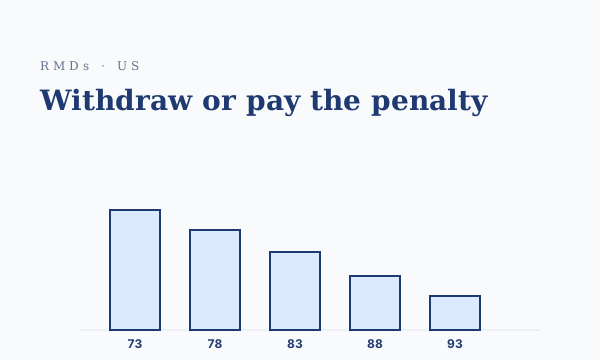
Required Minimum Distributions (RMDs) are amounts the IRS requires you to withdraw annually from most tax-deferred retirement accounts starting at a specific age. The purpose is straightforward: you got tax breaks for decades of contributions, and now the government wants its share. Miss an RMD and the penalty is severe — 25% of the amount you should have withdrawn.
RMDs affect Traditional IRAs, SEP-IRAs, SIMPLE IRAs, 401(k)s, 403(b)s, 457(b) plans, and most other pre-tax retirement accounts. Roth IRAs have no RMDs for the original owner (a significant advantage). Roth 401(k)s did have RMDs until 2024, when SECURE 2.0 eliminated them. Understanding which accounts require RMDs and when is central to retirement tax planning.
When RMDs start
Under current law (SECURE 2.0, 2022), RMDs begin at age 73 for people who turn 72 after 2022. The start age rises to 75 for people born in 1960 or later. Before SECURE 2.0, the RMD age was 70½ (before 2019), then 72 (2020-2022). Verify the current start age based on your birth year at IRS.gov.
Your first RMD must be taken by April 1 of the year AFTER you turn 73 — called the Required Beginning Date (RBD). Every subsequent RMD must be taken by December 31 of the applicable year. Taking your first RMD in the year after (using the April 1 deadline) means you take two RMDs in the same tax year, potentially pushing you into higher tax brackets. Most retirees take the first RMD in the year they turn 73 to spread the tax impact.
How RMDs are calculated
The RMD formula: divide your prior-year December 31 account balance by the life expectancy factor from the IRS Uniform Lifetime Table for your current age. Example: $500,000 IRA balance on December 31, 2023; you turn 73 in 2024. Uniform Lifetime Table factor for age 73 is 26.5. RMD = $500,000 ÷ 26.5 = $18,868.
Uniform Lifetime Table factors decrease with age, meaning RMDs consume a growing percentage of your balance each year. At 73, RMD is about 3.8% of prior-year balance. At 80, it becomes about 5%. At 90, about 8.8%. By age 100, RMDs approach 15.9% annually. This declining life expectancy factor forces increasingly aggressive withdrawals from the tax-deferred account over time.
Special table (Joint Life and Last Survivor Expectancy) applies when your spouse is the sole beneficiary AND more than 10 years younger than you. This table produces smaller RMDs because it accounts for the longer joint life expectancy. Use the correct table — using the wrong one produces RMD errors that compound over years.
Aggregating RMDs across multiple accounts
You calculate RMDs separately for each retirement account, but the withdrawal rules differ by account type. Traditional IRA RMDs can be aggregated — calculate each account separately, then withdraw the total from any one or combination of Traditional IRAs. This provides flexibility to withdraw from the account with the least favorable investments while preserving others.
401(k) RMDs cannot be aggregated with IRA RMDs. Each 401(k) requires its own RMD taken from that specific account. Consolidating 401(k)s into a single IRA at retirement simplifies RMD management (fewer accounts, aggregatable) — but weigh this against 401(k) advantages like superior creditor protection and access to institutional share classes.
403(b) RMDs can be aggregated with other 403(b)s but not with IRAs or 401(k)s. Inherited retirement accounts have their own RMD rules under the SECURE Act (mostly 10-year distribution rule for most non-spouse beneficiaries, with exceptions).
The penalty for missing an RMD
The RMD penalty is 25% of the amount not withdrawn (reduced from 50% under SECURE 2.0). If you miss a $10,000 RMD, you owe $2,500 in penalty plus the ordinary income tax on the $10,000 whenever it is eventually withdrawn. The penalty applies per year — accumulated missed RMDs generate accumulated penalties.
Correction procedure: if you catch the missed RMD within 2 years, the penalty drops to 10%. File Form 5329 (Additional Taxes on Qualified Plans) with your tax return, report the missed amount, calculate the penalty, and either pay it or request waiver based on "reasonable cause." The IRS typically grants waivers for genuine oversights (medical emergency, custodian error) if you take the missed RMD promptly upon discovery and file properly.
Prevention: automate RMDs at your custodian. Fidelity, Schwab, Vanguard, and most major custodians offer automatic RMD calculation and distribution services. Set it up in advance; do not rely on remembering annually. The convenience prevents penalties that dwarf any manual optimization benefit.
Strategies to reduce RMDs
Qualified Charitable Distributions (QCDs) let you direct up to $105,000/year (2024, inflation-adjusted) from a Traditional IRA directly to qualified charities. The QCD counts toward your RMD but is excluded from taxable income — potentially reducing your tax bill more than a normal charitable deduction would. Available to IRA owners age 70½ or older.
Roth conversions in the years between retirement and RMD age (typically 65-73) can dramatically reduce future RMDs. Converting Traditional IRA to Roth is taxable in the conversion year but Roth accounts have no RMDs. Strategic conversions during low-income years (early retirement, before Social Security starts) can shift assets from RMD-required to RMD-exempt status.
Delaying claiming Social Security and doing Roth conversions during 62-70 gap years is a powerful combination. Lower income during conversion years means lower conversion tax rates. Reduced Traditional balances mean smaller future RMDs. Delayed Social Security produces larger inflation-protected benefits later. All three work together.
RMDs and taxes: the coordination problem
RMDs are taxed as ordinary income in the year received. Combined with Social Security benefits (often 85% taxable), pension income, and other retirement income, RMDs can push retirees into higher tax brackets, trigger IRMAA Medicare premium surcharges, and increase Social Security taxation.
A retiree with $500K in Traditional IRA at 73 has RMD of $18,868. Combined with $30K Social Security and $20K pension, taxable income approaches $70K — potentially triggering IRMAA surcharges that add $70-190/month to Medicare Part B premiums. Managing this coordination is where retirement tax planning becomes valuable.
Tax withholding on RMDs is optional but recommended. Most custodians default to no withholding, meaning you owe the tax at filing. Setting withholding of 20-25% on RMD distributions prevents underpayment penalties and cash flow surprises at tax time.
Common RMD mistakes
The most common mistake is missing the first RMD deadline. Because the RBD is April 1 of the year AFTER you turn 73, many retirees mistakenly believe they have until age 74 to start. In reality, the RMD is FOR the year you turn 73 — just deadline-shifted. Take the first RMD in your 73rd year to avoid deadline confusion and double-RMD tax bracket effects.
The second common mistake is failing to aggregate correctly. Taking a Traditional IRA RMD from your 401(k) does not satisfy the 401(k) RMD requirement. Read the aggregation rules for each account type — mismatches generate penalties even when the total dollar amount withdrawn was correct.
The third mistake is treating RMDs as inflation-protected. RMDs are calculated from your account balance, which fluctuates with market performance. A market crash in December reduces the December 31 balance and next year’s RMD; a bull market year increases both. This is why sequence-of-returns risk matters in retirement — a bad market year immediately after RMDs start can force selling at lows.
Sources and methodology
We use primary and authoritative sources for rules, definitions, and data. Sources and factual claims were last checked September 4, 2026.
- Individual retirement arrangements (IRAs) — Internal Revenue Service (United States)
- 401(k) plans — Internal Revenue Service (United States)
- Publication 590-A: Contributions to IRAs — Internal Revenue Service (United States)
Frequently asked questions
- At what age do RMDs start?
- Under SECURE 2.0 (2022), RMDs begin at age 73 for people who turn 72 after 2022. The start age rises to 75 for those born in 1960 or later. Your first RMD can be delayed until April 1 of the year after you turn 73, but you would then owe two RMDs that year.
- What is the penalty for missing an RMD?
- The penalty is 25% of the amount not withdrawn (reduced from 50% under SECURE 2.0). If corrected within 2 years, the penalty drops to 10%. File Form 5329 to report the missed RMD and request penalty waiver based on reasonable cause.
- How is my RMD calculated?
- Divide your prior-year December 31 account balance by the life expectancy factor from the IRS Uniform Lifetime Table for your age. For age 73, the factor is 26.5. A $500,000 balance produces a first-year RMD of about $18,868. Custodians typically calculate this automatically but the responsibility to withdraw is yours.
Related articles
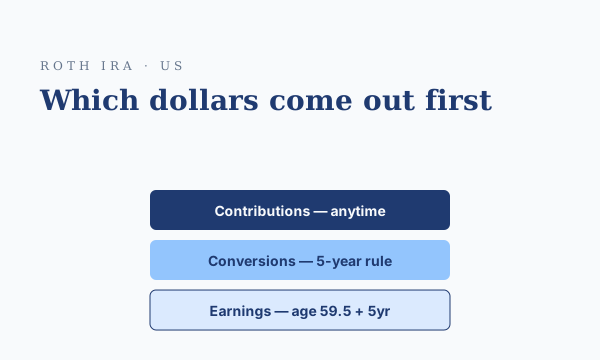
Roth IRA Withdrawal Rules: The Complete Guide
Roth IRA withdrawal rules confuse most savers. Contributions come out anytime tax-free; earnings have strict rules. Here is what actually applies to each dollar.
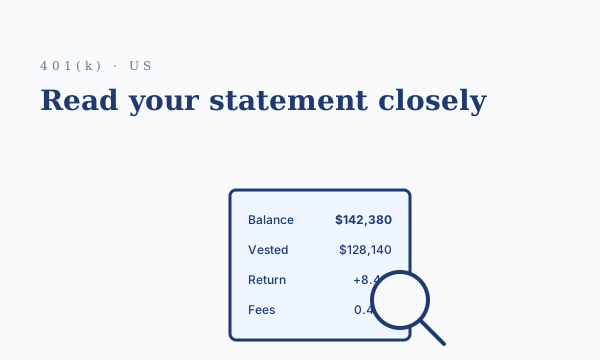
How to Read Your 401(k) Statement Like an Analyst
Your 401(k) statement contains everything you need to know about your retirement — if you can read it. Here is what every section actually means.

How to Start Investing With $100
You do not need thousands to begin. Here is a beginner-friendly path to putting your first $100 to work — and why starting small still matters.