Investing
How to Start Investing With $100
You do not need thousands to begin. Here is a beginner-friendly path to putting your first $100 to work — and why starting small still matters.
Last updated September 3, 2026
One of the most persistent myths about investing is that you need a large sum to begin. You do not. Thanks to commission-free brokerages and fractional shares, $100 is enough to start building the habit that matters far more than the initial amount. This guide walks through a simple, low-risk way to put your first $100 to work.
Why starting small still matters
The real value of investing early is compounding — your returns start earning their own returns. Someone who invests $100 a month consistently from age 25 to 65 at a historically typical 7% real return would accumulate roughly $260,000. Waiting ten years and starting at 35 with the same $100 monthly contribution would land closer to $122,000. The gap comes almost entirely from starting sooner, not from investing more per month.
Step 1: Open the right account
For long-term goals such as retirement, a tax-advantaged account (a Roth IRA if you are eligible in the US, or the equivalent in other countries) is usually the best home for the money because it can grow tax-free. For general investing you can also use a standard taxable brokerage account. Look for a reputable broker with no account minimum, no commissions on stock and ETF trades, and support for fractional shares.
Step 2: Choose what to buy
As a beginner, a broad, low-cost index fund or ETF is hard to beat. Instead of trying to pick individual winners, an index fund buys a tiny slice of hundreds or thousands of companies at once, which spreads your risk automatically. A total-market or S&P 500 index fund is a common starting point. Pay attention to the expense ratio (the annual fee) — lower is better, and broad index funds from major providers are typically very cheap, often below 0.10%.
Why not just pick a hot stock?
Individual stocks can rise or fall sharply, and beginners rarely have the information or temperament to pick winners consistently. With $100, buying a single stock also leaves you undiversified — if that one company stumbles, so does your whole investment. An index fund avoids that concentration risk.
Step 3: Use fractional shares
Some funds and stocks trade for hundreds of dollars per share. Fractional shares let you buy a portion, so your full $100 is invested rather than sitting idle waiting for a whole share. Most beginner-friendly brokers now support fractional shares.
Step 4: Automate and leave it alone
Set up a small recurring contribution — even $20 to $50 a month — and let it run. This is called dollar-cost averaging: by investing a fixed amount on a schedule, you buy more shares when prices are low and fewer when they are high, without trying to time the market. Then resist the urge to check daily. Long-term investing rewards patience, not constant tinkering.
A realistic expectation
Your first $100 will not change your life on its own — and that is fine. Its job is to get you started and comfortable with the process. The combination of regular contributions, low fees, and years of compounding is what builds real wealth over time.
The first $100 is a systems test
Before buying anything, define the goal, earliest spending date, and maximum loss you could tolerate without abandoning the plan. Money needed within a few years usually should not depend on stock-market recovery. Confirm that emergency cash and high-cost debt are under control, then choose a regulated provider whose fees, custody arrangements, withdrawal rules, and complaint path you can explain.
With a small balance, fixed fees dominate. Add trading commissions, account fees, fund expenses, foreign-exchange spreads, transfer fees, and tax reporting costs, then express them as a percentage of the amount invested. A $3 monthly fee is 36% of a $100 starting balance over a year before any return. Fractional investing helps only when the surrounding costs remain proportionate.
Write an investment policy on one page
Record the target asset mix, contribution schedule, rebalancing rule, and events that permit a withdrawal. Choose broad diversification rather than a handful of familiar companies, and decide how you will respond to a 20%, 30%, or 50% decline before one occurs. The policy should be boring enough to follow when headlines are not.
Automate a sustainable amount and increase it after income growth rather than trying to pick the perfect entry day. Review the provider and allocation annually or after a goal changes, not after every market move. If local law offers a tax-advantaged account, verify eligibility, access, and limits with the official authority before using U.S. account names as a template.
Why $100 is enough to start seriously
The idea that investing requires substantial capital is one of the most damaging myths in personal finance. Modern brokerages (Fidelity, Schwab, Vanguard, Robinhood) offer $0 account minimums, $0 commissions on stock and ETF trades, and fractional share purchases starting at $1. Someone with $100 can build a diversified portfolio of index funds today that would have required $10,000+ and hundreds in commissions two decades ago.
The value of starting with small amounts is not the immediate returns — $100 growing at 7% is $7 per year, hardly life-changing. The value is establishing systems: opening the account, learning the interface, making a first purchase, watching the balance move with the market, and beginning the psychological adjustment to being an investor. These behavioural foundations enable the much larger contributions that come later.
Choosing the right account first
Before making a single investment, choose the right account type. For most first-time investors, priority order: (1) employer 401(k) if a match is available — contribute enough to capture the full match before anything else; (2) Roth IRA if income eligible — provides tax-free growth for 30+ years; (3) HSA if eligible — triple tax advantage for medical expenses and long-term growth; (4) taxable brokerage account — flexible but no tax advantages.
For someone with $100 and no employer retirement plan, a Roth IRA at Fidelity, Schwab, or Vanguard is typically the best choice. The account can hold cash, stocks, ETFs, and mutual funds. Contribution limit for 2024 is $7,000 annually ($8,000 if age 50+). Contributions can be withdrawn at any time without tax or penalty; earnings can be withdrawn tax-free after 59½ if the account has been open at least 5 years.
A taxable brokerage account works if you already have retirement accounts covered or if you need flexibility. Taxable accounts have no contribution limits and no withdrawal restrictions but generate taxable events on dividends and capital gains. For beginners with small amounts, the tax complexity is usually minimal — but a Roth IRA is almost always better for long-term investing when eligible.
The single-fund starter portfolio
For $100 (or $1,000, or $10,000), the simplest and often best portfolio is a single total market index fund. Options include Vanguard Total Stock Market ETF (VTI), Fidelity ZERO Total Market Index Fund (FZROX), Schwab Total Stock Market ETF (SCHB), or their mutual fund equivalents. All track roughly the same underlying US stock market at expense ratios of 0.00-0.04% annually.
This "single fund" approach captures diversification across thousands of US companies, requires no rebalancing, and has essentially zero decision-making overhead. Someone who invested $100 in a total market fund monthly starting in 2010 would have accumulated approximately $23,000 by 2024 (assuming reinvested dividends and typical market returns).
For slightly more sophistication, add international diversification: 60-70% total US market + 30-40% total international market. Vanguard Total International Stock ETF (VXUS), Fidelity ZERO International Index (FZILX), and Schwab International Equity ETF (SCHF) are common choices. This "two-fund portfolio" captures nearly all the diversification benefit of more complex approaches at minimum complexity.
Automating contributions
Automation is more powerful than optimization. A worker who automates $200 monthly into a Roth IRA at 7% real returns for 40 years accumulates roughly $524,000 — nearly enough for a comfortable retirement supplement to Social Security. The same worker manually contributing "when they have extra money" typically contributes far less because irregular decisions are subject to spending priorities that always find alternatives.
Set up automatic contributions from checking account to investment account on the day after payday. Amount: whatever fits your budget after essentials. Even $25 or $50 monthly builds the habit. Increase by $10-25 with every raise until you are contributing 15-20% of gross income to retirement.
Fractional share investing makes automation efficient at any amount. Rather than saving up for whole shares, you can buy $50 of a $400 stock (0.125 shares). All major brokerages now support this — Robinhood pioneered it for stocks, Fidelity and Schwab followed for both stocks and ETFs. Vanguard offers fractional purchases of their own mutual funds and some ETFs.
What NOT to invest in as a beginner
Individual stocks are typically the wrong first investment. Picking winning stocks consistently is difficult even for professionals; most active fund managers underperform simple index funds after fees. A beginner betting $100 on a single stock is buying entertainment, not investing. Building a diversified stock portfolio requires many companies and significant capital; index funds provide this instantly.
Cryptocurrency, meme stocks, options, forex, and other speculative instruments are marketed to beginners because they promise excitement and rapid wealth. The mathematical reality: most speculators lose money, particularly after transaction costs. Some beginners have gotten lucky in specific market environments (2020-2021 crypto and meme stock bubbles); the same environments have also destroyed capital when they reversed.
High-cost mutual funds sold by insurance companies and full-service brokers are another trap. If a "financial advisor" recommends investments with expense ratios above 1%, sales loads, or 12b-1 fees, they are typically earning commissions that come out of your investment returns. Modern DIY investing with low-cost index funds is dramatically cheaper and typically outperforms recommendations from commission-based advisors.
Understanding market volatility as a beginner
The stock market drops 10% roughly once a year, 20% roughly every 4-5 years, and 30%+ roughly every 8-10 years historically. If you invest $100 today, that $100 may be worth $70 next year — this is normal, not a failure of the system. Long-term returns include these drops as part of the average; the 7-10% historical average is what you get if you stay invested through the drops.
The greatest wealth destroyer for beginners is panic-selling during downturns. Someone who sold their entire portfolio at the March 2020 low missed a 100% recovery within 18 months. Someone who kept contributing during the 2008-2009 crash accumulated shares at low prices that appreciated dramatically over the following decade.
Automation helps by removing emotional decisions from the process. When contributions are automatic and you check the account only quarterly, you avoid the temptation to react to short-term movements. When you check daily and see red numbers, the temptation to "do something" is powerful. Structure protects behaviour better than willpower does.
The path from $100 to serious wealth
The trajectory from $100 to significant wealth requires three things: consistent contributions, time in the market, and diversified investments. None of these individually is enough; all three together are almost guaranteed to work over decades.
Realistic milestones: $100 monthly starting at 25, at 7% real returns, produces $1,000 by year 1, $12,700 by year 10, $52,400 by year 20, $147,000 by year 30, $358,000 by year 40. Increasing contributions with raises accelerates this dramatically — the same worker contributing 10% of income (roughly $500/month by age 40) would reach $1M+ by retirement.
The $100 you invest today matters most for its role in establishing the habit and system that will handle much larger amounts later. Someone who successfully deploys $100/month for a year usually finds it easy to increase to $200 or $500 in subsequent years. The infrastructure remains; only the amount changes.
Common beginner mistakes
The most common mistake is waiting to "have enough" before starting. Every year of delay costs more in lost compounding than the amount invested during that year. Start with $50 monthly if that is what fits your budget; do not wait until you can afford $500.
The second common mistake is chasing recent winners. Whatever asset class performed best last year (whether tech stocks, cryptocurrency, real estate, or gold) attracts massive inflows from beginners buying near peaks. Simple index funds sound boring compared to whatever is trending, but diversification across the entire market beats concentration in yesterday’s winners over long periods.
The third mistake is stopping contributions during downturns. Downturns are when index funds are on sale — the exact worst time to stop buying. Automation removes this decision from monthly emotional cycles. Set the contributions and forget them until raise time.
Sources and methodology
We use primary and authoritative sources for rules, definitions, and data. Sources and factual claims were last checked September 3, 2026.
- Introduction to investing — Investor.gov, U.S. Securities and Exchange Commission (United States; concepts broadly applicable)
- Asset allocation and diversification — Investor.gov, U.S. Securities and Exchange Commission (United States; concepts broadly applicable)
- Investor education gateway — IOSCO (Global)
Frequently asked questions
- Is $100 really enough to start investing?
- Yes. With commission-free brokers and fractional shares, $100 can buy into a diversified index fund. The habit of investing regularly matters far more than the size of the first deposit.
- Index fund or individual stocks for a beginner?
- A low-cost, broad index fund is usually the better starting point. It spreads your money across many companies, which reduces the risk that any single stock could hurt your whole investment.
- What return should I expect?
- No return is guaranteed, and markets go up and down. Historically, broad stock markets have trended upward over long periods, but short-term results vary widely. Invest only money you will not need for several years.
Related articles
Index Funds Explained: The Simplest Way to Invest
Index funds now hold more money than all actively managed US mutual funds combined. Here is why they became the default recommendation for long-term investors.
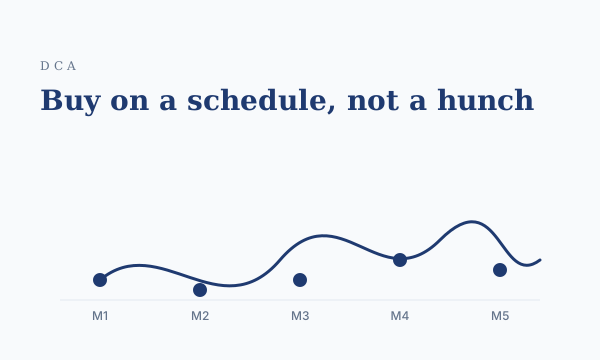
Dollar-Cost Averaging: The Boring Strategy That Usually Wins
Dollar-cost averaging removes market timing from investing. It rarely produces the best possible outcome, but it very often produces a good one — which matters more.
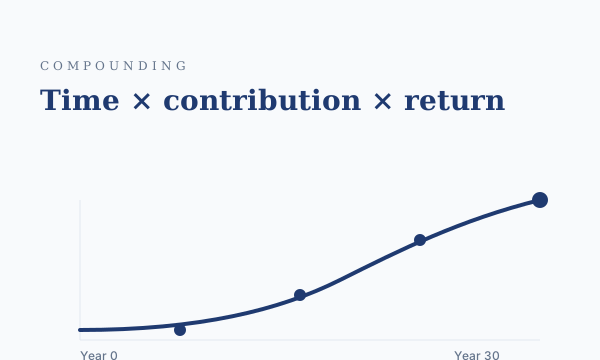
Compound Interest: The Single Most Important Idea in Personal Finance
Compound interest is the reason small consistent savings become large amounts over time, and also the reason small consistent debts become impossible ones. Here is how it works.