Investing
Compound Interest: The Single Most Important Idea in Personal Finance
Compound interest is the reason small consistent savings become large amounts over time, and also the reason small consistent debts become impossible ones. Here is how it works.
Last updated September 3, 2026
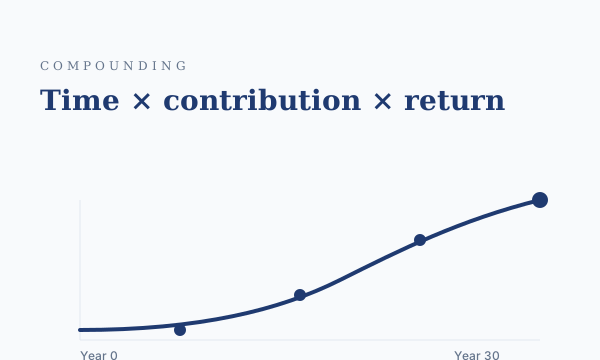
Compound interest is what happens when the interest you earn also starts earning interest. It sounds simple but the effect over decades is dramatic, and it is the single most important idea in personal finance. Understanding it deeply changes how you think about saving, investing, and debt.
Simple vs compound
Simple interest pays only on the original amount you invested. $1,000 at 5 percent simple interest earns $50 every year, forever. After 30 years, you have $2,500.
Compound interest pays on the original amount plus all previously earned interest. $1,000 at 5 percent compound interest earns $50 in year one, then $52.50 in year two (because you now have $1,050), then $55.13 in year three, and so on. After 30 years you have about $4,322 - not $2,500.
The rule of 72
A useful mental shortcut: divide 72 by an annual growth rate to estimate how long it takes an investment to double. At 6 percent, money doubles in about 12 years. At 8 percent, in about 9 years. At 10 percent, in about 7 years. The rule breaks down at very high or very low rates but is accurate enough for planning at typical long-term investment returns.
Why starting early matters so much
Consider two savers. Saver A invests $200 per month from age 25 to 35 (10 years, $24,000 total contributions) and then stops, letting the balance grow untouched. Saver B waits until 35 and then invests $200 per month from 35 to 65 (30 years, $72,000 total contributions).
At a historically typical 7 percent real return, Saver A ends up with about $315,000 at age 65. Saver B ends up with about $245,000. Saver A invested one-third as much money but ended with more, because those first ten years had 30 additional years to compound. This example is the single strongest argument for starting to invest early, even in small amounts.
Compounding works against you on debt
The same math applies to credit card debt in reverse. A $5,000 credit card balance at 22 percent APR, paying only the minimum, can take more than 20 years to pay off and cost more than $10,000 in interest. The bank is compounding interest against you exactly the way your investments compound for you.
This is why high-interest debt is a financial emergency: every month it exists, it grows faster than most investments earn. Paying off a 22 percent APR debt is mathematically equivalent to a guaranteed 22 percent return.
Frequency of compounding
Interest can compound annually, monthly, daily, or continuously. More frequent compounding produces slightly higher returns for the same nominal rate, but the difference is small. The Annual Percentage Yield (APY) is a standardised figure that accounts for compounding frequency, letting you compare accounts on equal terms.
Use the formula without turning an assumption into a forecast
For one deposit, future value equals principal × (1 + periodic rate) raised to the number of periods. Regular contributions require an annuity calculation and depend on whether money arrives at the start or end of each period. Calculators often hide that timing choice. Enter fees, tax, and contribution increases explicitly rather than selecting one attractive return.
Run at least three return paths and one interruption. A smooth 7% line is easy to understand but markets do not deliver the average each year, and withdrawals make return order important. Compare a conservative, middle, and optimistic assumption; then test a missed-contribution year, a large early decline, or a delayed start. The range is more useful than a precise-looking endpoint.
Nominal growth is not spending power
Convert future money into today’s purchasing power using an inflation assumption, then subtract product fees and likely taxes. A balance can rise while real value falls. Debt compounds too: unpaid interest, penalty rates, and fees can work against the borrower, which is why paying expensive debt may dominate investing even when a long-run market return sounds higher.
The levers are principal, contribution, time, net return, and withdrawals. Time is powerful but not magical; increasing a sustainable contribution is often more controllable than seeking a higher return. Never infer a guaranteed investment outcome from a calculator unless the underlying product itself has an enforceable guarantee and you understand its conditions.
The mathematics behind the magic
Compound interest is not magic; it is arithmetic. When money earns a return and the return itself earns a return, the balance grows exponentially rather than linearly. The formula is future value = principal × (1 + rate)^time. At 7% annual return, $10,000 grows to $19,672 after 10 years, $38,697 after 20 years, and $76,123 after 30 years. The first decade produces roughly $10,000 in growth; the third decade produces roughly $37,000 — despite the same starting balance and rate, because the growing balance itself compounds.
This exponential curve is why time matters more than amount for long-horizon investing. A worker who invests $5,000 per year from age 25 to 35 (10 years, $50,000 total contributions) and then stops contributing entirely typically ends up with more at 65 than a worker who starts at 35 and contributes $5,000 per year for 30 years ($150,000 total). The 10-year head start compounds for 30 additional years and outperforms three times the contributions with less compounding time.
Nominal vs real returns: why the number matters
The stated interest rate is nominal — before inflation. Real return is nominal return minus inflation. If your investment returns 7% nominally and inflation runs at 3%, your real return is roughly 4%. Over decades, the difference is enormous. $10,000 invested at 7% nominal for 30 years becomes $76,123 in future dollars, but only about $40,000 in today’s purchasing power after adjusting for 3% inflation.
Historical US stock market returns are commonly cited as ~10% annually, but this is nominal and includes dividends reinvested. The historical real return is closer to 6.5-7%. Retirement planning models that assume 10% real returns are dangerously optimistic; models that assume 5-7% real returns are more realistic. Use real returns for long-term goals; nominal returns are only useful when comparing to nominal alternatives like bond yields or savings rates.
The Rule of 72 and quick mental math
The Rule of 72 estimates how long a sum takes to double at a given interest rate: divide 72 by the annual rate. At 6% return, money doubles in about 12 years (72/6). At 8%, about 9 years. At 12%, about 6 years. The rule is close to exact for rates between 5% and 12%; it becomes less accurate at extremes but remains useful for mental estimation.
The rule works in reverse for calculating required return: to double money in 10 years, you need roughly 7.2% annual return (72/10). To double in 20 years, only 3.6%. This helps evaluate whether return targets are reasonable. Someone who expects to turn $50,000 into $500,000 in 15 years is expecting to double the money 3.3 times in 15 years, requiring roughly 15-17% annual returns — meaningfully above historical stock market averages and probably unrealistic.
Contribution timing: monthly vs annual
Regular contributions dramatically amplify compound growth. $500 invested monthly for 30 years at 7% grows to about $612,000. The same $6,000 contributed once per year (identical annual total) grows to about $590,000 — roughly $22,000 less, because monthly contributions have more months of compounding. Contribute as frequently as your income and provider allow; monthly or bi-weekly captures nearly all of the timing benefit compared to daily contributions.
For workers with irregular income, larger irregular contributions can achieve similar results if they average to the same annual total. A freelancer who contributes $18,000 in December each year captures less compounding than one who spreads contributions monthly, but the difference is usually small compared to the alternative of "waiting to have extra money" and contributing nothing consistently. Consistency beats optimisation.
The order-of-magnitude effects of small changes
Small changes in inputs produce order-of-magnitude changes in outcomes over long periods. Starting 5 years earlier at the same contribution rate typically increases final balance by 30-50%. Increasing contributions from 10% of income to 15% typically increases final balance by 50%. Reducing investment expenses from 1% to 0.1% typically increases final balance by 20-30% over 40 years. The individual changes seem modest; the compound effect is dramatic.
This is why "small" mistakes compound into "large" ones. A 401(k) with 1% fees seems reasonable next to a 1.5% fee; over 40 years, the fee difference alone reduces final balance by roughly 15-20%. A retirement start delayed by 5 years to "wait for a better time" typically costs more than a 30% market crash at retirement age. The lesson: prioritise the inputs you control (contribution rate, time in market, fees) rather than the inputs you cannot control (short-term market movements).
The dark side: how compound interest works against borrowers
Compound interest is not inherently positive; it compounds whichever direction the money flows. A $10,000 credit card balance at 22% APR that receives only minimum payments (typically 2% of balance) takes over 30 years to pay off and costs roughly $28,000 in total interest — nearly triple the original balance. The same $10,000 that could have been invested at 7% for 30 years would have grown to over $76,000. Debt at 22% vs investment at 7% represents a net swing of over $100,000 on a single $10,000 balance over 30 years.
This is why high-interest debt destroys long-term wealth-building capacity so completely. Every dollar servicing 22% debt is a dollar not earning 7% — and this differential compounds. Eliminating high-interest debt is not just a defensive move; it removes a compounding drag on future wealth. This is also why the priority order (starter fund → match → high-interest debt → full emergency fund → retirement accounts) makes mathematical sense: it removes negative compounding before pursuing positive compounding at scale.
Compounding frequency: daily vs monthly vs annual
Interest can compound at various frequencies. Daily compounding produces slightly higher returns than monthly, which produces slightly higher than annual. The differences are small: $10,000 at 5% APR for 10 years grows to $16,470 with annual compounding, $16,470 with monthly compounding, and $16,487 with daily compounding. For most practical purposes, compounding frequency is a minor factor compared to rate and time.
Where frequency matters: credit card interest, which typically compounds daily. This means the effective annual rate (APY) is slightly higher than the stated APR. A 20% APR compounding daily produces an effective annual rate of about 22.1%. Borrowers who calculate interest costs using APR slightly underestimate the true cost; the difference is real but modest.
Realistic assumptions for long-term planning
For retirement planning, use these historically-supported assumptions with appropriate caveats: 6-7% real return for a diversified stock-heavy portfolio over 30+ years, 3-4% real return for a balanced portfolio, 1-2% real return for a bond-heavy portfolio. These are averages; actual outcomes vary widely across specific time periods. Plans that assume the historical average will smoothly appear are dangerous; plans that stress-test against bad decades produce more resilient outcomes.
The sequence of returns matters as much as the average, particularly in the withdrawal phase of retirement. A 30-year average of 7% including a bad first 10 years produces very different outcomes than the same average with a good first 10 years, because withdrawals during the bad period deplete the balance that would otherwise compound during the good period. This is why retirees typically hold more bonds and cash than accumulation-phase investors: to buffer against bad early returns.
Common compound interest mistakes
The most common mistake is delaying the start. "I will start investing when I have more money" typically means starting 5-10 years later than possible. Those 5-10 years are the most valuable years of compounding — the years where small amounts grow into meaningful ones. Start with whatever amount is possible now, even if it feels trivially small; increase contributions later as income grows.
The second common mistake is trying to boost returns through active trading or speculative investments. The historical evidence is overwhelming: most active traders underperform simple index funds after costs. The "solution" to modest expected returns is usually higher savings rates or longer time horizons, not chasing higher returns through riskier strategies.
The third common mistake is stopping contributions during market downturns. Downturns are when index funds are on sale; contributing during these periods buys shares at lower prices that participate in future recoveries. The behavioural instinct to stop contributing when the account balance is falling is exactly wrong — but understanding this intellectually does not always overcome the emotional response. Automation removes the decision from monthly emotional cycles.
Sources and methodology
We use primary and authoritative sources for rules, definitions, and data. Sources and factual claims were last checked September 3, 2026.
- Compound interest calculator — Investor.gov, U.S. Securities and Exchange Commission (Global calculation; U.S. publisher)
- Introduction to investing — Investor.gov, U.S. Securities and Exchange Commission (United States; concepts broadly applicable)
- Inflation: Prices on the rise — International Monetary Fund (Global)
Frequently asked questions
- What return rate should I assume?
- For long-term stock market planning, a common assumption is 6 to 7 percent real (after inflation). No return is guaranteed, and short-term outcomes vary widely.
- Does compound interest work in savings accounts too?
- Yes, but at much lower rates. A high-yield savings account at 4 percent still compounds, just slower than long-term stock returns.
- Is compound interest a scam?
- No. It is a mathematical property of interest calculated on a growing base. It exists in every interest-bearing account and every loan.
Related articles
How to Start Investing With $100
You do not need thousands to begin. Here is a beginner-friendly path to putting your first $100 to work — and why starting small still matters.
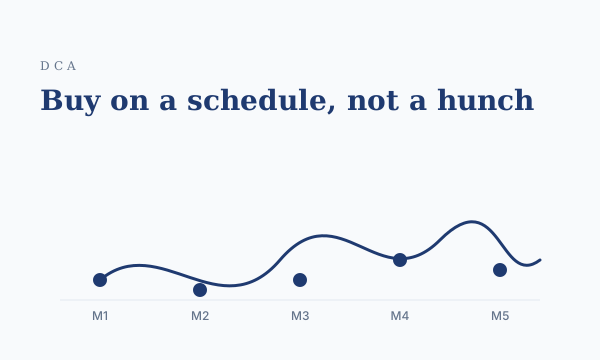
Dollar-Cost Averaging: The Boring Strategy That Usually Wins
Dollar-cost averaging removes market timing from investing. It rarely produces the best possible outcome, but it very often produces a good one — which matters more.
Inflation Explained: How Rising Prices Affect Your Money
Inflation is not just a headline number. It is the silent tax on cash. Here is how it works, why it matters for your savings, and how to protect against it.