Saving
Inflation Explained: How Rising Prices Affect Your Money
Inflation is not just a headline number. It is the silent tax on cash. Here is how it works, why it matters for your savings, and how to protect against it.
Last updated September 3, 2026
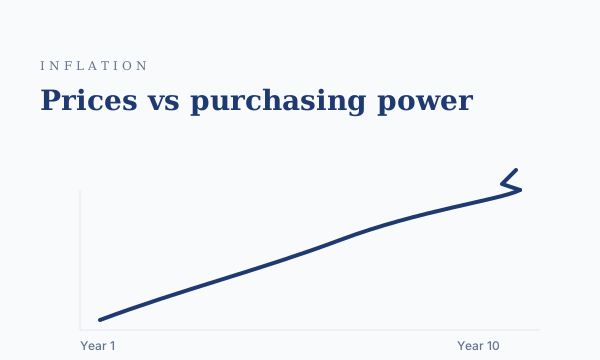
Inflation is the general rise in prices over time, and the corresponding fall in the purchasing power of a unit of currency. A dollar today does not buy the same basket of goods it did five years ago. That gap is inflation.
For most households, inflation is not an abstract macroeconomic concept. It is the reason a grocery bill keeps climbing, a rent renewal comes in higher, and a savings balance quietly loses ground even while the account balance stays flat.
How inflation is measured
The most widely cited US inflation measure is the Consumer Price Index (CPI), published monthly by the Bureau of Labor Statistics. CPI tracks the price of a representative basket of goods and services and reports the year-over-year change as an inflation rate. A CPI reading of 3 percent means the basket costs three percent more than it did a year earlier.
CPI is not the only measure. The Federal Reserve prefers the PCE (Personal Consumption Expenditures) index, which weights categories slightly differently. Both tell the same broad story; they disagree only at the margins.
Why inflation hurts cash
If your savings earn one percent while inflation runs at three percent, your real return is roughly minus two percent. The nominal balance grows, but what you can buy with it shrinks. Over a decade, that gap compounds meaningfully.
This is why holding long-term cash in a low-yield account is one of the most common quiet mistakes in personal finance. It feels safe because the number never drops, but the buying power is falling every day.
What historically beats inflation
Over long periods, broad stock markets have historically returned around six to seven percent above inflation. Real estate has also outpaced inflation over long horizons, though with more variability by region. High-yield savings accounts can approximately keep pace with moderate inflation during rate-hiking cycles, but often lag during high-inflation periods. Long-term bonds do poorly during inflation spikes because rising rates push existing bond prices down.
Inflation-protected securities
The US Treasury issues TIPS (Treasury Inflation-Protected Securities), bonds whose principal adjusts with CPI. If inflation rises, the principal and therefore the interest paid on it rises with it. Series I Savings Bonds work similarly for individual savers, with a purchase cap. These instruments do not maximise returns; they specifically hedge inflation.
What you can do this week
Two quick moves usually help. First, verify that your emergency fund and short-term savings sit in a high-yield savings account rather than a low-yield traditional bank account. Second, if you have a large cash balance beyond your short-term needs, consider a plan to gradually shift the excess into diversified long-term investments where your money has a fair chance of outpacing inflation over decades.
Official inflation is not your personal inflation rate
A consumer price index tracks a representative basket, not your exact spending. Estimate personal exposure by grouping annual spending into housing, food, transport, health, education, and other essentials, then compare how those costs changed. A renter renewing in a tight market can experience a different rate from a mortgage holder, even when both read the same national headline.
Distinguish the price level from the inflation rate. If inflation falls from 8% to 3%, prices are generally still rising, only more slowly; they do not automatically return to their earlier level. Deflation is a sustained decline in a broad price measure, not a temporary discount in one category. This distinction prevents unrealistic budgeting and wage expectations.
Protect a plan without making a market forecast
Near-term cash should remain safe and available even if its return trails inflation; its job is resilience. For longer horizons, compare expected return after fees, tax, and inflation, then diversify rather than buying an asset solely because it is marketed as an inflation hedge. Assets that sometimes respond to inflation can still be volatile or overpriced.
Use nominal cash flows for bills and real values for long-term goals. If a goal costs 10,000 today and you assume 3% annual inflation, its planning cost in ten years is about 13,439 before taxes or fees. Revisit the assumption instead of hard-coding one rate for decades, and use the official index most relevant to your country.
What inflation actually measures
Inflation is the rate at which prices of goods and services rise over time, reducing the purchasing power of money. When inflation is 3% annually, $100 today buys what $103 will buy next year — or, equivalently, $100 next year buys what $97 does today. Over 30 years at 3% inflation, purchasing power drops by roughly 60%: $100 today has the buying power of only $41 in 30 years.
The most commonly cited measure in the US is the Consumer Price Index (CPI), calculated monthly by the Bureau of Labor Statistics. CPI tracks a basket of goods and services considered representative of urban consumer spending: food, housing, transportation, medical care, apparel, education, and recreation. The specific composition of the basket updates periodically to reflect changing spending patterns.
Different inflation measures serve different purposes. Core CPI excludes volatile food and energy prices to reveal underlying trends. Personal Consumption Expenditures (PCE) is preferred by the Federal Reserve for policy decisions. Chained CPI (used for tax bracket adjustments) accounts for consumer substitution behavior. Each produces slightly different numbers; comparing across measures without adjustment can be misleading.
Why the official rate feels different from personal experience
Your personal inflation rate almost certainly differs from the national CPI. If you spend disproportionately on housing (which was 34% of the CPI weighting in 2024), your inflation experience will more closely track housing costs than the headline number. Someone with high healthcare costs will experience faster inflation when medical prices rise. Someone in an older home who does not need transportation to work will experience lower inflation when gas prices spike.
CPI also uses hedonic adjustments — statistical methods that adjust prices for quality improvements. If a new smartphone costs the same as last year’s model but has more features, CPI records this as a price decrease (you are getting more for the same money). Critics argue this understates actual price inflation as experienced by consumers who mostly need to buy things, not appreciate quality improvements.
Regional variation is also significant. Housing inflation in coastal metros has vastly exceeded national averages for decades; healthcare inflation has consistently exceeded overall CPI. Personal circumstances (renting vs owning, health status, geographic location, life stage) can produce inflation experiences 2-5 percentage points different from headline numbers in either direction.
Historical inflation context
US inflation has averaged roughly 3% annually over the past century, with significant variation. The 1970s saw double-digit inflation peaking above 13% in 1980. The 1990s and 2000s averaged 2-3%. Post-2008 through 2020 averaged near or below the Federal Reserve’s 2% target. 2021-2023 saw inflation spike to 9% (highest since 1981) before returning toward target levels.
Long-term averages hide important sequence risk. Someone who retired in 1968 experienced 15 years of high inflation that devastated fixed-income retirees. Someone who retired in 2005 experienced 15 years of low inflation before facing the 2021-2023 spike late in retirement. Retirement planning that assumes constant 2-3% inflation ignores the reality that inflation can persist at higher rates for years — with brutal consequences for retirees on fixed incomes.
The impact on savings and investments
Cash savings lose purchasing power to inflation continuously. A savings account paying 4.5% with 3% inflation yields only 1.5% real return; a savings account paying 0.5% during 5% inflation yields negative 4.5% real return — the money is losing purchasing power rapidly despite showing "positive interest."
Historically, stocks have provided long-term returns of 6-7% above inflation for diversified equity portfolios. This "real return" is what actually builds wealth. Bond returns have averaged 1-2% above inflation historically, though this varies dramatically by decade — the 1970s produced negative real bond returns as inflation exceeded interest rates.
Treasury Inflation-Protected Securities (TIPS) adjust principal for inflation, providing a guaranteed real return above inflation. Series I Savings Bonds combine a fixed rate with an inflation-adjusted rate that changes semi-annually. Both are useful for portions of a portfolio specifically dedicated to preserving purchasing power, though their yields are typically modest compared to riskier assets during normal periods.
Inflation and debt
Inflation benefits fixed-rate borrowers at the expense of lenders. A 30-year mortgage at 4% during 5% inflation is effectively "free money" in real terms — the loan balance shrinks in purchasing power over time even as the borrower makes fixed payments. This is why locking in fixed-rate mortgages before inflation rises can be a significant wealth-building move.
Variable-rate debt (many credit cards, ARM mortgages, some student loans) does not benefit borrowers during inflation because rates typically rise with inflation. Central banks raise interest rates to combat inflation, which pushes variable rates up. Borrowers with significant variable-rate debt often find their payments rising just when their real wages may be lagging inflation — a compound stressor.
Federal student loans have fixed rates set at origination; the borrower does not benefit further from inflation (already priced in), but does not face rate increases either. Refinancing federal loans to a lower variable rate right before inflation rises has historically been a serious mistake for borrowers who did not anticipate rate increases.
Wage growth vs inflation
Real wage growth is nominal wage growth minus inflation. If your salary rises 4% during 3% inflation, your real wage grew 1%. If your salary rises 4% during 6% inflation, your real wage shrank 2% — you are effectively earning less despite the raise. This distinction is central to understanding economic reality: nominal raises during high inflation are often illusory.
Salary negotiation during inflation should target the inflation rate as the floor for wage increases, not the ceiling. A "3% raise" during 6% inflation is a pay cut. Employees frequently accept nominal increases without calculating real changes, resulting in years of accumulated purchasing power loss. Track your own real wage growth annually to avoid this trap.
Some employers offer cost-of-living adjustments (COLA) tied to inflation measures. Government employees and some union contracts include automatic COLAs. Most private-sector employees do not have this protection and must actively negotiate for inflation-based increases.
Protecting against inflation
For retirement portfolios, maintain significant equity exposure. Historical data supports 6-7% real returns from diversified equities over long periods — the most reliable inflation protection available at scale. Extreme conservative allocations (heavy in bonds and cash) preserve nominal wealth while destroying real wealth over decades.
For near-term needs, TIPS and I Bonds provide direct inflation protection. Real estate (both primary residence and investment properties) has historically kept pace with or exceeded inflation. Commodities and gold provide episodic inflation protection but are volatile and produce no income. Cryptocurrency’s inflation-hedging claims remain unproven and controversial.
Beyond investments: maintain skills that keep income growing (inflation is worse for people whose wages stagnate), avoid variable-rate debt when possible, and lock in long-term fixed-rate obligations (mortgages) before inflation rises. Career development is often the single most important inflation hedge for working-age individuals.
Common inflation misconceptions
The most common misconception is treating "inflation is 3%" as if it applies uniformly to your life. Personal inflation varies by 5+ percentage points from official measures depending on individual spending patterns. Track your own most significant expense categories to understand your real inflation exposure.
The second common misconception is that inflation always destroys wealth. Wealth in the wrong assets (long-duration bonds, cash) does erode; wealth in the right assets (broadly diversified equities, well-located real estate, fixed-rate debt) can benefit or at least keep pace.
The third misconception is that inflation is a moral failing of individuals ("stop buying avocado toast") rather than a macroeconomic phenomenon largely outside individual control. Individual budget optimization matters, but the fact that housing has risen faster than wages for decades is not solved by cutting Netflix — it requires either dramatically higher income growth, geographic arbitrage, or acceptance of a lower standard of living than previous generations.
Sources and methodology
We use primary and authoritative sources for rules, definitions, and data. Sources and factual claims were last checked September 3, 2026.
- Inflation: Prices on the rise — International Monetary Fund (Global)
- Consumer Price Index — U.S. Bureau of Labor Statistics (United States)
- Financial education — OECD (Global)
Frequently asked questions
- Is a two percent inflation target good?
- Central banks including the Federal Reserve target about two percent because it leaves room for policy responses to downturns while keeping price changes small enough that households can plan around them.
- What is stagflation?
- A period of high inflation combined with slow economic growth and often rising unemployment. It is difficult to combat because tools that ease one problem often worsen the other.
- Does inflation hurt everyone equally?
- No. Lower-income households typically feel it more sharply because a larger share of their spending goes to volatile essentials like food, energy, and rent.
Related articles
High-Yield Savings Accounts: How They Work and How to Choose One
High-yield savings accounts pay roughly ten to twenty times more interest than traditional bank accounts. Here is how they work, how they are insured, and how to pick a good one.
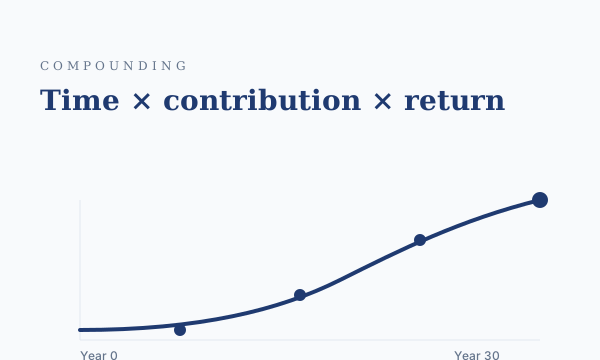
Compound Interest: The Single Most Important Idea in Personal Finance
Compound interest is the reason small consistent savings become large amounts over time, and also the reason small consistent debts become impossible ones. Here is how it works.
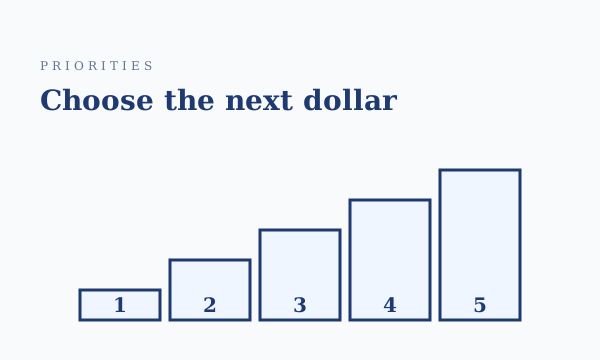
The Right Order of Financial Priorities (Most People Get This Backwards)
A practical order of operations for money — from a starter emergency fund to long-term investing — that avoids the common mistake of skipping cheap wins for flashier ones.