Saving
High-Yield Savings Accounts: How They Work and How to Choose One
High-yield savings accounts pay roughly ten to twenty times more interest than traditional bank accounts. Here is how they work, how they are insured, and how to pick a good one.
Last updated September 3, 2026
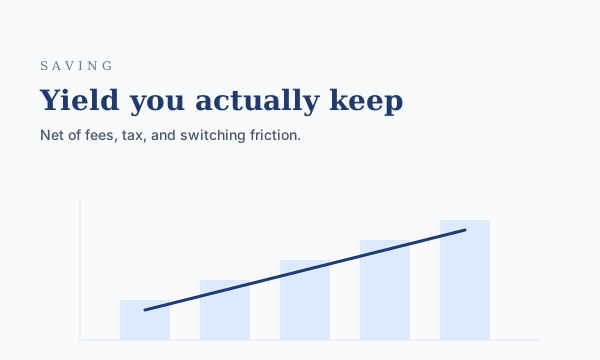
A high-yield savings account (HYSA) is a savings account that pays an above-average interest rate — typically many times higher than the national average paid by traditional brick-and-mortar banks. For money you want to keep safe and accessible (an emergency fund, a down payment being built over the next year or two, a planned tax bill), an HYSA is usually the single best home for it.
This guide explains how HYSAs work, how deposit insurance protects the money, and a practical checklist for choosing one that fits your needs.
Why HYSAs pay more
Most high-yield savings accounts are offered by online-only banks and credit unions. Without branch networks to fund, these institutions operate at lower cost and pass some of the savings back to depositors as higher interest. The interest rate on an HYSA is variable — it moves up and down with broader short-term rates set by the Federal Reserve (in the United States) or the equivalent central bank elsewhere.
Traditional brick-and-mortar banks often pay only a token amount of interest on standard savings accounts because they rely on inertia — most customers do not shop around. The Federal Reserve reports the national average savings rate has been well under 1% for years, even during periods when HYSAs pay 4% or more.
How deposit insurance works
In the United States, deposits at banks are insured by the Federal Deposit Insurance Corporation (FDIC) and deposits at credit unions by the National Credit Union Administration (NCUA). Coverage is typically $250,000 per depositor, per insured institution, per ownership category. If the bank fails, your covered balance is returned quickly — historically within a few business days.
If you plan to hold more than the insured limit, you can split the balance across multiple institutions or use one that partners with a network to spread deposits automatically. Verify insurance status directly at fdic.gov or ncua.gov rather than relying on a bank's marketing.
What to look for when choosing an HYSA
The rate — but read the fine print
The advertised APY (annual percentage yield) is the headline figure. Confirm that the rate applies to the full balance, not just a promotional first tier, and that no minimum balance is required to earn it. Some accounts pay a high rate only up to a cap, then drop sharply.
Fees and minimums
Look for no monthly maintenance fees, no minimum opening deposit (or a very low one), and no minimum balance to avoid fees. Any account that charges a monthly fee is worth skipping — there are plenty of no-fee options.
Transfer speed and ATM access
Because HYSAs are usually online-only, you access the money by transferring it to a linked checking account. Standard ACH transfers typically take one to three business days. If instant access matters, look for accounts that offer same-day transfers, a debit card, or ATM access through a network.
Reputation and stability
Stick with well-established online banks and credit unions with strong reviews for customer service, straightforward apps, and clean fee structures. Very high promotional rates from unfamiliar fintechs sometimes come with unusual terms or partner-bank arrangements — read the disclosures before committing.
When an HYSA is the right tool — and when it is not
An HYSA is ideal for short-term savings you cannot afford to lose: emergency funds, near-term goals within one to three years, tax reserves, and a cash cushion. It is not the right tool for long-term goals five or more years away — over long horizons, low-cost index funds have historically outperformed cash by a wide margin, even after accounting for volatility.
Compare the account you will actually use
Headline yield is only one line in the decision. Record whether the rate is variable or promotional, the balance range that earns it, monthly fees, minimum activity, transfer limits, withdrawal delays, and how interest is compounded. Calculate net annual interest after unavoidable fees and tax. A slightly lower rate with no conditions and same-day access can be more valuable for an emergency fund than a fragile promotional rate.
Test the rails before moving all your cash. Make a small inbound transfer, a small withdrawal, and a support request. Confirm the legal institution holding the deposit; a fintech interface may place money with a partner bank, and protection can depend on accurate pass-through records. Keep statements showing ownership and beneficiary details. Never infer government protection from words such as “cash account” or “savings feature.”
Use a repeatable switching rule
Calculate the annual gain from switching as balance × rate difference, then subtract fees, lost interest during transfer, and the value of your time. On a small balance, moving for a tiny rate gap may add complexity without meaningful benefit. Recheck when a promotional period ends or the provider changes terms, not every time market rates move by a few basis points.
For global readers, match the account currency to the emergency being funded. A higher foreign-currency yield can be erased by exchange-rate movement, conversion fees, or capital controls. If the account sits outside your home country, confirm tax reporting and whether the relevant guarantee scheme covers non-residents.
What a high-yield savings account actually is
A high-yield savings account, often written as HYSA, is a deposit account that pays a materially higher interest rate than the checking or standard savings account most banks offer by default. It sits inside a regulated bank or credit union, is normally covered by a national deposit insurance scheme up to a defined limit, and lets you withdraw or transfer your money quickly. The interest is variable: it can go up when central-bank policy rates rise and down when they fall, and the provider can change it at any time under the account terms.
HYSA is not a single legal product; it is a marketing label. Some providers call the same account a “savings account,” others use “online savings,” a “performance account,” or a “rewards saver” with tiers. What matters is the deposit relationship, the annual percentage yield after fees, the withdrawal rules, the eligible balance range, and the insurance status. Never let a name substitute for the disclosures — the words on the marketing page are not a contract, and the actual account agreement can be very different from what an influencer video suggested.
How the interest rate really works
The advertised annual percentage yield reflects the effect of compounding when the stated interest rate is applied over a year. Two accounts can quote the same rate and pay different amounts because one compounds daily and another compounds monthly, and small differences add up over larger balances. Look for both the interest rate and the yield in the disclosures; a provider showing only one of them may be quietly hiding the other.
Promotional rates deserve extra care. A quoted 5.10% may apply only for the first three months, only on balances up to a threshold, only if you receive a qualifying direct deposit, or only for new customers. When the promotion ends, the account often reverts to a much lower rate. Read what changes when the promotion ends, whether you must move money out to reclaim the rate elsewhere, and whether the account will keep working normally for the balance above the promotional cap.
Central-bank policy is not the only thing that moves rates. Providers compete for deposits, so a bank that needs to fund new lending may pay a temporarily better rate, and one whose balance sheet is comfortable may lag. That is why rate leaderboards shift week to week. Chasing every basis point is not efficient once you factor in switching costs and time; focus on providers whose rates have been consistently reasonable over 12–24 months.
How to compare accounts on the numbers that matter
Start with the effective yield you would actually earn on your typical balance, not the headline. Multiply the balance by the yield and subtract fees, then annualise. Include maintenance fees, minimum-balance fees, paper-statement fees, external transfer fees, and, if relevant, foreign-transaction or ATM-network fees for the times when the account is used for withdrawals. Two accounts that look similar at a distance can differ by tens or hundreds of local currency per year for a working household.
Then check practical mechanics: how many days does an external transfer take on average and worst case, is there a limit on the number of monthly withdrawals, how large a single transfer is permitted, and is there a hold on new deposits during the first month. Read how the provider communicates rate changes — some notify by email in advance, others simply update a rate page. If you rely on the rate being at a certain level, know exactly how you will find out when it moves.
Finally, review the insurance protection details. Confirm the legal institution holding the deposit, not just the brand you interact with. Some fintech interfaces place money at partner banks and coverage depends on accurate pass-through recordkeeping. If a provider’s marketing talks about deposit insurance without naming a specific bank or scheme, ask for the exact institution and coverage limit in writing before moving anything.
A safe switching process step by step
Open the new account before touching the old one. Complete identity verification, link one external account, and send a small test transfer in both directions. Verify the timing, statement format, and support responsiveness. Only after the round-trip test should you consider moving larger sums. This one habit prevents most of the horror stories readers write about — money stuck between accounts because a first-time transfer was flagged.
Move money in tranches rather than in a single transfer if the amount is large. Many providers apply a lower fraud limit for new customers, and a rejected transfer can take days to resolve. Keep the old account open until any pending interest posts and until you have downloaded final statements and tax forms. Only then close it, and save the closure confirmation.
If the account is for an emergency fund or short-term goal, avoid switching purely to capture a small rate lift. The value of a stable, well-understood account is real, and the mental load of another migration eats into the time and calm the account is supposed to protect. A rough rule: switch when the annual after-fee gain exceeds the value of your time and any transfer risk, not merely when a competitor advertises a slightly higher headline.
HYSA versus other places to hold safe cash
Compared with a checking account, an HYSA usually pays much more interest but is designed for saving rather than daily transactions; you may have withdrawal caps or slower external transfers. Compared with a money market account, features often overlap, though money market accounts sometimes offer check-writing or debit access and can have different balance tiers. Compared with a certificate of deposit, an HYSA sacrifices a locked yield in exchange for liquidity, which is the right trade-off for money you may actually need.
A money market fund is not a bank deposit. Its share price is designed to be stable but is not guaranteed by deposit insurance, and access can slow in stressed markets. Treasury bills held directly or through a broker have very high credit quality but come with their own rules for auctions, secondary sales, and taxation. None of these are wrong choices — but they solve slightly different problems, and confusing them with an HYSA is where readers get hurt during market stress.
Fees, taxes, and other quiet costs
Interest earned in a taxable account is generally taxable in the year it accrues, and providers report it to the tax authority. Keep interest statements for tax filing, and remember that the effective yield you actually keep is after-tax. In a higher tax bracket, the gap between two accounts can shrink noticeably; in a tax-advantaged account, other product types may make more sense for the same money.
Watch for currency and transfer costs when the account sits in another country. A foreign-currency HYSA may quote a higher yield in that currency, but movement in the exchange rate can erase or exceed the interest. If your obligations are denominated in your home currency, holding an emergency fund in a foreign currency introduces a new risk without addressing the risk the fund is meant to cover.
Some accounts use rate tiers that reward smaller balances and pay less on amounts above a threshold. The blended yield on a large balance can be much lower than the headline. Model your realistic balance across the year, not the round number at the top of the marketing page. If you are near a tier boundary, understand what happens on the day interest is credited so you are not surprised.
Practical rules that keep the account useful
Automate deposits on the day pay arrives. Even small, regular amounts turn saving into a routine and remove the negotiation you would otherwise have with yourself each month. Name each transfer so it maps to a goal: emergency, insurance, taxes, and so on. Reviews are easier when the ledger reads like a plan rather than a stream of anonymous transfers.
Keep the account distinct from your daily-transaction account. Add a two-step transfer, use a separate provider, or apply an internal delay rule. Behavioural friction is not moralism; it is engineering. It preserves the account for its stated purpose without requiring willpower during expensive weeks.
Review the yield, fees, and structure once or twice a year, not weekly. If the numbers still make sense, do nothing. Personal finance is a place where inaction is often the best decision, and a good HYSA earns its keep by fading into the background of a life that has more interesting things to think about.
Sources and methodology
We use primary and authoritative sources for rules, definitions, and data. Sources and factual claims were last checked September 3, 2026.
- Deposit insurance at a glance — Federal Deposit Insurance Corporation (United States)
- Share insurance coverage — National Credit Union Administration (United States)
- Bank accounts and services — Consumer Financial Protection Bureau (United States)
Frequently asked questions
- Are HYSAs safe?
- Yes, when opened at an FDIC-insured bank or NCUA-insured credit union. Deposits are typically insured up to $250,000 per depositor, per institution, per ownership category.
- Can the interest rate change?
- Yes. HYSA rates are variable and move with broader short-term rates. The bank can change the rate at any time without notice.
- Is the interest taxable?
- Yes. Interest earned on a taxable savings account is reported to you (in the US, on Form 1099-INT) and is generally taxed as ordinary income.
- HYSA versus money market account — which is better?
- For most savers, an HYSA is simpler and often pays a comparable or better rate. Money market accounts sometimes offer check-writing or debit-card access, which can be useful if you need occasional direct spending from the account.
Related articles
How Much Emergency Fund Do You Really Need?
The standard "three to six months of expenses" is a starting point, not a rule. Here is how to size your emergency fund based on your real situation.
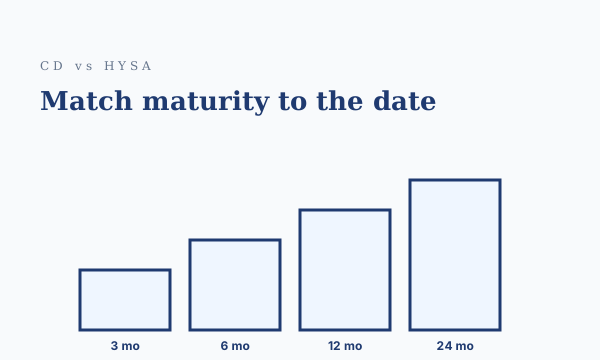
CDs vs High-Yield Savings: Which Is Better for Your Cash?
Certificates of deposit lock in a rate but lock up your money. High-yield savings stay flexible but the rate can drop. Here is how to choose between them.
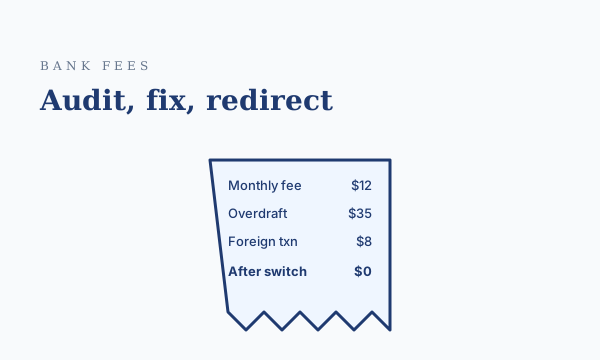
How to Never Pay a Bank Fee Again
The average American household still pays over $200 a year in avoidable bank fees. Getting that number to zero takes about an hour and stays free forever.