Saving
How to Never Pay a Bank Fee Again
The average American household still pays over $200 a year in avoidable bank fees. Getting that number to zero takes about an hour and stays free forever.
Last updated September 3, 2026
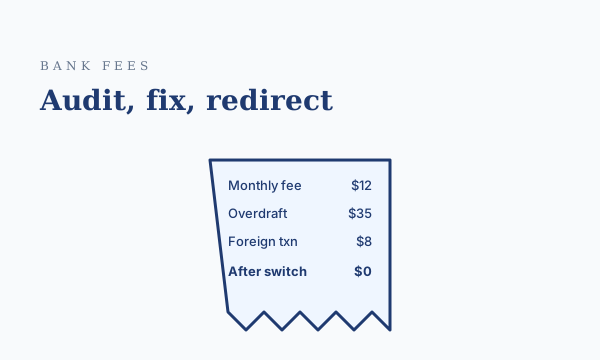
Bank fees are one of the purest forms of financial waste: money you pay for nothing in return, often because of small oversights that compound into hundreds of dollars per year. According to the Consumer Financial Protection Bureau, US banks collect more than $10 billion per year in overdraft fees alone, and most of them are avoidable.
This guide walks through the specific fees, why banks charge them, and how to eliminate each one.
Monthly maintenance fees
Many traditional chequing accounts charge $10 to $25 per month unless you meet a minimum balance or direct-deposit requirement. Over a year that is $120 to $300 for a service you should be getting for free. Every major online bank and most credit unions offer chequing with no monthly fee and no minimum balance. Switch. The process takes about an hour and stays fee-free forever.
Overdraft fees
Overdraft fees are what banks charge when you spend more than your account balance. They average around $35 per event and are famously punitive on small transactions (paying $35 to overdraw by $3 on a coffee). Three approaches eliminate them: choose a bank that does not charge overdraft fees at all (an increasing number of online banks and some large legacy banks); opt out of overdraft coverage so the transaction is simply declined instead of processed and fee-charged; or maintain a small buffer plus a low-balance text alert.
ATM fees
Out-of-network ATM fees are charged twice: once by the ATM owner (often $3 to $5) and once by your bank (often $2 to $5). Solutions: use only in-network ATMs (your bank app usually maps them), use a bank that reimburses out-of-network fees (many online banks and credit unions), or get cash back at retailers for free.
Foreign transaction fees
Many cards and accounts charge 1 to 3 percent on transactions in foreign currency. If you travel internationally with any frequency, use a card or debit card that charges zero foreign transaction fees. Many travel rewards cards and some online-bank debit cards waive this.
Minimum balance fees
If your account requires a minimum balance to avoid fees, either commit to maintaining that balance or switch accounts. Locking a few thousand dollars in low-yield chequing to avoid $10 monthly fees costs you more in lost interest than the fee itself.
Non-obvious fees to check
A quick audit of your last three months of statements often surfaces smaller fees: paper statement fees ($1 to $3), inactivity fees on accounts you rarely use, wire transfer fees (both incoming and outgoing), and cashier check or money order fees. Most of these have free alternatives if you ask or switch account types.
Create a fee inventory from statements, not memory
Download at least three months of statements and group every charge: maintenance, low-balance, overdraft, returned payment, ATM, transfer, foreign transaction, card replacement, paper statement, and inactivity. Annualise recurring charges and note the exact waiver rule. A “free” account that requires an unstable balance or salary credit may be more expensive than a transparent flat-fee account.
Fix the largest predictable fee first. Change alert thresholds, move bill dates, disable optional overdraft where local rules allow, use in-network cash access, and keep a transaction-account buffer separate from emergency savings. Ask the provider to explain the posting order and whether pending card holds reduce the balance used for fees.
Switch with a controlled migration
Before closing an account, open and test the replacement, redirect income, list automatic payments, and keep enough money in both accounts through one full billing cycle. Download statements and tax documents, then obtain closure confirmation. A rushed switch can create returned payments that cost more than the fee you were trying to avoid.
Confirm the legal institution, complaint path, deposit protection, support access, and foreign-exchange spread. Apps and wallets may not be bank deposits. If fees are caused by persistent cash-flow shortage rather than account design, pair the switch with a bill calendar or variable-income budget rather than relying on repeated courtesy refunds.
The full landscape of bank fees
Bank fees fall into predictable categories that most consumers can eliminate or dramatically reduce. Monthly maintenance fees ($5-15) charged for accounts below a minimum balance or without direct deposit; overdraft fees ($25-40 per occurrence); non-sufficient funds (NSF) fees ($25-40) when transactions are rejected; ATM fees ($2-5 for out-of-network use plus surcharge from ATM owner); foreign transaction fees (typically 3% on international purchases); wire transfer fees ($15-45 domestic, $35-75 international); paper statement fees ($2-5 monthly); and account inactivity fees ($5-10 monthly after 6-12 months of no activity).
The average American household pays $250-450 in bank fees annually according to Bankrate’s annual surveys. Some pay dramatically more — households with frequent overdrafts can pay $500-2,000+ annually in overdraft fees alone. The Consumer Financial Protection Bureau estimated overdraft fees cost consumers over $15 billion annually before recent regulatory changes reduced (but did not eliminate) the industry’s reliance on this revenue.
Eliminating monthly maintenance fees
The three common paths to fee-free checking: (1) meet the bank’s waiver requirements (typically maintaining a minimum balance, receiving direct deposits, or completing a set number of debit transactions monthly); (2) qualify for special account tiers (student, senior, military); or (3) switch to a bank that does not charge maintenance fees at all.
Many online banks (Ally, Discover, Capital One 360, Charles Schwab, SoFi) offer completely fee-free checking accounts with no minimum balance requirements. Credit unions typically have lower fee structures than large national banks. Community banks vary widely. For most consumers, switching to a fee-free provider is the simplest path to eliminating maintenance fees permanently.
If you prefer keeping your current bank, verify the exact waiver requirements and either meet them consistently or switch. Erratically meeting requirements (some months yes, some months no) results in occasional fees that add up over years. Set up direct deposits and automatic minimum balance monitoring rather than manually tracking each month.
Overdraft fees: the highest-cost bank charge
Overdraft fees typically cost $25-40 per occurrence, and some banks charge multiple overdrafts per day if multiple transactions clear when the account is negative. A borrower who overdrafts three transactions at $35 each pays $105 in fees for possibly less than $20 in overdrawn amounts — an effective interest rate that exceeds the worst payday loans.
Overdraft protection options: (1) opt out of overdraft coverage entirely (debit transactions and ATM withdrawals will be declined if funds are insufficient, but checks and automatic payments may still trigger fees); (2) link overdraft protection to a savings account (transfers cover shortfalls, often for a $5-12 transfer fee — much cheaper than overdraft fees); (3) link overdraft protection to a credit card or line of credit (interest applies to the borrowed amount but no per-transaction fee).
Modern low-fee banks (Chime, SoFi, Ally) offer various overdraft protection features including SpotMe (Chime), which covers small overdrafts up to a limit at no charge for eligible customers. Some traditional banks (Capital One 360, Ally) have eliminated overdraft fees entirely on their consumer accounts. Switching to these providers is the simplest solution for anyone who has paid multiple overdraft fees in the past year.
ATM fees and how to avoid them
ATM fees have two components: your bank charges $2-5 for using out-of-network ATMs, and the ATM owner charges $2-5 as a surcharge. A typical out-of-network withdrawal costs $4-10 total. Frequent out-of-network ATM use can cost $200-500 annually.
Solutions: (1) use only in-network ATMs from your bank; (2) choose a bank with a large ATM network or ATM network partnerships (Allpoint, Star, Cirrus networks provide access to tens of thousands of ATMs); (3) get cash back at merchants with debit purchases (no fee, and combines cash access with grocery/other purchases); (4) switch to a bank that reimburses ATM fees (Charles Schwab, Fidelity, SoFi, and some others offer full or partial ATM fee reimbursement).
For international travel, foreign ATM use typically incurs both foreign transaction fees (3%) and out-of-network fees. Some accounts specifically waive international fees (Charles Schwab checking is particularly good for international travelers). Consider opening such an account before extended travel abroad.
Foreign transaction fees
Most standard debit and credit cards charge 3% on international transactions — a $500 hotel bill becomes $515 due to fees alone. Some credit cards specifically waive foreign transaction fees (typically travel cards and premium cards; check card benefits before international travel). Debit cards with no foreign transaction fees are less common but exist (Charles Schwab checking, some credit union accounts).
When traveling internationally, always pay in local currency rather than accepting "dynamic currency conversion" offered by merchants. The merchant’s conversion rate is almost always worse than your card’s network rate (typically Visa or Mastercard interbank rates). Paying in local currency and letting your card convert typically saves 2-4% versus DCC.
Wire transfers are separate from foreign transaction fees. International wires typically cost $35-75 and take 1-5 business days. For sending money internationally, services like Wise (formerly TransferWise), Revolut, or Western Union often provide significantly better rates and lower fees than bank wires — sometimes saving hundreds of dollars on larger transfers.
Fees on savings accounts and CDs
Savings account fees are less common but exist: monthly maintenance for balances below minimums (typically $300-500), excessive withdrawal fees (historically capped at 6 monthly under Regulation D, though this cap was suspended in 2020), and inactivity fees. Most reputable online savings accounts have no such fees.
CD early withdrawal penalties are not really "fees" but reduce interest earned or principal on early withdrawal. Typical penalties: 90 days interest for CDs under 1 year, 180 days for 1-3 year CDs, 12 months for longer CDs. Some banks charge penalties larger than accrued interest, actually reducing principal. Read specific terms before opening any CD.
Wire transfer alternatives
Wire transfers ($15-45 domestic, $35-75 international) are often used for large money movements when speed matters. Alternatives that avoid or reduce fees: ACH transfers between accounts you own (typically free, take 1-3 business days), Zelle (free between bank accounts, near-instant), Venmo and Cash App (free for personal transfers from bank account, 3% for credit card funded), and PayPal (free between friends and family, fees for merchandise transactions).
For international transfers, Wise (formerly TransferWise) typically offers rates within 0.5% of interbank mid-market rates plus a small flat fee — often saving $30-100+ per transfer versus bank wires. Revolut, OFX, and other fintechs offer similar services with varying rate structures. Compare a specific transfer amount and currency across services before choosing.
Common bank fee mistakes
The most common mistake is not tracking bank fees at all. Many households pay $200-500 annually without noticing because each fee is small. Reviewing bank statements quarterly and identifying every fee is the first step to eliminating them. Bank apps sometimes highlight fees in transaction descriptions; use these to compile a list.
The second common mistake is staying with a fee-heavy bank out of inertia. Switching banks is significantly less friction than most people believe — modern account opening takes 15-30 minutes online, direct deposit rerouting takes one payroll cycle, and automatic payments can be updated over a few days. The annual savings from switching often exceeds $200-400.
The third mistake is opting into overdraft coverage without understanding the cost. Many people assume overdraft coverage is a service rather than a fee-generating feature. Opting out means transactions are declined when funds are insufficient — sometimes embarrassing but always cheaper than paying overdraft fees. For most consumers, opting out is the right choice.
Sources and methodology
We use primary and authoritative sources for rules, definitions, and data. Sources and factual claims were last checked September 3, 2026.
- Bank accounts and services — Consumer Financial Protection Bureau (United States)
- Deposit insurance at a glance — Federal Deposit Insurance Corporation (United States)
- Global Findex Database — World Bank (Global)
Frequently asked questions
- Is switching banks a hassle?
- Not really. Most online banks make account opening a 10-minute process. Updating direct deposit and autopay is the main effort, and takes another 30 to 60 minutes over a few weeks.
- Are credit unions really cheaper than banks?
- Often, yes. Credit unions are member-owned nonprofits and typically charge fewer and lower fees. Not always though, so compare a specific institution against the fee-free online options before deciding.
- What is the safest way to avoid overdrafting?
- Opt out of overdraft coverage. The transaction will simply be declined at the register, which is embarrassing for a moment but never expensive.
Related articles
High-Yield Savings Accounts: How They Work and How to Choose One
High-yield savings accounts pay roughly ten to twenty times more interest than traditional bank accounts. Here is how they work, how they are insured, and how to pick a good one.
How to Cut Your Monthly Bills Without Feeling Deprived
Most household budgets contain a few large recurring costs and dozens of small subscriptions. Focusing on the right ones creates real savings without changing how you live.
Credit Card vs Debit Card: Which One Should You Actually Use?
For most day-to-day spending, a credit card offers stronger consumer protection and better rewards — but only if used with the discipline of a debit card.