Budgeting
How to Cut Your Monthly Bills Without Feeling Deprived
Most household budgets contain a few large recurring costs and dozens of small subscriptions. Focusing on the right ones creates real savings without changing how you live.
Last updated September 3, 2026
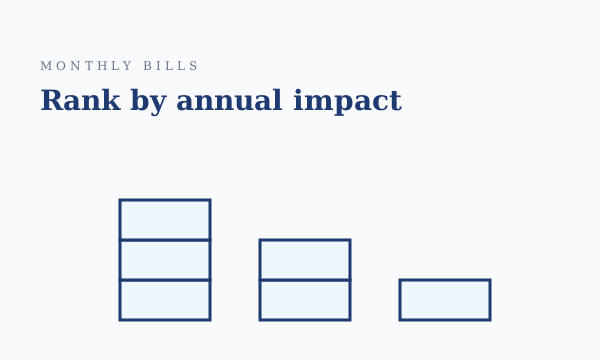
Advice on cutting expenses often obsesses over the tiny cost of a daily coffee while ignoring the four-figure annual cost of an insurance policy you have not shopped in five years. If you want to lower your monthly bills without downgrading your life, focus on the big recurring costs first and treat the small ones as bonuses.
This guide walks through a prioritised checklist, roughly ordered by how much money it can free up for the average household.
1. Reshop your insurance annually
Auto and home insurance premiums drift upward over time, and staying loyal to one insurer often costs more than switching. Get three or four quotes on the same coverage every twelve to eighteen months. Households that switch commonly save $200 to $600 per year without reducing coverage. Confirm you are keeping equivalent limits and deductibles when comparing.
2. Renegotiate your phone and internet
Phone and internet providers reserve their best pricing for new customers. Call once a year and ask what promotions are available for existing customers, or say you are considering switching. Many providers will move you to a promotional rate to keep your business. If your current provider will not, competitors usually will, and porting your number typically takes less than an hour.
Also check whether you are paying for a plan larger than you use. Roughly half of all mobile customers pay for unlimited data but use only a fraction of it. Downgrading to a plan that matches your actual usage frequently saves $10 to $30 per month.
3. Audit your subscriptions
Streaming, apps, magazines, and boxed services quietly add up. Pull the last three months of statements and list every recurring charge. Cancel anything you have not used in the last thirty days. A common household finds four to eight forgotten subscriptions totalling $30 to $100 per month.
4. Eliminate bank fees
Monthly maintenance fees, overdraft fees, and out-of-network ATM fees are the easiest waste to remove. Switch to a chequing account with no monthly fee (most online banks and many credit unions offer them), enable low-balance alerts to avoid overdraft, and use only in-network ATMs. The average American household still pays around $200 a year in avoidable bank fees — zero is achievable.
5. Refinance high-interest debt
If you carry credit-card debt at 20%+ APR, moving it to a lower-rate personal loan or a 0% balance-transfer card can save hundreds per year in interest. Balance-transfer cards typically charge a 3–5% transfer fee — if the interest saved during the promotional period exceeds that fee, it is a clear win, but only if you can pay off the balance before the promo ends.
6. Reduce the small stuff — but do not obsess
After the large items, look at lifestyle costs you can painlessly trim: brewing coffee at home a few days a week, batching errands to save on fuel, or switching one paid gym for a free outdoor routine. These add up over time, but they should be the last layer, not the first — they cannot compensate for a poorly shopped insurance policy or an unused $50 subscription.
Rank bills by annual impact and switching friction
Export three months of transactions, list each recurring charge, and convert it to an annual cost. Mark renewal date, cancellation notice, penalty, usage, and a replacement price from a comparable provider. Start with large contracts and duplicated services, not dozens of tiny cuts. A lower monthly price can cost more when it resets quickly, strips necessary cover, or adds equipment and exit fees.
For insurance, compare the same limits, deductibles, exclusions, and named people or property. For phone, internet, and utilities, include installation, hardware, taxes, usage caps, and promotional expiry. Ask the current provider for a written retention offer only after obtaining a real alternative, and save chat or email evidence of the terms.
Protect reliability while reducing cost
Do not cut required insurance, medicines, secure housing, essential connectivity, or preventive maintenance merely because the benefit is not visible each month. Instead change specification: remove unused add-ons, alter a deductible only if the emergency fund can absorb it, share a service lawfully, or schedule a switch at contract end. The goal is lower total cost for the needed outcome.
Redirect verified savings immediately. If a cancelled service saves 40 per month, schedule 40 toward the chosen sinking fund, debt, or reserve on the former billing date. Review the next two statements for final or duplicate charges. Savings that remain as unassigned current-account cash are easily consumed without improving the plan.
The audit that reveals your real spending
The starting point for cutting monthly bills is knowing exactly what you spend. Download the last three months of transactions from your primary bank account and credit cards into a spreadsheet. Categorize every recurring charge: subscriptions, utilities, insurance, telecom, streaming services, memberships, meal delivery, financial services. Convert every recurring charge to an annual number by multiplying monthly amounts by 12. Small charges look trivial monthly but reveal their true cost annually.
Most households discover $2,000-5,000 in annual recurring charges when they audit properly. Common surprises: three streaming services totaling $50/month ($600/year), unused gym membership ($40/month = $480/year), a "free trial" that converted to paid a year ago ($15/month = $180/year going forward), extra insurance coverage sold at policy renewal that adds $20/month ($240/year), premium credit card annual fees no longer justified by benefits used ($95-695 annually).
Sort your recurring charges by annual amount, highest to lowest. Focus first on the top 5-10 items — these represent 80% of total recurring costs. A single $200/month insurance policy is worth more attention than ten $10/month subscriptions. Once large items are optimized, move down the list systematically.
Insurance: the largest reducible expense for most households
Auto and home insurance premiums typically rise year over year even without claims or coverage changes. Insurance companies count on customer inertia — a customer who does not shop tends to pay 20-40% more than the market rate over time. Shopping every 2-3 years is essential to keep insurance costs current.
Get quotes from 3-5 different insurers for identical coverage. Use online tools (Progressive’s Name Your Price, Policygenius, The Zebra) for initial comparisons, then verify with direct quotes from top candidates. Independent insurance agents work with multiple carriers and can compare on your behalf; they earn commissions from the insurer so their service is typically free to you.
Bundling auto and home insurance with the same carrier typically saves 10-20% versus separate policies. Verify by comparing the bundled quote to separate quotes from different carriers — sometimes separate carriers with the best individual rates beat the bundled rate even accounting for the bundling discount.
Deductible optimization: raising auto and home insurance deductibles from $500 to $1,000 typically reduces premium by 10-15%. This is worthwhile if you have adequate emergency savings to absorb the higher deductible — otherwise you are trading small premium savings for potential financial crisis if you file a claim.
Telecom and internet
Phone and internet bills accumulate charges beyond the advertised price. Modem/router rental fees ($10-15/month), broadcast TV surcharges on cable ($15-25/month), regulatory fees on cell phones ($10-30/month), and other line items often add 25-40% to the "advertised" price. Review the itemized bill and question every charge.
Cell phone alternatives to major carriers can save $50-100+ monthly per line. Mint Mobile, Visible, Cricket, Google Fi, and other MVNOs (mobile virtual network operators) provide access to major carrier networks (Verizon, T-Mobile, AT&T) at dramatically lower prices. A family of four switching from major carrier plans ($200-300/month) to MVNOs ($60-120/month) saves $1,500-2,000+ annually.
Internet negotiations work if you follow the script: (1) research competitors’ current promotional rates in your area; (2) call your ISP; (3) request cancellation and be transferred to retention; (4) explain you found a better rate elsewhere and are considering switching; (5) accept the retention offer if it matches or beats the competitor rate. Most ISPs will match competitor rates rather than lose customers. This works better every 12-24 months as introductory rates expire.
Streaming and subscription services
Streaming service prices have risen significantly over the past 5 years. A household with Netflix ($15.49), Disney+ ($13.99), Max ($15.99), Hulu ($17.99), Apple TV+ ($9.99), and Spotify ($10.99) spends $84.44 monthly — over $1,000 annually. This is more than most cable packages cost 10 years ago.
The realistic strategy: subscribe to services when you actively use them, cancel when you do not. Watch a specific series on Max? Subscribe for a month, watch, cancel. Return next month for a different service. This "rotation" approach captures the value of streaming content while dramatically reducing average monthly cost. Yearly ad-supported plans often offer 30-50% savings versus monthly ad-free plans if you use a service consistently.
Audit every recurring service quarterly. Log into each account and check the last 3 months of usage. Any service unused for 90 days is a candidate for cancellation. Reactivation is typically trivial (30 seconds through the app) if you decide you want the service back later.
Utility bills and energy costs
Electricity, gas, and water bills vary by 10-30% based on usage patterns most consumers do not think about. Basic optimizations: (1) LED bulbs throughout the house (save $200-500+ annually vs incandescent); (2) programmable thermostat set to appropriate temperatures when away (save 10-15% on heating/cooling); (3) unplug electronics not in use (phantom power draws can add 5-10% to electric bills); (4) full loads for dishwasher and laundry rather than partial loads.
In deregulated electricity markets (Texas, Pennsylvania, Ohio, others), you can choose your electricity generation supplier separately from the distribution utility. Switching to a competitive supplier can save 10-30% on the generation portion of the bill. Compare rates at your state’s energy comparison website (each deregulated state has one).
Water bills are typically volumetric — you pay per gallon used. Low-flow showerheads, dual-flush toilets, and fixing leaks (a running toilet can waste 2-3 gallons per minute continuously) can reduce water bills by 20-40%. Some utilities offer rebates for water-efficient appliances that make replacement more affordable.
Financial services fees
Bank fees, investment account fees, credit card annual fees, and other financial services fees often total $500-1,500 annually for households that do not audit. Bank maintenance fees, overdraft fees, ATM fees, and foreign transaction fees are all typically avoidable through better bank selection.
Investment account fees include expense ratios on funds (should be under 0.20% for index funds), advisor fees (should be flat-fee or hourly, not percentage-of-assets for most investors), transaction fees, and account maintenance fees. A portfolio charged 1% annually vs 0.10% pays $9,000 more per year on a $1M portfolio — a life-changing difference over decades.
Credit card annual fees are only worth paying when the benefits used exceed the fee cost. A $95 annual fee for a card whose rewards you actually claim ($200 in cashback + $150 in travel credits used) makes sense. A $95 annual fee for a card whose benefits you never use is $95 wasted. Downgrade cards when benefits are not being captured — most issuers offer no-fee versions of premium cards.
The redirect: where saved money should go
Simply cutting bills without redirecting the savings often leads to "lifestyle absorption" — the saved money quietly gets absorbed into miscellaneous spending. To capture the benefit, immediately redirect saved amounts to specific goals: emergency fund, high-interest debt payoff, retirement account contribution increase, or specific savings targets.
Automation makes this stick. Cancel a $50/month subscription? Immediately increase your automatic Roth IRA contribution by $50/month. Switch cell phone providers and save $80/month? Add $80/month to emergency fund transfer. The money is redirected before it can be absorbed into general spending. Without this step, saved money often disappears without corresponding goal progress.
Common bill-cutting mistakes
The most common mistake is doing a one-time audit then never revisiting. Bills creep back over time as promotional rates expire, subscriptions renew, insurance premiums rise, and new services get added. Schedule quarterly audits (30-60 minutes each) to catch and reverse this creep before it accumulates.
The second common mistake is being too aggressive and cutting things that provided genuine value. If cancelling all streaming services makes weekends unpleasant, the "savings" may not be worth it. The goal is optimization, not maximization of cuts. Keep services that provide genuine value; cut only those whose value is less than their cost.
The third mistake is ignoring the opportunity cost of the audit time. If your hourly earning capacity is $50/hour and an audit takes 4 hours, the audit costs $200 of opportunity cost. Aim for audits that identify $500-2,000+ in annual savings to make the time investment worthwhile. Focus on the largest bills first for maximum return on time invested.
Sources and methodology
We use primary and authoritative sources for rules, definitions, and data. Sources and factual claims were last checked September 3, 2026.
- Budgeting resources — Consumer Financial Protection Bureau (United States)
- Bank accounts and services — Consumer Financial Protection Bureau (United States)
- Financial education — OECD (Global)
Frequently asked questions
- Which cut saves the most money?
- For most households, reshopping insurance and negotiating phone and internet plans produce the biggest wins because the annual dollar amounts are large.
- Will my credit score drop if I shop for insurance?
- No. Insurance quotes typically use a "soft inquiry" that does not affect your credit score.
- Is cutting small expenses pointless?
- Not pointless, but not primary. Cut the big items first, then trim small ones as a bonus. Focusing only on lattes while ignoring insurance is the wrong order.
Related articles
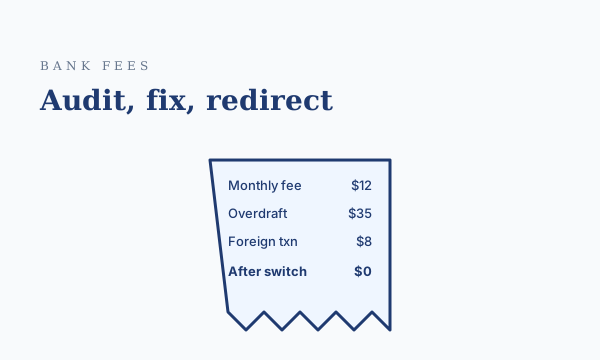
How to Never Pay a Bank Fee Again
The average American household still pays over $200 a year in avoidable bank fees. Getting that number to zero takes about an hour and stays free forever.
Sinking Funds: The Budgeting Trick That Stops Big Bills From Blindsiding You
Annual insurance, car maintenance, holiday spending — the expenses that wreck budgets are the ones that are large but predictable. Sinking funds solve that problem.
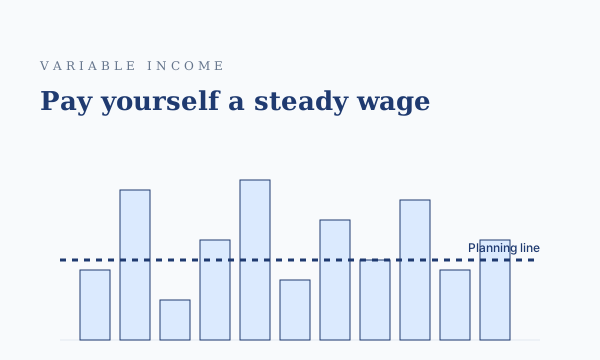
How to Budget on a Variable Income
Freelancers, contractors, and commission earners cannot budget from a steady paycheque. Here is a system that keeps a variable-income household stable month to month.