Budgeting
How to Budget on a Variable Income
Freelancers, contractors, and commission earners cannot budget from a steady paycheque. Here is a system that keeps a variable-income household stable month to month.
Last updated September 3, 2026
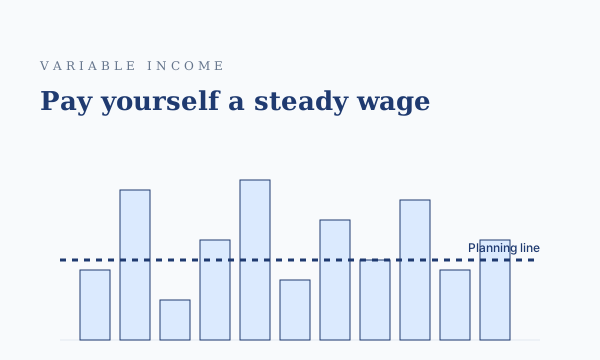
Traditional budgeting advice assumes a predictable paycheque, which does not describe the reality of freelancers, contractors, commission earners, small-business owners, or anyone whose income varies month to month. A budget that requires a stable input cannot handle a stable output when the input keeps changing.
The solution is not to abandon budgeting — it is to add one layer between your income and your spending: a buffer account that pays you a steady "salary" from lumpy earnings.
Step 1: Find your baseline monthly income
Look at the last twelve months of income. Take the lowest three months, average them, and use that as your baseline. This is the amount you will pay yourself each month. Using the lowest months (rather than the average) means slow months do not force you to cut back — they simply mean the buffer works harder.
Step 2: Set up a buffer account
Open a separate chequing or high-yield savings account and route all income into it. This is not your spending account — it is your holding tank. From this account, transfer your fixed baseline "salary" to your personal chequing on the same day each month. Everything else stays in the buffer.
Step 3: Reserve taxes immediately
For every payment received, move a percentage into a separate tax account. The exact percentage depends on your country, income level, and business structure, but 25–35% is a common starting range for US self-employed workers. Reserving on receipt (rather than at year-end) is the single most effective way to avoid a tax bill you cannot pay.
Step 4: Budget your salary like a normal paycheque
Once you are paying yourself a steady monthly amount, apply a normal budgeting method — 50/30/20 or zero-based — to that amount. Because the "salary" is stable, the rest of your budgeting looks and feels like anyone else's.
Step 5: Grow the buffer to at least three months
The buffer's job is to absorb slow months. Aim to build it to at least three months of "salary" in reserve before considering higher pay-outs. Once the buffer reaches six months, you can either raise your salary permanently or move surplus into longer-term savings and investing.
Handling irregular expenses
Layer sinking funds on top for expenses that do not match your monthly rhythm — annual insurance, quarterly tax payments, equipment replacement, professional dues. Together, a buffer account, fixed salary, tax reserve, and sinking funds turn a chaotic income stream into a boring, predictable household budget.
Build the plan from timing, not average income
Map when cash arrives and when essential bills leave. Calculate a conservative planning income from recent low months only after removing one-off windfalls. Keep a separate list of invoice amounts that are earned but not collected; receivables are not spendable cash. Fund housing, food, utilities, transport, insurance, minimum debt payments, and required taxes before flexible categories.
Use a holding account or ledger for income, then pay yourself a stable transfer based on the conservative plan. In strong months, first replenish the income buffer and known annual costs; only then increase goals or flexible spending. In weak months, use the buffer according to a written floor rather than treating every fluctuation as an emergency.
Create a waterfall for every payment
When money arrives, allocate in order: locally required tax or social contributions, costs needed to earn the income, next essential bills, sinking funds, buffer restoration, goals, and discretionary spending. Percentages may help, but the correct tax reserve depends on jurisdiction, profit, total household income, and deductions. U.S. readers should use current IRS estimated-tax guidance rather than a fixed percentage from an article.
Track three numbers monthly: lowest realistic income, essential spending, and months of income buffer. Recalculate after losing a client, changing prices, gaining a dependant, or moving tax residence. If volatility is seasonal, compare the same season across years rather than reading one unusually good month as permanent capacity.
Why standard budgeting breaks with variable income
Standard budgeting advice assumes predictable monthly income — subtract fixed expenses, allocate the rest. When your income varies from $2,000 one month to $8,000 the next, this approach breaks down. Basing spending on strong months leaves you short in weak months; basing on weak months leaves surplus that gets spent inefficiently in strong months. The result: variable-income earners often oscillate between overspending and undersaving despite earning enough averaged annually.
Common variable income sources: freelancers and consultants paid by project, commission-based sales roles, gig workers (Uber, DoorDash, Instacart, Rover), small business owners, seasonal workers, real estate agents, restaurant workers reliant on tips, contract workers with hourly variations. All share the fundamental challenge: income is a range, not a number.
The income smoothing approach
The core solution: pay yourself a stable monthly salary from a buffer account, regardless of what actually came in that month. All income deposits into the buffer account. On the first of each month, transfer a fixed amount from buffer to checking as your "salary." Live on that salary. Strong months build the buffer; weak months draw from it. The variability is contained within the buffer.
The starting "salary" amount should be based on your lowest realistic monthly income, not your average. If your last 12 months of income ranged $2,000-$8,000, base salary on $2,500-$3,000 initially. This ensures you can survive any typical month without buffer support. As the buffer grows over time, gradually increase your salary — but always lag actual income by 20-30%.
Building the initial buffer is the hardest part. Aim to accumulate one month of essential expenses as buffer before switching to the "salary" model. Until you have that buffer, budget conservatively from your lowest expected income and direct surplus in strong months entirely to buffer accumulation. Once complete, the system self-sustains.
Tax reserves for self-employed variable income
For freelancers, contractors, and gig workers, taxes are the largest budget wrecker. W-2 employees have taxes automatically withheld; self-employed workers receive gross payments and owe both income tax and self-employment tax (15.3% on net earnings up to $168,600 for 2024). A freelancer earning $5,000 in a month may owe $1,500-2,000 in federal taxes alone before state taxes.
Set aside 25-30% of every net income dollar (income minus deductible expenses) into a separate savings account immediately upon deposit. This "tax bucket" is separate from operating cash flow and separate from the income smoothing buffer. When quarterly estimated taxes come due (April 15, June 15, September 15, January 15), the money is already isolated and ready.
Better precision: calculate your effective tax rate based on last year’s tax return, add SE tax, add state tax. Someone with a 22% federal marginal rate + 15.3% SE tax on $100K profit ≈ 33% blended rate on new income. Adjust seasonal or annual tax bucket percentage based on this calculation. Under-reserving during the year creates April surprises; over-reserving is inefficient but easily corrected.
Prioritizing the waterfall of income allocation
When variable income arrives, allocate in this priority order: (1) tax reserve (25-30% of net income); (2) essential business expenses (software subscriptions, phone, internet allocated to business); (3) top up income smoothing buffer if below target; (4) transfer stable "salary" to personal checking; (5) allocate remainder to specific goals — emergency fund, retirement, debt payoff, or specific savings targets.
This waterfall protects against the temptation to spend windfalls. A freelancer landing a $10,000 project may feel entitled to celebrate with $2,000 of discretionary spending. The waterfall approach automatically routes that money through tax reserves, buffer, and goals first — leaving less than expected for discretionary spending, which is usually the correct outcome.
Windfall protocols: for any single payment above 150% of typical monthly income, direct at least 50% to tax reserves and long-term goals before any discretionary allocation. This prevents "lifestyle absorption" where every good month expands baseline spending. The pattern of variable-income earners who succeed long-term versus those who struggle often comes down to how they handle windfalls, not how much they earn.
Managing irregular expenses when income is also irregular
Variable income makes sinking funds essential rather than optional. Predictable annual expenses (insurance renewals, quarterly taxes, professional membership fees, vehicle maintenance) can devastate a variable-income budget if not funded gradually. Divide expected annual expenses by 12 and fund each month regardless of income level.
Business expenses often follow their own patterns unrelated to income. Software subscriptions typically renew annually; equipment purchases (laptops, tools) may cluster around specific times; conference and training expenses may concentrate in specific months. Sinking funds for these expenses smooth the impact across the year.
Health insurance is particularly critical for self-employed workers. Marketplace insurance premiums can range $400-1,500+ monthly for adequate coverage. This must be budgeted monthly regardless of income variability — going without coverage during a low-income period risks catastrophic health costs during exactly the period when income cannot cover them.
Emergency fund sizing for variable income
Standard emergency fund advice (3-6 months of expenses) assumes stable employment. Variable-income workers face two overlapping risks: income drops and unexpected expenses. Both risks may hit simultaneously — a slow business quarter combined with a car breakdown, for example. The buffer needs to cover both.
Target 6-9 months of essential expenses for variable-income workers, potentially more if income is highly seasonal or business is early-stage. This is on top of the income smoothing buffer (which itself is essentially a mini emergency fund for income variability). Two accounts, two purposes: income buffer handles typical monthly variation; emergency fund handles unusual events.
Health savings account contributions become more valuable for self-employed workers because health insurance costs can be volatile. HSA balances can pay medical expenses tax-free, and if not needed for medical, function as an additional retirement account after age 65. Prioritize HSA contributions if you have HDHP coverage.
Retirement contributions with variable income
Self-employed workers have expanded retirement account options: Solo 401(k), SEP-IRA, SIMPLE IRA. Solo 401(k) is typically the most powerful, allowing employee contributions up to $23,000 (2024, $30,500 age 50+) plus employer contributions up to 25% of self-employed compensation, totaling up to $69,000 annually. SEP-IRA is simpler to administer but only allows the employer contribution portion.
Fund retirement accounts on a percentage basis rather than fixed dollar amounts. If you commit to $2,000 monthly Roth IRA contributions, weak months become impossible while strong months waste opportunity. Instead, allocate 15-20% of net income to retirement automatically — the dollar amount varies with income but the discipline remains constant.
For Solo 401(k) and SEP-IRA, contributions can be made until tax filing deadline (April 15 or October 15 with extension). This lets you calculate the exact contribution amount based on full-year income rather than trying to project monthly. Many self-employed workers make one large contribution in Q1 of the following year after knowing exact income and tax situation.
Common variable-income budgeting mistakes
The most common mistake is basing budgets on average income rather than lowest realistic income. Averages hide variability; someone whose income averages $5,000 monthly but ranges $2,000-$8,000 cannot sustain $5,000 monthly spending because some months only provide $2,000. Budget conservatively to protect against sequence risk of consecutive low months.
The second common mistake is spending windfalls before tax reserves are set aside. A $20,000 project payment feels like $20,000 of new capacity; the reality is $5,000-7,000 belongs to taxes and $2,000-3,000 should go to sinking funds and reserves before any discretionary allocation. Failing to set aside tax reserves creates April tax bills that must be funded through emergency savings or debt.
The third mistake is delaying retirement contributions "until income stabilizes." For most variable-income workers, income never fully stabilizes. Waiting for perfect stability means missing decades of compounding. Instead, contribute a percentage of each income (adjustable up or down based on that month’s income) — the discipline of contributing at all matters more than the amount consistency.
Sources and methodology
We use primary and authoritative sources for rules, definitions, and data. Sources and factual claims were last checked September 3, 2026.
- Budgeting resources — Consumer Financial Protection Bureau (United States)
- Financial education — OECD (Global)
- Estimated taxes — Internal Revenue Service (United States)
Frequently asked questions
- How much should I set aside for taxes?
- For US self-employed workers, 25–35% is a common starting range, but the exact figure depends on income level, state, deductions, and business structure. A quick session with a tax professional at the start of the year is worth the cost.
- What if my baseline income cannot cover my essential expenses?
- That is a signal to either cut essentials, increase income, or both — not to overpay yourself from the buffer and hope for a big month.
- Can I do this without a separate business account?
- You can, but a separate account is strongly recommended. It removes confusion between business and personal spending and makes bookkeeping (and taxes) far easier.
Related articles
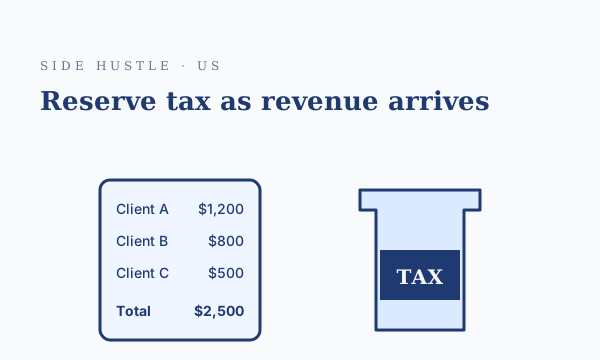
Side Hustle Taxes: A Beginner Guide for US Workers
Side income comes with tax responsibilities most first-time earners miss until the following April. Here is what to set aside, when to pay, and what to deduct.
Sinking Funds: The Budgeting Trick That Stops Big Bills From Blindsiding You
Annual insurance, car maintenance, holiday spending — the expenses that wreck budgets are the ones that are large but predictable. Sinking funds solve that problem.
How Much Emergency Fund Do You Really Need?
The standard "three to six months of expenses" is a starting point, not a rule. Here is how to size your emergency fund based on your real situation.