Budgeting
Side Hustle Taxes: A Beginner Guide for US Workers
Side income comes with tax responsibilities most first-time earners miss until the following April. Here is what to set aside, when to pay, and what to deduct.
Last updated September 3, 2026
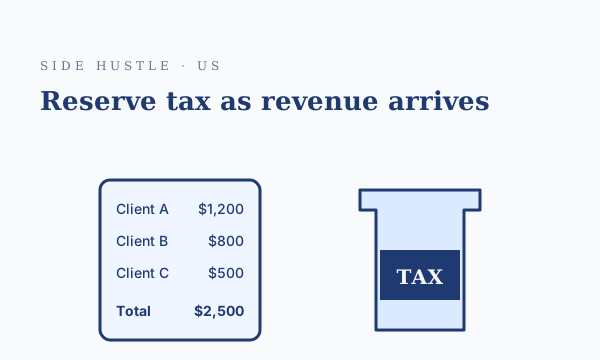
A side hustle is any income you earn outside your regular W-2 job (freelance writing, driving, tutoring, reselling, consulting). In the US, that income is generally reported on Schedule C of your personal tax return and is subject to both regular income tax and self-employment tax. Many first-time side-hustlers do not realise this until they file and get a surprise bill.
This guide covers the basics of what you owe, how to reserve for it, and what you can deduct. It is not a substitute for personalised tax advice; consult a CPA or Enrolled Agent for anything unusual.
Self-employment tax
Self-employment tax is Social Security and Medicare tax combined, currently 15.3 percent on the first roughly $168,000 of net self-employment income and 2.9 percent Medicare on income above that (with an additional 0.9 percent Medicare surtax at higher incomes). W-2 employees split these taxes with their employer; self-employed workers pay both halves.
You can deduct half of your self-employment tax as an adjustment to income, which softens the sting slightly. It does not reduce the SE tax itself, only your regular income tax.
Estimated quarterly payments
The US tax system is pay-as-you-go. If you expect to owe more than $1,000 in federal tax that is not already withheld from a paycheque, the IRS expects quarterly estimated payments in April, June, September, and January. Underpayment can trigger a penalty, even if you pay the full balance in April.
A common rule of thumb is to reserve 25 to 35 percent of net side-hustle income for taxes, depending on your marginal bracket and state. Set the money aside in a separate savings account as it arrives, then make quarterly payments from that account.
Common deductions
Ordinary and necessary business expenses reduce your net income (and therefore your tax). Common examples include a portion of home internet and phone, business software, mileage for business driving, supplies, professional services, and a home-office deduction if you have a dedicated space used exclusively and regularly for the business. Keep records; the IRS can ask for substantiation.
Retirement account bonus
Self-employment income opens access to retirement accounts that W-2 workers do not have: a SEP-IRA or Solo 401(k) can shelter meaningful amounts of side-hustle income from tax while building retirement savings. For someone with a serious side income, this is often the highest-value tax move available.
When to hire a professional
For a small, straightforward side hustle, quality tax software handles it well. Hire a CPA or Enrolled Agent when your side hustle grows past a few thousand dollars per year, when you have multiple income streams or unusual deductions, or when you have made a mistake in a prior year that needs correcting.
Build records around the business, not the tax deadline
Use a dedicated account or ledger, issue and retain invoices, and reconcile gross receipts to payment-processor reports and information forms. Forms can be missing or duplicated and are not the complete definition of taxable income. Record business purpose, date, amount, vendor, and receipt for expenses; a bank transaction alone may not establish deductibility.
Profit is generally income minus allowable business expenses, while cash received and tax due are different concepts. Set aside money as revenue arrives, but calculate the reserve from an estimate that includes household income, filing status, credits, state obligations, and prior-year safe-harbour rules—not a universal internet percentage. Revisit after a material profit change.
Use current forms and current-year guidance
The mechanics can involve Schedule C, Schedule SE, estimated payments, and information forms, but thresholds, dates, mileage rates, deductions, and reporting platforms change. Use the IRS pages linked below for the relevant tax year. A side activity can also trigger state registration, local licence, sales tax, or foreign reporting that a federal overview cannot resolve.
Separate legitimate planning from inventing deductions. An expense must satisfy applicable rules and may need allocation between business and personal use. Home office, vehicle, equipment, travel, meals, inventory, and contractor payments have specialised requirements. Seek a qualified tax professional when records are incomplete, work crosses borders, or entity selection and payroll enter the picture.
Why side hustle taxes surprise nearly everyone
W-2 employees have taxes automatically withheld from every paycheck. Side hustle income arrives without any tax withheld — you get every dollar earned upfront, which feels great until April when the tax bill arrives all at once. Compounding the surprise: self-employment income owes both income tax AND self-employment tax (15.3% covering Social Security and Medicare — the "employer portion" that W-2 workers never see). A side hustler earning $10,000 net profit can easily owe $3,000-4,000 in federal taxes alone before any state taxes.
The IRS knows this creates surprise tax bills and requires quarterly estimated tax payments for anyone expecting to owe $1,000+ in taxes beyond what W-2 withholding covers. Missing quarterly payments generates penalties (currently 8% annualised) on the underpaid amount. Understanding this early — before the first tax filing — is the difference between painful surprise and a smoothly managed side business.
Self-employment tax explained
Self-employment (SE) tax is 15.3% on net self-employment earnings: 12.4% for Social Security (on the first $168,600 of combined W-2 and SE income for 2024) plus 2.9% for Medicare (no cap). This replaces the FICA taxes normally split between employer and employee at 7.65% each. When you are self-employed, you are both employer and employee, so you owe both halves.
You can deduct half of the SE tax from adjusted gross income when calculating income tax — the IRS treats it like the "employer portion" that would normally be deductible. This softens the blow slightly but does not eliminate the impact. On $10,000 of net SE income, you owe roughly $1,530 in SE tax (before the deduction adjustment), plus federal and state income tax on the reduced AGI.
SE tax only applies to net earnings, which is gross income minus business expenses. Aggressive tracking of legitimate business expenses can dramatically reduce SE tax. A freelance photographer earning $40,000 gross with $15,000 in legitimate expenses owes SE tax on $25,000 (about $3,825), not $40,000 (about $6,120). The $15,000 in expenses saved roughly $2,300 in SE tax alone, before considering income tax savings.
Quarterly estimated tax payments
The IRS collects taxes throughout the year, not just at filing time. For W-2 employees, this happens automatically through paycheck withholding. For self-employed workers, quarterly estimated tax payments serve the same purpose. Due dates: April 15 (Q1 income), June 15 (Q2), September 15 (Q3), and January 15 of the following year (Q4). Note that "quarters" are unequal — Q1 covers Jan-Mar, Q2 covers just Apr-May, Q3 covers Jun-Aug, Q4 covers Sep-Dec.
To avoid underpayment penalties, you must pay at least the smaller of: 90% of the current year’s tax liability, or 100% of the previous year’s tax liability (110% for higher earners with AGI over $150,000). The "previous year" safe harbour is often easier to hit — you know exactly what you owed last year and can pay that amount in quarterly installments regardless of how income unfolds this year.
Payments can be made through IRS Direct Pay (free, uses bank transfer), EFTPS (Electronic Federal Tax Payment System), or by check with Form 1040-ES. Direct Pay is easiest for occasional payments. EFTPS requires enrollment but is more suitable for regular users. Save confirmation numbers — the IRS occasionally has difficulty matching payments to the correct tax year, and confirmation numbers resolve disputes quickly.
Deductible business expenses: what actually counts
The IRS standard is expenses that are "ordinary and necessary" for your business. Ordinary means common in your type of business; necessary means helpful and appropriate. Common deductible expenses for side hustles: business subscriptions (software, services, professional memberships), business phone and internet allocated to business use, business travel (transportation, lodging, 50% of meals), business supplies and equipment, business insurance, professional development, and legitimate home office expenses.
The home office deduction has two calculation methods. Simplified method: $5 per square foot of dedicated business space, up to 300 square feet ($1,500 maximum). Regular method: percentage of home expenses (mortgage interest, utilities, insurance, depreciation) equal to the percentage of home used for business. The regular method typically produces larger deductions but requires more record-keeping and creates complications when you sell the home (depreciation recapture).
Vehicle expenses can be deducted using either standard mileage rate (67 cents per business mile for 2024) or actual expenses (gas, maintenance, insurance, depreciation allocated to business use). You must track business miles either way — the IRS requires contemporaneous documentation of date, destination, business purpose, and miles for each trip. Apps like MileIQ and Everlance automate this tracking.
Recordkeeping requirements
The IRS requires records supporting all reported income and deductions. For income: invoices, payment records, 1099 forms received, bank deposits. For expenses: receipts (paper or digital) showing amount, date, vendor, and business purpose. Credit card statements alone are insufficient — you need underlying receipts or invoices for individual purchases.
Records should be kept for at least 3 years after filing (the standard IRS audit lookback period), 7 years for records supporting bad debt deductions or losses, and indefinitely for records establishing asset basis (used to calculate depreciation and eventual sale proceeds). Digital records are acceptable — many businesses now scan or photograph receipts and store them in cloud services like Google Drive, Dropbox, or dedicated apps like Receipt Bank or QuickBooks.
Separate business banking is not legally required for sole proprietors but is strongly recommended for practical purposes. Business income and expenses commingled with personal spending create documentation nightmares during audits and quarterly tax calculations. A separate business checking account and one dedicated credit card for business expenses solve this at minimal cost.
Common self-employment tax mistakes
The most common mistake is not setting aside taxes as income arrives. A useful rule of thumb: set aside 25-30% of every net income dollar (income minus deductible expenses) into a separate savings account labeled "taxes." When quarterly payments come due, the money is already isolated and ready. Without this discipline, tax season becomes an emergency requiring credit card debt or asset sales.
The second common mistake is missing quarterly payments. The underpayment penalty (currently 8% annualised) compounds quarterly. Missing all four quarters on a $5,000 tax bill can add several hundred dollars in penalties by filing time — money entirely avoidable by setting calendar reminders and paying on time.
The third mistake is claiming expenses that do not qualify or lack documentation. The IRS audits Schedule C filers at higher rates than W-2 employees, and disallowed deductions plus penalties and interest can make aggressive deductions cost more than they save. When uncertain about deductibility, either verify with a tax professional or skip the deduction. Legitimate deductions with proper documentation are safe; questionable deductions are not worth the audit risk.
When to hire a tax professional
DIY tax filing with software (TurboTax, H&R Block, FreeTaxUSA) works fine for most simple side hustles. Consider hiring an enrolled agent (EA) or CPA when: gross side hustle income exceeds $30,000 annually, you have complicated deductions (home office, vehicle, multiple business locations), you form an LLC or S-corporation, you hire employees or independent contractors, you have income from multiple states, or you receive an IRS notice.
A good tax professional often saves more in identified deductions and avoided errors than they charge in fees. Look for EAs and CPAs with specific small business or self-employment experience. Fees typically range from $300-1,500 for annual filing plus quarterly guidance. Avoid tax preparers who lack credentials or make grandiose promises about refund sizes.
Sources and methodology
We use primary and authoritative sources for rules, definitions, and data. Sources and factual claims were last checked September 3, 2026.
- Self-employment tax — Internal Revenue Service (United States)
- Estimated taxes — Internal Revenue Service (United States)
- Schedule C (Form 1040) — Internal Revenue Service (United States)
Frequently asked questions
- Do I need to file taxes if I made $500 side income?
- You are generally required to file if net self-employment earnings are $400 or more, even if you would not otherwise be required to file.
- What if I did not get a 1099?
- You still have to report the income. The 1099 form is issued by clients that paid you at least $600 in a year, but the reporting requirement on you is not contingent on receiving one.
- Can I deduct my whole phone bill?
- Only the business-use portion, based on a reasonable estimate. If half your phone use is business and half is personal, half the bill is deductible.
Related articles
How to Budget on a Variable Income
Freelancers, contractors, and commission earners cannot budget from a steady paycheque. Here is a system that keeps a variable-income household stable month to month.
Sinking Funds: The Budgeting Trick That Stops Big Bills From Blindsiding You
Annual insurance, car maintenance, holiday spending — the expenses that wreck budgets are the ones that are large but predictable. Sinking funds solve that problem.

The Right Order of Financial Priorities (Most People Get This Backwards)
A practical order of operations for money — from a starter emergency fund to long-term investing — that avoids the common mistake of skipping cheap wins for flashier ones.