Saving
The Right Order of Financial Priorities (Most People Get This Backwards)
A practical order of operations for money — from a starter emergency fund to long-term investing — that avoids the common mistake of skipping cheap wins for flashier ones.
Last updated September 3, 2026
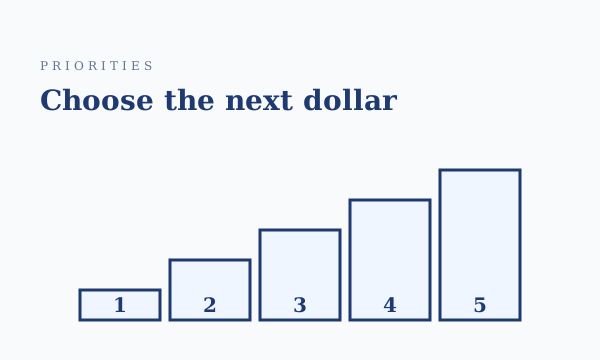
One of the most common causes of stalled financial progress is doing the right things in the wrong order — investing in a taxable account while carrying credit-card debt at 22% interest, or overpaying a low-rate mortgage while ignoring an employer 401(k) match. A defensible order of operations, followed loosely, produces better outcomes than an elegant plan followed inconsistently.
This guide lays out a widely used sequence, roughly ordered by the guaranteed return each step delivers. Individual circumstances change the details, but the general order holds up well for most US households.
Step 1: A $1,000 starter emergency fund
Before anything else, park a small buffer of $500 to $1,000 in a savings account. This is not the full emergency fund — it is a shield to prevent the next surprise from becoming a credit-card balance. Without this, every unexpected expense sets progress back to zero, no matter how good the later steps are.
Step 2: Capture the full employer retirement match
If your employer offers a 401(k) or similar match, contributing enough to receive the full match is usually the highest-return step available anywhere. A 50% or 100% match is a guaranteed return you cannot replicate anywhere else. Passing on the match to prioritise anything else is almost always a mistake.
Step 3: Eliminate high-interest debt
Debt with interest rates above roughly 8% (and especially above 15%) is a guaranteed negative return that grows automatically. Paying off a 20% APR credit card is mathematically equivalent to earning a 20% guaranteed return, which no investment reliably matches. Attack this debt aggressively using the snowball or avalanche method until it is gone.
Step 4: Complete the full emergency fund
Grow the emergency fund from the $1,000 starter to three to six months of essential expenses (more if you are self-employed or a sole earner). Hold it in a high-yield savings account, separate from your everyday chequing. With this in place, most future financial surprises stop being emergencies.
Step 5: Contribute to tax-advantaged retirement accounts
With debt handled and cash secured, increase retirement contributions beyond the match. In the US, a common priority within this step is: max out an HSA if eligible (triple tax advantage), then max a Roth or Traditional IRA (whichever fits your tax situation), then continue contributing to the 401(k) up to the annual limit. Aim for total retirement savings of at least 15% of gross income across all accounts.
Step 6: Save for medium-term goals
Once retirement is on track, redirect surplus toward medium-term goals like a home down payment, a paid-off mortgage, or funding children's education. The right tool depends on the timeline: HYSAs and short-term bonds for goals within three years; a mix of stocks and bonds for goals five to ten years out; broad index funds for goals a decade or more away.
Step 7: Additional investing and wealth building
After everything above is on track, additional savings can go into a taxable brokerage account for long-term wealth building, real estate, or business ventures. This is where financial life becomes more personal — the "right" allocation depends more on goals and temperament than on a universal formula.
Why the order matters
Skipping ahead almost always costs money. Investing at a hoped-for 7% while carrying 22% credit-card debt is guaranteed to underperform paying the debt. Overpaying a 4% mortgage while ignoring a 100% employer match forfeits a return no market can match. Following the sequence loosely — the exact percentages matter less than the order — is the single most reliable way to make financial progress.
Choose the next dollar by risk and return
For each possible use of money, write the guaranteed benefit, liquidity lost, deadline, and consequence of waiting. Capturing an employer contribution may offer an immediate contractual return; paying a very high-cost debt gives a guaranteed interest saving; building a starter buffer prevents the next shock from returning to debt. Long-term investing has uncertain returns and should not be compared as though they were guaranteed.
The sequence changes when basic safety is at risk. Overdue housing, essential utilities, required insurance, court obligations, and minimum debt payments come before optimisation. After that floor, build a starter reserve, capture clearly understood matching benefits, remove toxic-rate debt, complete the emergency reserve, and then expand long-term goals. Local law and employment terms can alter that order.
Resolve conflicts with a split rather than paralysis
When two priorities are both urgent, set a temporary percentage split and an exit rule. For example, direct most surplus to expensive debt while a smaller amount grows the starter buffer until it reaches one month of essentials; then redirect that share. Write the trigger in advance. Without an exit rule, a temporary compromise quietly becomes permanent.
Review after interest-rate changes, employer benefit changes, a new dependant, relocation, or loss of income. Do not treat a flowchart as personalised advice: taxes, debt enforcement, pensions, health costs, and social insurance differ sharply. The framework organises questions; current local terms determine the answer.
Why sequence matters more than optimisation
Personal finance advice often focuses on individual tactics — the best credit card, the highest-yielding savings account, the ideal asset allocation. This misses a bigger truth: the sequence in which you address financial priorities matters more than optimising any single one. A perfectly optimised investment portfolio inside a household with no emergency fund and high-interest debt is a house built on sand. Sequence, not sophistication, is where most households find leverage.
The right order is not arbitrary. It follows from the mathematics of guaranteed versus expected returns, the psychology of financial stress, and the reality that finite time and mental bandwidth force triage. Each priority in the sequence unlocks the ability to focus on the next; skipping steps usually produces worse outcomes even if the "skipped" step seems less important than the "advanced" one.
Priority 1: A starter emergency fund of $1,000-2,000
The very first priority is a small emergency reserve. Not a full 3-6 month fund — that comes later — but enough to handle the routine surprises that would otherwise force credit card debt: a car repair, a medical co-pay, a broken appliance, an urgent travel need. For most US households, $1,000-2,000 covers 80% of these events. The number is deliberately achievable: waiting until you can save six months of expenses before addressing debt or investing means most people never start.
Build this reserve in weeks, not months. Cut discretionary spending temporarily, sell items you do not use, take on temporary extra work if possible. The reserve is the foundation that lets everything after it work: it prevents new debt during a shock, which lets you actually pay down existing debt; it removes low-grade financial anxiety, which lets you focus on longer-term decisions. Skipping this step and going straight to debt payoff or investing usually results in returning to the starter reserve step every 3-6 months when a shock forces new debt.
Priority 2: Capture the full employer retirement match
If your employer matches retirement contributions, contribute at least enough to capture the full match before addressing any other priority except the starter emergency fund. This is the single highest guaranteed return available to most workers. A 100% match on your first 3% of pay is a 100% instant return — mathematically superior to paying down any debt at any rate. A 50% match is a 50% instant return. Even a partial match usually beats every other option except the starter emergency fund.
The match takes priority even over high-interest debt because the match is a limited-time offer. If you do not contribute enough to capture the match in this pay period, that match is gone permanently. High-interest debt will still be there next month at only slightly more interest. The math strongly favours capturing every available match dollar even while continuing minimum payments on debt.
Verify the specifics of your employer’s match. Common structures: dollar-for-dollar match up to X%, 50 cents on the dollar up to X%, tiered matches (100% on first 3%, 50% on next 2%). Some employers also make non-elective contributions regardless of employee contribution. Read the Summary Plan Description or ask HR in writing — the specifics of your plan matter more than any generic advice.
Priority 3: Eliminate high-interest debt (typically above 8-10% real interest)
After the starter fund and employer match, focus on eliminating high-interest debt. The threshold "high-interest" is subjective, but reasonable rules of thumb suggest anything above 8-10% real interest (after subtracting expected inflation). This includes almost all credit card debt, payday loans, most personal loans, and some auto loans. It usually excludes mortgages (often below inflation-adjusted breakeven), federal student loans (moderate rates with borrower protections), and low-rate car loans.
The debt avalanche method (highest rate first) minimises total interest paid; the debt snowball (smallest balance first) may improve completion rates for borrowers who need psychological momentum. Choose based on your history: if you have failed at debt payoff before, snowball may fit better; if this is your first serious attempt and you are motivated by math, avalanche is optimal. Either way, this priority typically takes 12-36 months and requires consistent focus.
While paying down debt, resist the urge to invest beyond the employer match. Investing money at a hoped-for 7% while paying 22% on credit card debt is a guaranteed losing trade. The exception is if the debt is very close to being paid off (within 3-6 months) and you want to maintain investing habits during the transition.
Priority 4: Complete the emergency fund to 3-6 months of expenses
Once high-interest debt is eliminated, complete the emergency fund to 3-6 months of essential expenses. The exact target depends on income stability, dependents, insurance coverage, and industry conditions. Dual-income households in stable industries with strong disability insurance may target 3 months; single-earner households with dependents in cyclical industries may target 6-9 months; self-employed workers with variable income may target 9-12 months.
This is a much larger sum than the starter fund and takes longer to build — typically 6-18 months of consistent contributions. Hold it in a high-yield savings account, separate from daily transaction accounts, with immediate liquidity. Do not invest emergency reserves; the whole point is that the balance should not fall when you need it.
Priority 5: Max out tax-advantaged retirement accounts
With emergency fund complete and high-interest debt eliminated, expand retirement contributions beyond the match. Priority order within this bucket: (1) health savings account (HSA) if eligible, because it offers triple tax advantages; (2) Roth or Traditional IRA up to annual limit, choosing based on tax situation; (3) additional 401(k) contributions up to the employee annual limit.
The HSA-first priority surprises many people. When used for qualified medical expenses, HSA contributions are pre-tax, growth is tax-free, and withdrawals are tax-free — the only account structure with all three advantages. Pay current medical expenses from cash flow and let the HSA grow untouched as a long-term investment account, saving receipts for future reimbursement. This maximises the tax-free growth window.
Priority 6: Pay off moderate-interest debt and address other financial goals
After maxing tax-advantaged retirement accounts, address moderate-interest debt (typically 4-8%) and other financial goals: house down payment, children’s education, larger emergency reserves, taxable investment accounts. The specific priority within this bucket depends on individual circumstances: a borrower with 5% student loans and a plan to buy a house in 5 years may prioritise the down payment; one with the same debt and no housing goal may focus on debt elimination.
For low-rate mortgages, aggressive payoff is usually suboptimal compared to investing the same money in diversified assets over long periods — the historical spread favours investing. This changes when interest rates rise significantly or when the borrower approaches retirement and wants housing costs eliminated for cash flow reasons. There is no universal answer; the individual math and psychology matter.
Priority 7: Long-term wealth building and specialised goals
Once all prior priorities are addressed, remaining income goes to long-term wealth building. Options: additional taxable investment contributions, larger real estate investments, business investments, larger children’s education funds, or lifestyle improvements. This is the priority level where advice becomes genuinely personal — there is no universally correct allocation because goals themselves become the primary variable.
This priority level is also where estate planning enters seriously: wills, trusts, insurance beyond term life, and generational wealth transfer become worth professional attention. Households reaching this level typically benefit from a fee-only financial advisor and an estate attorney, both of whom charge flat fees rather than percentages of assets.
When priorities need to be adjusted
The sequence above assumes typical circumstances. Real households have edge cases. If you have dependents but no life insurance, term life insurance jumps to Priority 2. If you have no disability insurance and depend on your income, disability coverage jumps ahead of retirement contributions. If a specific short-term goal (surgery, education, family emergency) requires cash within 1-2 years, that goal may temporarily displace long-term investing.
Also, priorities are not always sequential; some households can address multiple priorities simultaneously with sufficient income. A high earner may capture the full match, pay down debt aggressively, and complete an emergency fund all at once. The sequence matters most for households where trade-offs are required — which is most households.
Common priority mistakes
The most common mistake is investing in taxable accounts before capturing the employer match. This is mathematically indefensible: leaving free money on the table to fund a taxable investment account is a loss. Capture the match first, always.
The second common mistake is refusing to invest until debt is eliminated. For a borrower with $50,000 in student loans at 5%, waiting 10 years to start investing means giving up a decade of compounding — usually far more valuable than the interest saved by aggressive payoff. Balance debt reduction with retirement contributions rather than treating them as either/or.
The third mistake is treating the priority list as a competition to reach the highest priority. The goal is not to reach Priority 7; the goal is to sustainably progress through the priorities that apply to your situation. A household stuck at Priority 3 (paying down debt) for 3 years but doing it consistently is winning; a household that jumped to Priority 5 while still carrying credit card debt is losing regardless of how sophisticated the investing looks.
Sources and methodology
We use primary and authoritative sources for rules, definitions, and data. Sources and factual claims were last checked September 3, 2026.
- Financial education — OECD (Global)
- An essential guide to building an emergency fund — Consumer Financial Protection Bureau (United States)
- Introduction to investing — Investor.gov, U.S. Securities and Exchange Commission (United States; concepts broadly applicable)
Frequently asked questions
- What if I cannot afford both the 401(k) match and the starter emergency fund?
- Do both, small. Contribute the minimum needed to capture the match while directing everything else at the $1,000 starter. Neither takes long at typical incomes.
- At what interest rate should I invest instead of paying off debt?
- A common rule of thumb is below 6–8% — but personal risk tolerance matters. Debt with a guaranteed cost above the expected long-term return on investments is generally worth paying off first.
- Should I follow this order strictly?
- Not rigidly. Use it as a default and deviate for good reasons. The order captures the general priority; your specific situation may justify small shuffles.
Related articles
How Much Emergency Fund Do You Really Need?
The standard "three to six months of expenses" is a starting point, not a rule. Here is how to size your emergency fund based on your real situation.
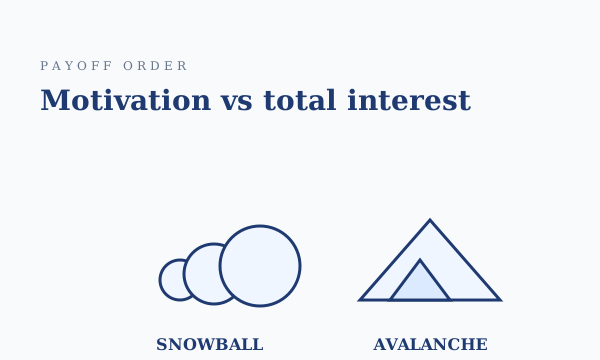
Debt Snowball vs Avalanche: Which Pays Off Debt Faster?
Two popular strategies, one goal: becoming debt-free. Here is how each works, a worked example, and how to choose the one you will actually stick with.
How to Start Investing With $100
You do not need thousands to begin. Here is a beginner-friendly path to putting your first $100 to work — and why starting small still matters.