Saving
How Much Emergency Fund Do You Really Need?
The standard "three to six months of expenses" is a starting point, not a rule. Here is how to size your emergency fund based on your real situation.
Last updated September 3, 2026
Most personal finance guides repeat the same advice: keep three to six months of expenses in an emergency fund. That guidance is not wrong, but it is incomplete. Three months of expenses for a salaried renter with no dependents is a very different number from three months for a freelancer supporting a family, and the "right" figure depends on how stable your income is and how many people rely on it.
This guide walks through a repeatable method to size your own emergency fund, decide where to hold the money, and build it in stages that stay achievable even on a modest income.
What an emergency fund actually is
An emergency fund is money set aside specifically for unexpected, necessary expenses — a job loss, an urgent car repair, a medical bill, or a sudden increase in essential costs. Its purpose is not to earn a return; it is to be available immediately, without forcing you into high-interest debt. In practical terms, that means the money should be liquid (accessible within a day, without penalty) and stable in value (not exposed to market swings).
The Consumer Financial Protection Bureau reports that roughly one in four Americans has no emergency savings at all, and about 40% cannot cover a $400 unexpected expense from cash. Closing that gap is the single highest-leverage financial move most households can make.
Step 1: Add up your essential monthly expenses
Start with the costs required to keep your household running: housing, utilities, groceries, transportation to work, insurance premiums, and minimum debt payments. Leave out discretionary spending — dining out, subscriptions you could pause, travel, and non-essential shopping. The goal is a realistic bare-bones number, not a comfortable one.
A worked example
Assume essentials look like this: rent $1,400, utilities $180, groceries $450, transportation $200, insurance $220, and minimum debt payments $150. That totals $2,600 per month. A three-month fund is therefore $7,800 and a six-month fund is $15,600. Those two figures define a realistic range for a person with that budget.
Step 2: Choose your multiplier
Use the low end of the range (about three months) if your income is stable, you have no dependents, and comparable work is easy to find in your field. Move toward six months or more if you are the sole earner in a household, if you have dependents, if you work on commission or freelance, or if job searches in your industry commonly take longer than three months. People with irregular income should lean high — variability is precisely what an emergency fund is meant to absorb.
For self-employed workers, contractors, and business owners with lumpy revenue, nine to twelve months of essentials is often more appropriate. The extra buffer reduces the pressure to accept unfavourable clients or projects during a slow period.
Step 3: Decide where to keep it
Emergency savings belong in a high-yield savings account (HYSA) that is separate from your everyday checking. Separation reduces the temptation to spend the balance on non-emergencies, and a HYSA earns meaningful interest while keeping the money fully liquid. Certificates of deposit (CDs) and money market accounts can work as a partial home for the fund, but only if you understand the withdrawal rules and keep at least one month of essentials in a plain savings account for instant access.
The one place emergency money does not belong is the stock market. The whole point is that the balance should not fall when you need it, and market downturns often coincide with the same macroeconomic events (recessions, layoffs) that trigger household emergencies.
Step 4: Build it in stages
A large target can feel impossible if you look at it as one number, so break it into milestones. Stage one is a $1,000 starter buffer, enough to cover common small surprises. Stage two is one full month of essentials. Stage three is your full target from Step 2. Automate a fixed transfer on payday so saving happens before you can spend the money — even $50 to $100 per paycheque compounds into meaningful security over a year.
If you also carry high-interest debt (credit cards above roughly 15% APR), build only the $1,000 starter buffer first, then aggressively pay down the debt before returning to grow the fund. Paying 22% interest to hold cash earning 4% is a losing trade in most cases.
Common mistakes to avoid
Three mistakes appear again and again. First, keeping the fund in the same account you spend from, which allows it to be quietly drained. Second, investing the fund in stocks or crypto and losing access when markets fall. Third, sizing the fund off gross income rather than essential expenses, which inflates the target and stalls progress before it starts.
Once the fund is in place, your financial life becomes noticeably calmer. You can then focus on the next priorities — paying down remaining debt, contributing to a retirement account, and building longer-term investments — knowing that a surprise expense will not derail those plans.
A stress-test is better than a universal number
Treat three or six months as a starting hypothesis, not a command. List the events the fund must absorb: a job gap, urgent travel, a health deductible, essential repairs, or a temporary interruption to benefits. Estimate both the cost and how quickly cash would be needed. A household with two stable incomes may reasonably hold less than a sole earner with dependants, seasonal work, or limited insurance, even when their monthly spending is identical.
Run a simple runway test. Divide liquid emergency savings by essential monthly spending, excluding savings contributions and costs you could pause immediately. Then model a bad month rather than an average month: add likely deductibles, minimum debt payments, and any currency conversion needed if obligations sit in another country. That produces a defensible range instead of a round target copied from someone else.
Separate emergencies from predictable irregular costs
Annual insurance premiums, school fees, routine maintenance, holidays, and known tax bills are not emergencies. Put them in sinking funds with their own deadlines. Mixing them into one balance creates false confidence: the number may look healthy even though most of it is already committed. Keep a small operating buffer in the transaction account, sinking funds for known dates, and a distinct emergency reserve for genuinely uncertain shocks.
Review the target after a move, new dependant, job change, insurance change, or large debt payoff. Do not chase yield with money you may need tomorrow. The useful hierarchy is safety, access, currency match, and only then return. Verify the local deposit-guarantee scheme and withdrawal rules rather than assuming a bank-like product is protected.
How much cash is enough — a structured method
A single number like three months or six months is a starting hypothesis, not a decision. The useful method is a stress-test: list the specific events the fund must absorb over a realistic recovery window, estimate the cost of each, note how quickly the cash would be needed, then compare that to essential monthly spending. Two households with the same paycheque can land on very different targets once dependants, insurance quality, notice periods, and job-market conditions enter the picture.
Break essential spending into non-negotiable, near-non-negotiable, and pausable. Rent or mortgage, utilities, groceries, minimum debt payments, insurance premiums, and essential transport are non-negotiable. Childcare, medications, and communication typically fall into near-non-negotiable. Subscriptions, dining out, and discretionary shopping are pausable. Multiply the first two groups by the number of months you expect to need cover, then add likely one-off shocks such as an insurance deductible, a car repair, or an unavoidable travel cost.
Model at least three scenarios: a short income gap of one month, a longer gap of three to six months, and a compound event such as an income loss combined with a health issue or urgent home repair. Sum the required cash for each scenario, subtract reliable secondary income and any short-term benefit you have actually confirmed you would receive, and use the largest realistic scenario as your working target. Write down every assumption so you know exactly what must change when your situation changes.
A three-tier structure that mirrors how emergencies unfold
Real emergencies rarely arrive as a single event that needs one big withdrawal. They arrive in waves — an unexpected bill, then a follow-up cost, then a longer disruption. A tiered structure matches this pattern. Tier one is a small operating buffer of one to two weeks of essential spending that sits in the checking or transaction account and absorbs everyday timing shocks such as an early bill or a late paycheque. Tier two is one to three months of essential spending in a high-yield savings or money market account with same-day access. Tier three is the deeper reserve for the low-probability, high-impact event.
Tiering also protects against psychology. When every dollar sits in one balance, it is tempting to interpret a healthy total as spending room. When money is labelled by purpose and held in different accounts, the friction of transferring reminds you to justify each move. Behavioural friction is not a moral judgement; it is a tool for people who know honest human tendencies do not disappear just because someone reads a personal finance article.
Keep sinking funds — for known future bills such as insurance renewals or property taxes — completely separate. Mixing predictable annual bills into an emergency reserve creates false confidence: the account balance may look adequate while most of it is already committed to invoices arriving in the next quarter. A spreadsheet with dated categories, an app envelope, or a second savings account all work; the requirement is that no category can spend money that already belongs to another category.
Where to hold the money without losing sleep or purchasing power
Prioritise safety, speed, and currency match before yield. Safety means the institution is regulated and the account is covered by a deposit-insurance scheme up to a defined limit. In the United States that is the FDIC for banks and the NCUA for credit unions; other countries have their own schemes, and confirming your country’s protection is the reader’s job, not an assumption an article can make for you. Speed means you can retrieve the money in hours or a day, not weeks. Currency match means the money is denominated in the currency you owe your bills in.
A high-yield savings account is a common home for the tier-two portion because it usually combines protection, liquidity, and reasonable interest. Money market funds and short-term treasury products can work for parts of tier three, but the details matter: some money market products are not deposits and are not insured in the same way, and their liquidity can worsen during exactly the kinds of market events that create household emergencies. If a product’s prospectus or terms require you to understand liquidity gates or notice periods, treat that as a signal to keep at least tier one and tier two in simpler accounts.
Do not stretch for yield by locking cash into long certificates of deposit, brokered notes with penalty periods, or investments with price volatility. Extra yield is only useful if you can access the money when you need it. Inflation erodes cash, but a 1% real loss on money you can spend is better than a 10% paper loss on money you cannot touch during the exact week you need it. This is why an emergency fund is a safety plan, not an investment plan, and why the two should live in separate columns of your net-worth statement.
Building the fund without stalling every other goal
Order matters when cash flow is tight. Aim first for a starter reserve of 500 to 1,000 units of local currency, or one month of the absolute essential spend, whichever is larger. This alone breaks the loop of using credit to smooth ordinary shocks and can meaningfully reduce interest paid on existing debt over a year. Automate the transfer on payday so the decision is made once, not thirty times a month.
While completing the deeper reserve, split surplus cash between the emergency fund and the highest-priority financial goal — typically capturing an employer retirement match if one exists, or clearing very high-interest debt. A common split is 70% to the reserve and 30% to the priority goal until the reserve reaches one month, then shifting to 50/50 until three months, then reversing until the reserve is complete. Whatever split you choose, write it down; a split without an exit rule quietly becomes permanent and you will look up in a year to find neither goal complete.
When a windfall arrives — a tax refund, a bonus, a reimbursement — apply a pre-agreed rule instead of deciding in the moment. For example, 50% to the emergency fund until complete, 30% to a debt or investing goal, 20% to a small guilt-free item. Rules like this prevent both the guilt of never enjoying money and the drift of always spending it. Windfalls are the fastest way to build a reserve; do not squander them on undirected splurges you cannot even remember six months later.
Rules for using the fund without treating it as a slush account
Before you touch the reserve, write a two-line justification: what happened, and why this is not a predictable cost you should have already funded. If the cost is predictable — for example a car service, an annual insurance premium, or a school fee — the withdrawal is a signal that a sinking fund is missing, not that the emergency reserve is broken. Fix the sinking-fund gap after the immediate cost is handled so the pattern does not repeat.
When you spend from the fund, schedule replenishment the same day. Reduce optional spending, redirect one automated goal contribution temporarily, and set a target date to restore the balance. If the withdrawal was large, decompose the repayment into pay-period-sized transfers rather than pretending it will happen “when things settle down.” Emergencies are rarely followed by long calm periods; treat replenishment as the second half of the same event.
Review the target after every significant life change: a new dependant, a house move, an insurance change, a career shift, a country change, or a large debt payoff. Each of these can raise or lower the required reserve. Emergency funds are not a museum exhibit; they are a living number attached to the specific shape of your life this year.
Common failure modes and how to avoid them
The first failure is treating the number as motivational rather than mathematical. A random six-month target that ignores real household costs will either be discouragingly large or dangerously small. Always calculate from your own numbers. The second failure is holding the fund in the same account as everyday spending, which erases the psychological boundary and quietly turns emergency money into overspending capacity by the third week of the month.
The third failure is refusing to invest anything until the reserve is “perfect,” which for many people means never. A starter tier that covers common shocks, combined with capturing an employer retirement match and paying down toxic-rate debt, is usually better than an aggressive all-cash phase that delays long-term compounding for years. The fourth failure is chasing yield with money you actually need — moving the reserve into a stock portfolio or crypto because a friend’s account rose 40% last year. The purpose of the reserve is stability, not return.
The fifth failure is silence about the reserve within the household. A partner who does not know it exists cannot use it in an emergency, and a partner who assumes it is spending money will treat it that way. Agree on the purpose, the trigger conditions, and the replenishment rule together, and revisit those agreements once a year. Money conversations are easier when they are scheduled and expected.
Sources and methodology
We use primary and authoritative sources for rules, definitions, and data. Sources and factual claims were last checked September 3, 2026.
- An essential guide to building an emergency fund — Consumer Financial Protection Bureau (United States)
- Financial education — OECD (Global)
- Deposit insurance at a glance — Federal Deposit Insurance Corporation (United States)
Frequently asked questions
- Should I build an emergency fund or pay off debt first?
- Build a small $1,000 starter buffer first so a surprise does not push you deeper into debt, then focus on high-interest debt (roughly 15%+ APR). Once that is under control, grow the fund to your full target.
- Where should I keep my emergency fund?
- In a high-yield savings account (HYSA) that is separate from your everyday checking. It stays fully liquid, earns interest, and the separation reduces the temptation to spend it.
- Is three months of expenses enough?
- It can be if your income is stable and no one depends on you. Sole earners, people with dependents, and anyone with variable income should aim for six to twelve months.
- Does a high-yield savings account really make a difference?
- Over a $10,000 balance, the difference between a 0.5% traditional savings account and a 4.5% HYSA is roughly $400 per year — meaningful money for a fund you would keep for years.
Related articles
High-Yield Savings Accounts: How They Work and How to Choose One
High-yield savings accounts pay roughly ten to twenty times more interest than traditional bank accounts. Here is how they work, how they are insured, and how to pick a good one.
Sinking Funds: The Budgeting Trick That Stops Big Bills From Blindsiding You
Annual insurance, car maintenance, holiday spending — the expenses that wreck budgets are the ones that are large but predictable. Sinking funds solve that problem.
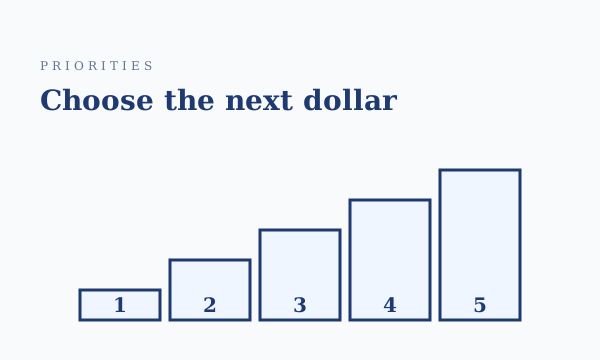
The Right Order of Financial Priorities (Most People Get This Backwards)
A practical order of operations for money — from a starter emergency fund to long-term investing — that avoids the common mistake of skipping cheap wins for flashier ones.