Saving
Sinking Funds: The Budgeting Trick That Stops Big Bills From Blindsiding You
Annual insurance, car maintenance, holiday spending — the expenses that wreck budgets are the ones that are large but predictable. Sinking funds solve that problem.
Last updated September 3, 2026
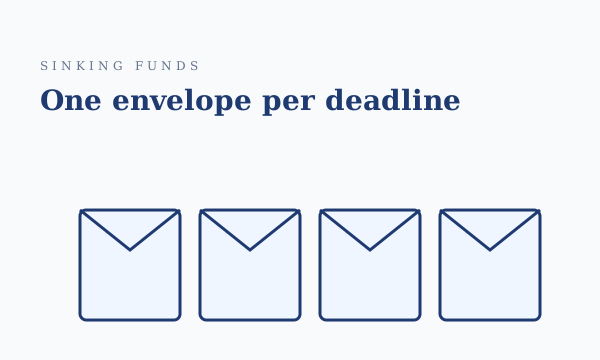
If you have ever felt like your budget works fine most months and then falls apart in a single expensive week, you have run into the core problem sinking funds solve. Some expenses are not truly "unexpected" — they are predictable but infrequent, and if you treat each one as a surprise you will keep raiding your savings or reaching for a credit card.
A sinking fund is a small, purpose-labelled savings pot that you feed a little each month so the money is already waiting when the bill arrives. It is one of the simplest, most effective budgeting techniques available.
How a sinking fund works
Pick an expense you know is coming — say, $1,200 of annual car insurance. Divide it by twelve: $100 per month. Transfer that $100 into a dedicated savings pot every month. When the annual bill arrives, the money is already there and your regular budget is untouched.
The concept is not new — accountants have used sinking funds for over a century to plan for large future liabilities. Applied to a household budget, it turns "big surprise expenses" into ordinary monthly line items.
Which expenses deserve a sinking fund
Any expense that is large, predictable, and infrequent is a candidate. Common examples include annual or semi-annual insurance premiums, property or vehicle taxes, car maintenance and tyres, medical and dental copays, holiday and gift spending, back-to-school costs, and travel. Even irregular items like eyeglasses every two years or a new laptop every four years benefit from a small monthly contribution.
A realistic starter set
You do not need a fund for everything. A useful starter set for most households is four funds: car (maintenance, tyres, registration), home (repairs, appliance replacement), gifts and holidays, and medical. Together, these usually cover the majority of surprises that would otherwise blow up a monthly budget.
Where to hold them
Keep sinking funds in a high-yield savings account, separate from your everyday chequing account. Many online banks let you create multiple named "buckets" or sub-accounts inside one HYSA, which lets you track each fund without opening several accounts. If your bank does not offer that feature, a simple spreadsheet listing balances is enough.
Do not keep sinking funds in chequing. The whole point is that the money is labelled and untouched until the expense actually arrives.
A worked example
Assume a household expects the following annual expenses: $1,200 car insurance, $800 car maintenance, $600 holiday spending, $500 medical, and $600 home repairs. That totals $3,700 per year, or roughly $308 per month split into five sinking funds. Instead of five separate financial shocks, the household has one steady $308 monthly contribution and never has to guess how to pay for the next known bill.
How sinking funds change how a budget feels
The biggest benefit of sinking funds is psychological. When large expenses stop feeling like emergencies, you also stop dipping into your emergency fund for things that were never truly emergencies. That preserves your real emergency reserve for genuine surprises — a job loss, a serious medical event — and makes the rest of the budget dramatically more stable.
Build each fund from a date and a probability
For a known bill, subtract what is already saved from the expected amount and divide by the pay periods remaining. For an uncertain but recurring cost—repairs, medical co-payments, gifts—use several years of actual spending or a conservative estimate, then contribute monthly. Add a margin where prices are volatile. The label matters less than making the amount, deadline, and funding rule visible.
Prioritise by consequence. Housing, insurance, taxes, essential transport, and unavoidable professional fees belong ahead of optional travel or upgrades. If cash is tight, fully fund the highest-consequence item instead of putting a token amount into ten categories. A sinking fund is a plan for a cost, not permission to spend it when the purpose disappears.
Reconcile the plan without raiding emergencies
At month-end, compare each balance with its target path. If a cost arrives early, adjust future contributions or reduce a lower-priority category; record the transfer so the trade-off stays visible. When a bill is lower than expected, decide deliberately whether the surplus rolls forward, moves to another known obligation, or returns to general savings.
Keep predictable costs separate from the emergency fund even if the bank shows one combined balance. A spreadsheet, ledger, or app category is enough. The control is that total category allocations never exceed the actual cash in the account. For variable income, fund the next due dates after every payment rather than waiting for an ideal monthly schedule.
What sinking funds solve that generic saving does not
A sinking fund is money set aside now for a specific, known future cost. Its power comes from separation: because the money is labelled and reserved, it does not accidentally become spending capacity when a good sale appears or a spontaneous plan tempts you. Generic saving fails not because people lack discipline but because everything looks fungible in a single account. Naming the money changes behaviour more reliably than resolving to be more careful.
A sinking fund also protects the emergency fund. When the annual insurance premium, the vehicle service, or the school fee is handled by its own funded envelope, the emergency reserve is not raided for events that were never surprises. Emergencies stay for genuine surprises: illness, urgent travel, job loss, storm damage, an unexpected legal or medical cost. That separation is what keeps both accounts credible over time.
Designing the fund from a date and an amount
Every sinking fund starts with two numbers and one deadline. Estimate the expected cost using last year’s bill or a conservative range. Note the exact date the cost is due. Divide the remaining amount to save by the number of pay periods before that date. That gives the per-pay-period contribution. Recalculate after every price change and after any missed contribution instead of pretending the original schedule still works.
For irregular events with unknown timing — home repairs, medical co-payments, gifts — use three-year historical spending as a base. If you have no history, use a conservative estimate and add a small margin. It is better to overshoot slightly and roll the surplus forward than to run short. Track actual spending against the estimate; the third year of data usually tells the truth.
Priorities when there is not enough money for every fund
Rank funds by consequence of missing the cost. Housing-related bills, tax, insurance renewals, and required professional or licence fees are near the top because non-payment triggers penalties, interest, or loss of coverage. Vehicle maintenance and preventive health care come next; delaying them tends to increase eventual cost. Discretionary categories such as holidays or gifts sit lower and can absorb reductions without a lasting problem.
Fully fund the highest-consequence item before spreading token amounts across many envelopes. A partially funded critical bill still creates a shortfall on the due date; a fully funded critical bill produces a quiet, uneventful payment day. When cash tightens, pause the lowest-priority envelope entirely rather than starving every category. Silence the temptation to “save a little in every direction” — that is the emotional response, not the mathematical one.
Digital, cash, and hybrid implementations
Digital envelopes live inside an app, a spreadsheet, or a bank that supports labelled sub-accounts. They automate contributions, sync with statements, and reduce paper handling. They can also become invisible; if you never look, they stop influencing decisions. Set a weekly or fortnightly review moment to confirm balances match the plan, or the ledger will drift silently.
Physical cash envelopes work well for tight variable categories such as food, personal spending, or entertainment. Friction is the feature: handing over paper feels different from tapping a card. But cash is inconvenient for online purchases, can be lost or stolen, and creates reconciliation work. Most households do best with a hybrid: automated digital envelopes for fixed obligations, physical or app-based envelopes for the two or three categories that repeatedly drift.
Reconciliation, rollover, and honest reporting
At least monthly, reconcile envelope balances to the actual account cash. The total across envelopes must never exceed available cash minus committed but not yet posted spending. If it does, an envelope is quietly overspent. Fix by moving money from a lower-priority envelope and record the transfer with a date and reason; a paper trail preserves lessons for next year’s planning.
Rollover decisions must be intentional. If a fund ends the month under budget, decide whether the surplus stays in that fund, moves to a related goal, or returns to general savings. A vague policy of “keep everything” leads to inflated categories that quietly outgrow their purpose. Cost overruns need the opposite discipline: acknowledge the shortfall in writing, choose the funding source, and update the future contribution rate.
Building sinking funds when income is variable
On variable income, calendar-based contribution schedules break constantly. Instead, allocate a fixed percentage of every incoming payment to critical sinking funds before anything else, and increase it in strong months rather than deciding you have extra to spend. When a lean month arrives, protect the highest-consequence funds and pause discretionary ones. Percentages recover faster than fixed amounts.
Keep a small buffer inside each critical sinking fund to absorb timing shocks in your own income. If you rely on the exact monthly amount landing on time, one delayed invoice ruins the plan. A one-month buffer inside each critical fund is not idle cash — it is a shock absorber that keeps promises to future bills.
Common failure modes and how to avoid them
The first failure is creating too many envelopes at once. Ten new categories in one month produces spreadsheet fatigue and abandonment by week three. Start with three: the largest predictable bill, the most volatile discretionary category, and one goal. Add another only when the first three have run smoothly for two full cycles.
The second failure is treating a full envelope as permission to spend on the goal early. Sinking funds hold money for a purpose; they do not authorise the purchase before the date arrives. If circumstances change, deliberately reallocate with a written note rather than raiding silently. The third failure is combining sinking funds and emergency funds in one account without a ledger; the balance appears healthy but is over-committed.
The fourth failure is skipping post-event review. When the actual bill arrives, compare it with the estimate, note the variance, and update next year’s target. Personal finance improves through small, honest adjustments over years, not through occasional heroic revisions. Sinking funds reward maintenance more than inspiration.
Sources and methodology
We use primary and authoritative sources for rules, definitions, and data. Sources and factual claims were last checked September 3, 2026.
- Budgeting resources — Consumer Financial Protection Bureau (United States)
- Financial education — OECD (Global)
Frequently asked questions
- How is a sinking fund different from an emergency fund?
- A sinking fund is for expenses you know are coming (annual insurance, holiday gifts). An emergency fund is for genuine surprises (job loss, urgent medical). Keeping them separate protects your emergency reserve.
- How many sinking funds should I have?
- Start with three to five that cover your biggest lumpy expenses (car, home, gifts, medical, travel). Add more only if they earn their place by reducing real financial stress.
- Should sinking funds earn interest?
- Yes — hold them in a high-yield savings account. The money sits for months at a time, so even a modest yield adds up across several funds.
Related articles
How Much Emergency Fund Do You Really Need?
The standard "three to six months of expenses" is a starting point, not a rule. Here is how to size your emergency fund based on your real situation.
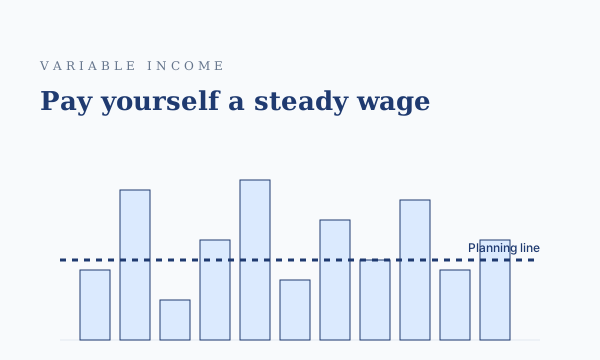
How to Budget on a Variable Income
Freelancers, contractors, and commission earners cannot budget from a steady paycheque. Here is a system that keeps a variable-income household stable month to month.
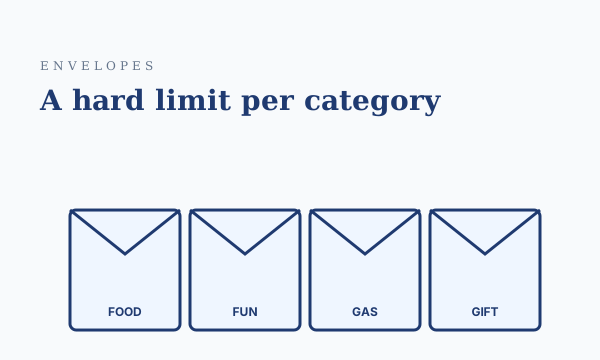
The Cash Envelope System: An Old Method That Still Works
The envelope system is a decades-old budgeting method that keeps working for one reason: the physical friction of handling cash slows down spending in ways an app cannot.