Debt
Debt Snowball vs Avalanche: Which Pays Off Debt Faster?
Two popular strategies, one goal: becoming debt-free. Here is how each works, a worked example, and how to choose the one you will actually stick with.
Last updated September 3, 2026
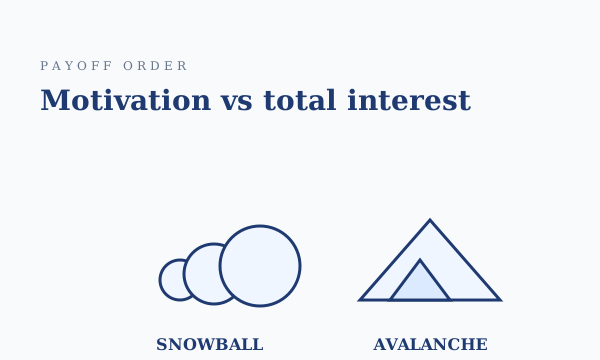
When you are paying off multiple debts, the order you tackle them in matters. Two methods dominate the conversation: the debt snowball and the debt avalanche. Both tell you to keep making minimum payments on everything and throw every spare dollar at one target debt — they just disagree on which debt to attack first.
How the debt avalanche works
With the avalanche, you list your debts from the highest interest rate to the lowest and focus all extra payments on the highest-rate debt first, while paying minimums on the rest. Once the highest-rate debt is gone, you roll its payment into the next-highest, and so on. Because you are always attacking the most expensive debt, this method minimizes the total interest you pay and usually gets you debt-free fastest on paper.
How the debt snowball works
With the snowball, you ignore interest rates and order your debts from the smallest balance to the largest. You put every extra dollar toward the smallest balance until it is gone, then roll that payment into the next-smallest. The appeal is psychological: knocking out a whole debt quickly gives you a visible win and momentum, which helps many people stay motivated. Research from the Harvard Business Review has shown that this "small wins" effect measurably improves the odds of finishing a debt-payoff plan.
A side-by-side example
Suppose you have three debts: a $500 store card at 24% interest, a $2,000 credit card at 19%, and a $4,000 personal loan at 9%. The avalanche would target the 24% store card first (highest rate), then the 19% card, then the 9% loan — saving the most interest. The snowball would also start with the $500 store card because it is the smallest balance, then move to the $2,000 card, then the $4,000 loan.
In this particular case the first target happens to be the same, but the paths diverge when the smallest balance is not also the highest rate. Imagine instead a $300 loan at 6% and a $2,500 credit card at 22%: the avalanche hits the 22% card first (saving more money), while the snowball clears the $300 loan first (delivering a fast emotional win).
So which is faster?
Mathematically, the avalanche is faster and cheaper because it eliminates the most expensive interest first. The difference is often modest for smaller debts and grows larger when high-interest balances are big. The snowball can cost a bit more in interest, but if the early wins keep you from giving up, it may get you to debt-free when a "perfect" plan would have stalled.
How to choose
If you are motivated by numbers and want to pay the least, choose the avalanche. If you have struggled to stay consistent and need visible progress to keep going, choose the snowball. You can also blend them — clear one tiny balance first for the morale boost, then switch to attacking the highest interest rate. The best strategy is the one you will still be following six months from now.
Build the debt table before choosing an order
List creditor, balance, annual rate, minimum payment, due date, rate type, security, arrears status, fees, and any promotional expiry. Keep all required minimums current while directing extra money to one target. Debts tied to housing, transport, court orders, taxes, or essential services can have consequences that override a purely mathematical ranking.
The avalanche targets the highest effective cost first and normally minimises interest when payments and rates stay as assumed. The snowball targets the smallest balance first and may create earlier account closures. Compare both with an amortisation schedule using actual terms, then quantify the extra cost of the motivational option rather than calling one method universally right.
Use a hybrid when behaviour and cost conflict
A deliberate hybrid might clear one very small balance, then switch to highest-rate debt. Write the switching rule before starting and do not reshuffle after every statement. Send windfalls according to the same rule, preserve a starter emergency buffer, and remove new borrowing access only when doing so will not disrupt essential payments.
Contact creditors early if minimums are not affordable. Ask in writing about hardship, rate reduction, term change, fee relief, and credit-reporting treatment. Verify any debt-relief provider with the local regulator and never stop paying solely because a salesperson promises negotiation. Insolvency or legal enforcement questions require qualified local advice.
The mathematical case for the avalanche method
The debt avalanche minimises total interest paid by directing extra payments to the debt with the highest interest rate first, regardless of balance size. Mathematically, this is optimal: every dollar diverted from a lower-interest debt to a higher-interest debt saves the rate differential over the remaining life of the debt. On a portfolio of three credit cards at 24%, 18%, and 15%, focused avalanche payments to the 24% card save meaningfully more interest than spreading payments proportionally or attacking the smallest balance first.
The avalanche advantage grows with rate spreads. If your highest rate is 24% and your lowest is 22%, the difference between methods is small — perhaps a few hundred dollars over the payoff period. If your rates span 8% to 29%, the avalanche can save thousands. Calculate the exact savings using an amortisation calculator before choosing a method; the answer depends on your specific rates, balances, and available extra payment amounts.
The behavioural case for the snowball method
The debt snowball, popularised by Dave Ramsey, directs extra payments to the smallest balance first regardless of interest rate. Mathematically it usually costs more in total interest than the avalanche. Behaviourally, it may cost less because closed accounts produce visible progress markers that sustain motivation over what can be a multi-year process. Research by Northwestern University (Gal and McShane, 2012) found that closing small debts first correlated with higher rates of overall debt elimination, suggesting behavioural momentum matters.
The snowball is most valuable for people who have failed at debt payoff before. If motivation is a real constraint — if you have started debt payoff and abandoned it multiple times — the psychological rewards of the snowball may be worth the modest additional interest cost. Nobody pays off zero debt at 0% interest; the theoretically optimal method that you abandon in month four is worse than the theoretically inferior method you complete in three years.
A hybrid approach that captures both benefits
A useful hybrid: identify any debt smaller than one month of your total minimum payments across all debts, and pay those off first regardless of rate. This eliminates one or two accounts quickly, providing the psychological win of the snowball. Then switch to strict avalanche ordering for the remaining debts. The behavioural momentum carries you through the mathematically optimal remainder.
Another hybrid: start with the smallest debt but only if it can be eliminated within 60-90 days. Longer than that and the psychological benefit erodes while the interest cost accumulates. This produces one quick win before switching to avalanche, without stretching the "quick win" phase into months of avoidable interest payments.
Setting up the mechanics for either method
Regardless of method, the mechanics are identical. First, list every debt: creditor, balance, minimum payment, interest rate, due date. This inventory alone is valuable — many people have never listed their debts in one place. Second, determine your total extra payment capacity beyond minimums. This is the "attack amount" that will be applied to one debt at a time. Third, choose the target debt (smallest balance for snowball, highest rate for avalanche). Fourth, pay minimums on all debts and the attack amount plus minimum on the target debt.
When the target debt is paid off, roll its minimum payment plus the attack amount to the next target. This is where the "snowball" metaphor comes from: the amount applied to each successive debt grows as prior debts eliminate their minimums. By the time you reach the largest debt, you may be attacking it with 3-5x the original attack amount, dramatically accelerating payoff of what would otherwise be the slowest debt.
When to consider debt consolidation or balance transfer instead
Debt consolidation loans combine multiple debts into a single loan with (ideally) a lower interest rate and fixed payoff timeline. Balance transfer credit cards move existing credit card debt to a new card with a 0% introductory rate for 12-21 months, usually with a 3-5% transfer fee. Both can accelerate payoff, but both require discipline to avoid re-accumulating debt on the newly available credit lines.
Consolidation makes sense when you can qualify for a materially lower rate and commit to not adding new debt during the payoff period. Balance transfers make sense when you can pay off the transferred balance within the promotional period, including the transfer fee in the math. Failing to pay off before the promotional rate ends leaves you with a large balance at a potentially higher rate than the original debt. Neither tool eliminates debt; they change the structure of the debt to make elimination easier or cheaper — but only if the underlying behaviour changes too.
Prioritising minimum payments and avoiding new damage
Never miss a minimum payment while pursuing accelerated payoff of another debt. Missed payments trigger late fees, penalty APRs (often 30%+), and credit score damage that can persist for years. Set every minimum payment on autopay from a checking account with a small buffer. Then make extra payments manually to your target debt. This structure protects against the worst-case outcomes of any temporary cash flow disruption.
Freeze new debt while executing the payoff plan. Continuing to add new credit card charges while trying to pay down old ones is like bailing water while the boat still leaks. Some people find it helpful to physically remove credit cards from wallets, delete stored payment methods from shopping sites, or use debit-only or cash-only spending for the payoff period. The specific tactic matters less than the outcome: net debt must decrease every month.
When to seek professional help
If minimum payments alone consume more than 40% of your take-home income, DIY payoff methods may not work fast enough to prevent longer-term damage. In this situation, consider non-profit credit counselling organisations (which are typically free or low-cost and can negotiate reduced rates with creditors), debt management plans, or in severe cases, bankruptcy consultation. All three have costs and consequences; all three are also legitimate tools designed for specific circumstances that regular budgeting cannot address.
Avoid for-profit debt settlement companies that charge large upfront fees and promise to negotiate debts down. Many of these operations damage credit severely, sometimes cause creditors to sue, and often result in worse outcomes than professional counselling or negotiated arrangements handled directly. The Consumer Financial Protection Bureau publishes warnings about specific patterns to avoid; check their site before engaging any debt relief service.
What happens after payoff: preventing recurrence
The single biggest failure mode of debt payoff is not the payoff itself but what happens afterward. Households that eliminated debt and then rebuilt it typically failed to address the underlying spending patterns that created the debt. Before celebrating payoff, examine why the debt accumulated in the first place: was it a one-time medical event, ongoing overspending, a business failure, income loss? The prevention plan depends on the diagnosis.
For overspending-driven debt, the prevention structure is usually: fully-funded emergency fund (3-6 months expenses), zero-based budget or envelope system, and elimination of easy access to unsecured credit (lower credit limits, remove cards from wallets, close accounts if reopening would be a serious temptation). For event-driven debt (medical, job loss), the prevention structure is emergency fund, appropriate insurance, and income diversification where possible.
Common debt payoff mistakes
The most common mistake is closing paid-off credit cards immediately. Closing accounts reduces your total available credit, which can increase your credit utilisation ratio and lower your credit score. Keep older accounts open with occasional small purchases paid in full to maintain the credit history and available credit without accumulating balances.
The second common mistake is stopping retirement contributions to accelerate debt payoff. If your employer matches contributions, the match is usually a higher guaranteed return than most debt interest saved. A 100% employer match on your first 3% of pay is a 100% return — mathematically superior to paying off any consumer debt. Maintain at least the match level while paying down debt.
The third mistake is treating the debt payoff period as permanent austerity. If the payoff will take 3+ years, sustainable habits matter more than maximum short-term discipline. Include modest discretionary spending in the plan so you do not burn out and abandon it entirely. A slightly longer payoff period with a plan you can sustain beats a shorter plan you cannot.
Sources and methodology
We use primary and authoritative sources for rules, definitions, and data. Sources and factual claims were last checked September 3, 2026.
- Debt collection resources — Consumer Financial Protection Bureau (United States)
- Credit card resources — Consumer Financial Protection Bureau (United States)
- Financial education — OECD (Global)
Frequently asked questions
- Which saves more money, snowball or avalanche?
- The avalanche saves more because it targets the highest interest rate first, reducing the total interest you pay. The snowball can cost slightly more but is easier to stick with for many people.
- Can I switch methods partway through?
- Yes. A common hybrid is to clear one small balance first for motivation (snowball), then switch to attacking the highest interest rate (avalanche).
- Should I pay off debt or save at the same time?
- Keep a small starter emergency fund so surprises do not create new debt, then focus aggressively on high-interest debt. Once high-interest debt is gone, rebalance toward saving and investing.
Related articles
Debt Consolidation: What It Is and When It Actually Helps
Debt consolidation combines several debts into one lower-rate payment. It is a useful tool for the right borrower — and a trap for the wrong one.
Balance Transfer Cards: When They Save You Money (and When They Don't)
A 0% balance transfer can save hundreds in interest — or cost you more than it saves. The difference comes down to one number and one honest question.
The Right Order of Financial Priorities (Most People Get This Backwards)
A practical order of operations for money — from a starter emergency fund to long-term investing — that avoids the common mistake of skipping cheap wins for flashier ones.