Debt
Debt Consolidation: What It Is and When It Actually Helps
Debt consolidation combines several debts into one lower-rate payment. It is a useful tool for the right borrower — and a trap for the wrong one.
Last updated September 3, 2026
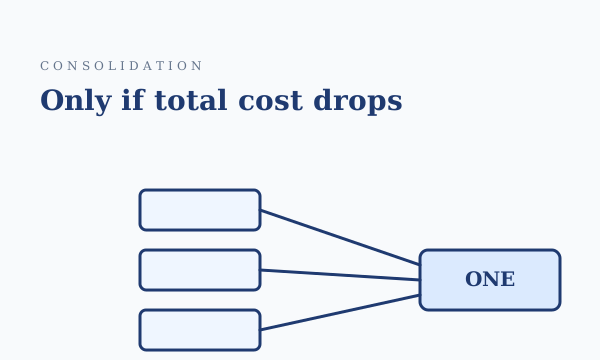
Debt consolidation is the practice of combining several debts into one new debt, ideally at a lower interest rate. Done well, it simplifies repayment and reduces total interest cost. Done poorly, it lowers monthly payments while quietly extending the debt for years and increasing what you ultimately pay.
The three most common consolidation methods
Personal loan
A personal loan from a bank, credit union, or online lender pays off your existing debts and leaves you with one fixed monthly payment at a fixed rate over a fixed term. Rates depend on your credit — a strong borrower can often qualify for a rate significantly below typical credit-card APRs. Fixed payments and a clear payoff date are the main appeal.
Balance transfer card
Moving credit-card balances onto a 0% promotional balance transfer card is a form of short-term consolidation. It works well for balances you can pay off inside the promotional period; less well when the balance is too large or the payoff plan is unrealistic. Covered in more detail in a dedicated guide.
Home equity loan or HELOC
Homeowners can borrow against home equity at rates typically lower than unsecured debt. The trade-off is significant: your home becomes collateral. Missing payments on unsecured debt hurts your credit; missing payments on a home-secured loan can put your house at risk. Home equity should never be used to consolidate unsecured debt without a firm, tested plan to avoid re-accumulating the same debt.
When consolidation actually helps
Consolidation is a genuinely good tool when three conditions hold. First, the new rate is meaningfully lower than the weighted average rate of the old debts. Second, the term is not extended so long that total interest paid rises even with the lower rate. Third, the underlying spending behaviour that produced the debt has changed — otherwise the old credit-card limits will simply fill back up.
When consolidation quietly costs more
The most common failure mode is extending a five-year credit-card payoff into a seven-year personal loan for a slightly lower monthly payment. Lower monthly payment, higher total cost. Always compare total interest paid over the full term, not just the monthly figure.
The second failure mode is behavioural. Consolidating $10,000 of credit-card debt into a personal loan leaves you with $10,000 of freshly available credit on the original cards. Without a firm rule against using them, many borrowers end up with the personal loan plus new card balances — double the debt.
Alternatives to consider
If your credit is not strong enough to qualify for a lower rate, a nonprofit credit counselling agency (accredited by the NFCC or FCAA) can set up a debt management plan that consolidates payments and often negotiates reduced rates directly with creditors. For overwhelming debt, a consultation with a bankruptcy attorney is worth the time — bankruptcy is a serious step with lasting credit consequences, but for the right circumstances it is the correct tool.
How to decide
Consolidation is worth pursuing when a lower-rate option exists, the new total interest cost is lower, and you can commit in writing not to re-borrow on the paid-off accounts. If any of those three is uncertain, focus first on stopping new debt, then on the snowball or avalanche method with what you owe today.
Compare total cost on the same payoff date
For every existing debt, calculate remaining payments under the current plan. For the consolidation offer, include origination, transfer, appraisal, legal, annual, and early-repayment fees plus the full interest schedule. A lower monthly payment can cost more when the term is extended. Compare both plans using the same target payoff date before valuing convenience.
Check whether the quoted rate is fixed or variable, conditional on automatic payment, secured by property, or only available to the strongest applicants. Prequalification is not final approval. If unsecured card debt becomes debt secured by a home or vehicle, the consequence of nonpayment becomes more severe even when the rate falls.
Fix the cash-flow cause at the same time
Close or restrict paid-off revolving accounts only after considering payment access and local credit effects, but do not treat the restored limits as new spending capacity. Build a post-consolidation budget, automate the new payment, keep a starter reserve, and direct savings from the lower required payment only according to a written plan.
Be cautious with firms that charge before delivering work, promise to erase accurate debt, tell you to stop communicating with creditors, or present settlement as consolidation. Verify licensing and complaints with the relevant authority. If required payments remain unaffordable after a realistic budget, independent debt advice or legal insolvency guidance may be more appropriate than another loan.
What debt consolidation actually accomplishes
Debt consolidation combines multiple existing debts into a single new loan or credit line. The consolidation itself does not reduce the amount owed; it changes the structure of the debt. Done well, consolidation reduces the interest rate, simplifies management to a single monthly payment, and provides a fixed payoff timeline. Done poorly, it extends the repayment period without reducing total cost, moves unsecured debt into secured debt (adding collateral risk), or frees up credit lines that get re-used to accumulate new debt on top of the consolidation loan.
The question to ask before consolidating: will the new arrangement reduce my total cost of debt (including any fees) while keeping the payoff timeline the same or shorter? If yes, consolidation likely makes sense. If the new arrangement lowers the monthly payment by extending the term without meaningfully reducing the interest rate, it is technically a "consolidation" but it may cost more over the full repayment period than the original debts.
The four common consolidation approaches
Personal loans are the most common consolidation vehicle. An unsecured personal loan (typically 2-7 years, fixed rate, fixed monthly payment) is used to pay off higher-rate credit card debts. Rates for borrowers with strong credit are often 8-15%, materially lower than the 18-29% typical of credit cards. Origination fees (0-8% of loan amount) reduce the net proceeds; factor these into the effective rate comparison.
Balance transfer credit cards offer 0% introductory rates for 12-21 months in exchange for a 3-5% transfer fee. If you can pay off the transferred balance within the promotional period, this is often the cheapest consolidation option — the transfer fee spread over 18 months is roughly a 2-3% effective rate. Failing to pay off within the promotional period leaves the balance at the go-to rate, which can be higher than the original card rates.
Home equity loans and HELOCs use home equity as collateral. Rates are typically much lower than unsecured debt (often 7-10% for HELOCs, 6-9% for fixed HELs) because the loan is secured. The catastrophic trade-off: unpaid debt can now lead to foreclosure. Converting unsecured credit card debt to secured home debt reduces monthly cost but adds severe consequences to non-payment. This tool is appropriate for disciplined borrowers with stable income; it is dangerous for borrowers whose debt accumulated due to income instability or overspending.
401(k) loans allow borrowing from your own retirement balance, typically at prime rate plus 1-2%. Interest paid returns to your account rather than to a bank, which sounds attractive but is not free money: the borrowed amount stops growing while it is out, and unpaid balances at separation from employment often become taxable distributions with penalties. This option is generally the worst choice for consolidation despite the low apparent rate.
The math: how to know if consolidation actually helps
Calculate the current total cost: for each existing debt, use an amortisation calculator to project total interest paid if you continue current payments. Sum across all debts. Then calculate the total cost of the proposed consolidation: loan amount times the rate over the full term, plus any origination or transfer fees. The consolidation only helps if the total cost is lower — often meaningfully lower, given the effort involved.
Also compare payoff timelines. A consolidation that stretches 3-year credit card payoff into a 7-year personal loan may reduce monthly payments and total interest but ties up money for years longer. The right comparison is between what you would actually do (aggressive payoff vs minimum payments) with each option, not the best-case scenario for each. Realistic behaviour, not theoretical optimisation, drives real outcomes.
Consolidation traps to avoid
The "chasing lower payments" trap: many consolidation loans reduce monthly payments primarily by extending the term. A 5-year loan replacing 3-year credit card payoffs may lower monthly payment while increasing total interest. Focus on total cost and payoff date, not monthly payment alone. Some lenders emphasise monthly savings in marketing because it sounds good but obscures the real cost.
The "credit card rebuild" trap: after paying off credit card balances with a consolidation loan, the credit lines remain open with $0 balances. Many consolidators find themselves 2-3 years later with the consolidation loan still being paid plus new credit card balances — effectively doubling their debt. If you cannot commit to freezing credit card use during the consolidation payoff, consolidation may make your situation worse rather than better.
The "hidden fees" trap: origination fees, prepayment penalties, and account fees can dramatically change the effective rate. A 9% loan with a 6% origination fee is not really a 9% loan — the effective APR is closer to 12-13%. Read the truth-in-lending disclosure that shows APR (which includes fees) rather than just the interest rate. Ask specifically about prepayment penalties; some loans charge fees for paying off early, which defeats the purpose of consolidation for many borrowers.
Debt management plans (DMPs) as an alternative
Non-profit credit counselling agencies (accredited by the NFCC or FCAA) offer Debt Management Plans that consolidate credit card payments into a single monthly payment to the agency, which distributes to creditors. The agency typically negotiates reduced rates (often 6-12%) and waived fees with creditors. DMPs are not loans — the debt is not consolidated legally, only the payment stream — and typically require closing enrolled credit cards during the plan (which does affect credit score temporarily).
DMPs work best for borrowers with moderate credit card debt who need structure and negotiated rates but do not qualify for competitive consolidation loans. Fees are typically low ($25-50 monthly). Avoid for-profit "debt settlement" companies that promise to negotiate debts down; these often damage credit severely, sometimes cause creditors to sue, and typically deliver worse outcomes than the alternatives.
When bankruptcy may be more appropriate than consolidation
If your total unsecured debt exceeds 40-50% of your annual income and you cannot realistically pay it off within 5 years even with aggressive effort, consolidation may be delaying the inevitable. Chapter 7 bankruptcy discharges most unsecured debts within a few months; Chapter 13 restructures debts into a 3-5 year court-supervised repayment plan that may include partial discharge. Both severely damage credit for 7-10 years but provide a legal fresh start.
Bankruptcy is not a moral failing; it is a legal tool designed for specific situations that regular financial planning cannot address. Consulting a bankruptcy attorney (many offer free initial consultations) before pursuing consolidation is often worthwhile if your debt situation is severe. The attorney can evaluate whether bankruptcy would produce better outcomes than years of consolidation-and-payoff, and may identify options you had not considered.
Rebuilding after consolidation
Successful consolidation ends with the loan paid off and credit lines still open but unused. This is the moment to establish the systems that prevent recurrence: fully-funded emergency fund (3-6 months expenses), zero-based budget or envelope system, and hard rules about credit card use (some borrowers commit to paying off statement balances in full every month; others use debit-only for a period). The systems matter more than the promises.
Do not close all paid-off credit cards immediately after consolidation. Closing reduces available credit and can hurt credit score by increasing utilisation ratios. Keep the oldest cards open with small recurring charges paid in full monthly. Close only cards with annual fees you cannot avoid or cards from issuers you do not want to maintain relationships with.
Common consolidation mistakes
The most common mistake is consolidating without addressing the underlying cause of the debt. If the debt accumulated because of a specific event (medical, job loss, one-time family emergency), consolidation to reduce the cost of paying it off makes sense. If the debt accumulated because of ongoing overspending, consolidation without behavioural change simply moves the debt around while allowing it to grow.
The second common mistake is consolidating multiple debts of very different rates. Consolidating a 7% student loan with a 24% credit card at a 10% consolidation rate may reduce the credit card cost but increases the student loan cost. Sometimes selective consolidation (only the highest-rate debts) works better than consolidating everything.
The third mistake is failing to compare offers. Rates and terms vary dramatically across lenders. Get 3-5 offers before committing (most personal loan providers do soft pull pre-approvals that do not affect credit score). Use the lowest rate with acceptable terms as leverage to negotiate with your preferred lender if needed.
Sources and methodology
We use primary and authoritative sources for rules, definitions, and data. Sources and factual claims were last checked September 3, 2026.
- What do I need to know about consolidating my credit card debt? — Consumer Financial Protection Bureau (United States)
- Debt collection resources — Consumer Financial Protection Bureau (United States)
- Credit card resources — Consumer Financial Protection Bureau (United States)
Frequently asked questions
- Will debt consolidation hurt my credit score?
- Short-term: usually a small dip from the hard inquiry when you apply. Medium-term: often a boost, because paying off card balances lowers your credit utilisation. Long-term: depends on whether you avoid re-accumulating debt.
- Is a debt management plan the same as debt consolidation?
- Similar in effect but different in structure. A DMP is administered by a nonprofit credit counselling agency and typically negotiates reduced rates without taking out a new loan. Your accounts are usually closed as part of the plan.
- What is the difference between debt consolidation and debt settlement?
- Consolidation pays creditors in full at a new (usually lower) rate. Debt settlement negotiates with creditors to accept less than the full amount owed. Settlement can be legitimate but carries significant credit-score damage and tax implications on any forgiven balance.
Related articles
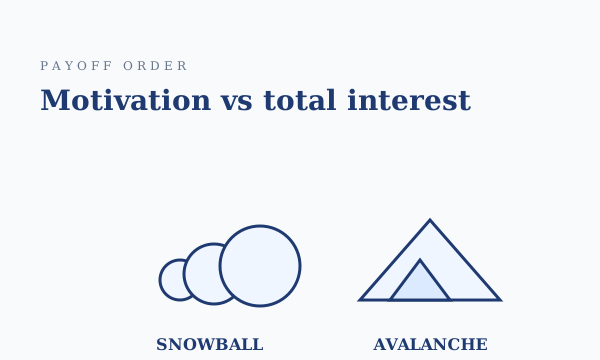
Debt Snowball vs Avalanche: Which Pays Off Debt Faster?
Two popular strategies, one goal: becoming debt-free. Here is how each works, a worked example, and how to choose the one you will actually stick with.
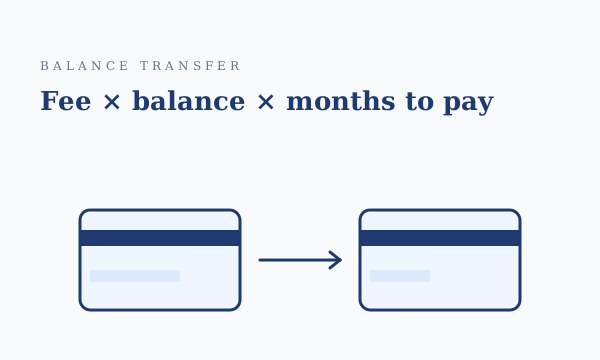
Balance Transfer Cards: When They Save You Money (and When They Don't)
A 0% balance transfer can save hundreds in interest — or cost you more than it saves. The difference comes down to one number and one honest question.
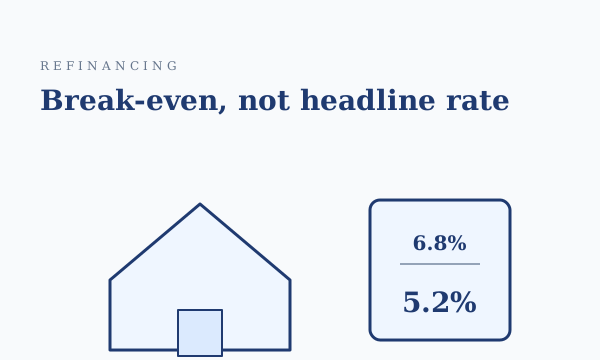
When Does It Make Sense to Refinance a Mortgage?
The old rule of "refinance if rates drop 1 percent" is a rough shorthand for a math question that has a clean answer once you calculate the breakeven point.