Debt
When Does It Make Sense to Refinance a Mortgage?
The old rule of "refinance if rates drop 1 percent" is a rough shorthand for a math question that has a clean answer once you calculate the breakeven point.
Last updated September 3, 2026
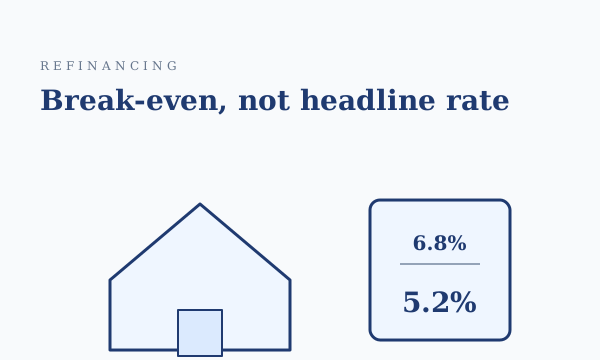
Refinancing a mortgage means replacing your existing home loan with a new one, typically at a lower interest rate. Done at the right time and for the right reason, it can save tens of thousands of dollars. Done at the wrong time, or without doing the math, it can quietly cost you money by resetting the loan clock and pushing more of your early payments back into interest.
How the math works
Two questions: what are the closing costs, and how much lower is the monthly payment? Divide the closing costs by the monthly savings to find the breakeven point in months. If closing costs are $6,000 and the new payment saves $200 per month, the breakeven is 30 months (2.5 years). If you plan to stay in the home longer than the breakeven, refinancing likely saves money.
The interest-rate rule of thumb
The old rule "refinance when rates drop 1 percent below your current rate" is a rough shorthand. A more precise version: refinance when the monthly savings times the number of months you expect to stay in the home clearly exceeds the closing costs. On a small loan balance, even a 1.5 percent rate drop may not clear the breakeven. On a large loan balance, even 0.5 percent can be worth it.
Term matters as much as rate
Refinancing to a lower rate on the same remaining term is a straightforward win if you clear the breakeven. Refinancing to a longer term (say, resetting a 30-year loan back to another 30 years) usually lowers the monthly payment but increases total interest paid, sometimes dramatically, because the loan clock restarts. If you have already paid off 8 years of a 30-year mortgage, refinancing into a fresh 30-year loan effectively adds 8 years of interest.
A better approach when you want the rate benefit but not the reset: refinance into a term matching or shorter than your remaining term. Many lenders offer non-standard terms (25, 20, 15 years) that fit this.
Cash-out refinancing
A cash-out refinance is a new loan larger than your current balance, with the difference paid to you in cash. This is genuinely useful for high-value purposes (home improvements that add value, consolidating meaningfully higher-interest debt into a mortgage-rate loan), but risky when used to fund lifestyle spending. Turning unsecured debt into home-secured debt without changing behaviour is a fast path to losing the house.
When not to refinance
Skip refinancing if you plan to move within a couple of years, if you cannot clear the breakeven, if you would extend the loan term meaningfully, or if your credit score has fallen since the original loan (which usually means a worse rate offer). Also skip if the paperwork burden and short-term credit-score dip would interfere with a near-term goal like buying another property.
Calculate break-even from complete written offers
Compare rate, annual percentage rate where applicable, points, lender credits, appraisal, title, legal, government, and recurring charges. Divide true upfront cost by monthly after-tax savings for a simple break-even estimate, then test the planned time in the property. Costs rolled into the balance are still costs and also accrue interest.
Match remaining term as well as payment. Replacing a loan with twenty years left by a new thirty-year loan can lower the payment while increasing lifetime interest. Compare a term close to the remaining schedule, and include any prepayment charge on the existing loan. Use current same-day disclosures; market averages do not determine the rate offered to one borrower.
Identify what risk is changing
A fixed-to-fixed refinance may reduce cost; an adjustable-to-fixed refinance may buy payment certainty; cash-out increases debt and reduces equity. Record whether the new loan changes rate risk, currency risk, collateral, insurance, or required reserves. Do not use short-term rate savings to justify converting unsecured debt into housing risk without a broader repayment plan.
Keep the emergency reserve outside closing funds and verify when the first old and new payments are due. Compare several lenders on identical loan amount, term, rate type, points, and lock period. If break-even is close to the expected move or sale date, the apparent saving may disappear with one extra fee or month.
The break-even calculation that determines whether to refinance
The single most important refinancing calculation is the break-even point: how long you must stay in the home for the interest savings to exceed the closing costs. Divide total refinancing costs by monthly savings from the lower rate to get the number of months. If you plan to stay in the home beyond that period, refinancing likely makes sense; if you plan to move sooner, refinancing costs money.
Example: current mortgage is $300,000 at 6.5% (30 years remaining, monthly P&I about $1,896). Refinancing to 5.5% at the same balance and term reduces payment to about $1,703 — monthly savings of $193. If refinancing closing costs are $6,000, break-even is $6,000 / $193 = 31 months, or 2.6 years. Staying 5 more years saves roughly $11,600 net; leaving in 2 years costs $3,300.
The calculation seems simple but omits several factors: refinancing typically extends the loan term (resetting a 30-year clock), which means paying more total interest even at a lower rate; closing costs paid out of pocket are lost immediately even if rate savings materialise; and if you plan to pay off the mortgage before its term regardless, the calculation must reflect actual expected payoff timing, not the loan term.
When refinancing clearly makes sense
The classic case for refinancing: current rates are meaningfully lower than your existing rate (typically 0.75-1% or more), you plan to stay in the home well beyond the break-even period, and you can pay closing costs out of savings rather than rolling them into the new loan. In this scenario, the lower monthly payment and reduced lifetime interest produce clear financial gains.
Another clear case: refinancing to eliminate PMI. If your home has appreciated to the point where your loan-to-value ratio is now below 80%, refinancing to a new conventional loan without PMI can save 0.3-1.5% annually of the loan amount. This works even if rates have not moved much, as long as the PMI savings exceed the closing costs over your expected holding period.
A third case: refinancing to shorten the loan term. Switching from 30-year to 15-year mortgages captures the historically lower rates offered on shorter terms (often 0.5-1% below 30-year rates) and dramatically reduces total interest paid over the life of the loan. Monthly payments increase because the balance is amortising faster, but total interest can drop by 60-70% over the remaining loan life.
When refinancing is a mistake even at lower rates
Refinancing does not make sense when you plan to move within the break-even period. A 1% rate reduction is meaningless if you sell the house 18 months later and only realised $2,500 in savings while paying $6,000 in closing costs. Be honest about your likelihood of staying — job changes, family needs, or lifestyle preferences that might trigger a move should factor into the analysis.
Refinancing also doesn’t make sense when you would restart a 30-year mortgage after already paying down 5-10 years of the original loan. Even at a lower rate, you extend the total interest paid over the extended term. Options: refinance to a shorter term (15 or 20 years) to preserve payoff timing, or make additional principal payments after refinancing to accelerate payoff back to the original schedule.
Cash-out refinancing — borrowing more than the current balance and taking the difference as cash — deserves particular caution. Using home equity to pay off credit card debt converts unsecured debt into secured debt; if you cannot pay, you can lose your home. Using home equity for lifestyle purchases (vacations, cars, weddings) extends the payoff over 30 years at mortgage rates, making the purchase far more expensive than it appears.
Understanding refinancing closing costs
Refinancing typically involves: origination fee (0.5-1% of loan amount), appraisal ($400-800), title insurance ($500-2,000), lender attorney fees ($200-800), recording fees ($50-500), escrow setup, tax service fees, and various small charges. Total closing costs typically run 2-5% of the loan amount. On a $300,000 refinance, expect $6,000-15,000 in closing costs depending on state and lender.
Some lenders offer "no closing cost" refinances, which typically work in one of two ways: closing costs are added to the loan balance (you still pay them, just financed over the loan term with interest), or the interest rate is slightly higher than a standard refinance in exchange for the lender absorbing costs. Neither is truly free; both are legitimate options depending on your cash situation and expected holding period.
Ask every lender for a Loan Estimate document, which is standardised under federal regulation and allows direct comparison across lenders. Focus on Section A (origination charges) and Section B (services you cannot shop for) — these represent lender-controlled costs. Section C (services you can shop for) is where you can potentially save by choosing your own title company, insurance provider, etc.
Rate-and-term vs cash-out refinancing
Rate-and-term refinancing replaces your existing mortgage with a new one at (ideally) a better rate or shorter term without increasing the loan balance materially. This is the "vanilla" refinance most homeowners consider. Rates and qualification requirements are standard.
Cash-out refinancing borrows more than you owe and gives you the difference at closing. Uses vary: home improvements, debt consolidation, business investment, tuition, or general savings. Cash-out refinances typically carry higher rates (0.125-0.5% higher than rate-and-term), require more equity (usually 20% remaining after cash-out), and involve larger closing costs due to the larger loan.
HELOC (Home Equity Line of Credit) is an alternative to cash-out refinance for accessing equity. HELOCs are second mortgages with revolving credit lines, typically variable rates, and lower closing costs than full refinances. If you already have a low-rate first mortgage you want to keep, a HELOC lets you access equity without disturbing the first mortgage. The trade-off is HELOC rates are typically higher than first mortgages and adjust with market rates.
Adjustable rate mortgages and refinancing considerations
Homeowners with existing adjustable rate mortgages (ARMs) face particular refinancing considerations. If your ARM is approaching its rate adjustment date and rates have risen, refinancing to a fixed rate can lock in the current rate before your adjustment. If your ARM adjustment cap is high (some ARMs can adjust 2-5% at first adjustment), the risk of future payment shock may justify refinancing even at higher current fixed rates.
Conversely, if you have a fixed-rate mortgage at 7% and expect rates to fall significantly in the next few years, waiting to refinance may make sense — but timing the rate market is difficult and often wrong. A defensible approach: refinance when the numbers work for your current situation, and refinance again later if rates fall further. Serial refinancing can be worthwhile if each refinance clears its own break-even.
Common refinancing mistakes
The most common mistake is focusing on rate without considering total cost. A 5% rate with $10,000 in closing costs may be worse than a 5.25% rate with $2,000 in closing costs for someone holding less than 5 years. Always calculate total cost over your expected holding period, not just monthly payment differences.
The second common mistake is refinancing to a new 30-year term without accounting for the extended amortisation. If you have 22 years left on a 30-year mortgage and refinance to a new 30-year at a lower rate, you may reduce monthly payments while increasing total interest paid. Options to preserve payoff timing: refinance to a shorter term, or refinance to 30 years and make additional principal payments to match your original schedule.
The third mistake is not shopping enough lenders. Refinance rates and fees vary significantly across lenders — often 0.25-0.5% in rate and thousands of dollars in fees between the best and worst offers. Get quotes from at least 3-5 lenders including big banks, credit unions, and online lenders. Use the best offer as leverage to negotiate with your preferred lender.
Sources and methodology
We use primary and authoritative sources for rules, definitions, and data. Sources and factual claims were last checked September 3, 2026.
- Mortgages key terms — Consumer Financial Protection Bureau (United States)
- Primary Mortgage Market Survey — Freddie Mac (United States)
- What do I need to know about consolidating my credit card debt? — Consumer Financial Protection Bureau (United States)
Frequently asked questions
- How long does refinancing take?
- Typically 30 to 45 days from application to closing, though it varies with lender workload and appraisal timelines.
- Does refinancing hurt my credit score?
- The hard inquiry causes a small temporary dip. Rate-shopping multiple lenders within a short window (typically 14 to 45 days) is usually treated as a single inquiry.
- Can I refinance an FHA loan into a conventional loan?
- Yes, and doing so to eliminate lifetime mortgage insurance is one of the most common reasons to refinance. Requires you to have built enough equity to qualify without PMI.
Related articles
How Much Should You Put Down on a House?
The 20 percent rule you keep hearing is not required. Here is how to decide the right down payment for your situation, balancing interest, insurance, and opportunity cost.
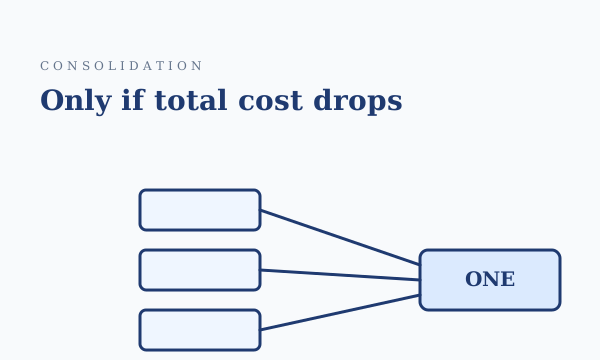
Debt Consolidation: What It Is and When It Actually Helps
Debt consolidation combines several debts into one lower-rate payment. It is a useful tool for the right borrower — and a trap for the wrong one.
Auto Loans: What Actually Determines the Total Cost
Dealers negotiate on monthly payment, but total cost is set by three levers: price, rate, and term. Ignoring any of them is how buyers end up upside-down on a car loan.