Debt
Auto Loans: What Actually Determines the Total Cost
Dealers negotiate on monthly payment, but total cost is set by three levers: price, rate, and term. Ignoring any of them is how buyers end up upside-down on a car loan.
Last updated September 3, 2026
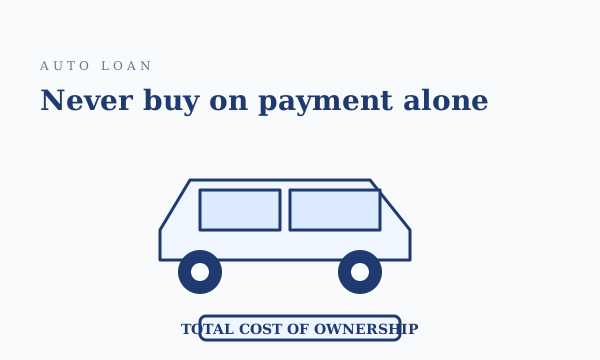
An auto loan is straightforward on paper: you borrow to buy a vehicle, pay it back monthly with interest, and own the car free and clear when the loan is paid off. In practice, the way auto loans are sold - through dealerships that also sell the car and often the financing - creates several opportunities to pay more than you should.
Understanding the three levers (price, rate, and term) protects you from the most common trap: focusing only on the monthly payment.
The three levers
Price is what you pay for the car. Rate is the APR on the loan. Term is how many months you spread payments over. Dealers routinely propose changes to term and rate to make a specific monthly payment work, without changing the total you will pay. A cheaper monthly payment on a longer term almost always costs more overall.
Why monthly payment is a trap
$30,000 at 8 percent over 48 months is a $732 monthly payment and about $5,150 in total interest. The same $30,000 at 8 percent over 84 months is a $468 monthly payment and about $9,300 in total interest. The lower monthly payment costs $4,000 more. Focus on the total repayment amount over the term, not the monthly figure.
Get preapproved before you shop
Walk into a dealership with a preapproval from a bank or credit union in hand. This does two things. First, it tells you the actual rate you qualify for based on your credit, independent of what the dealer offers. Second, it removes the dealer financing office as your only option, which turns their financing offer into a competitive one. Many dealers will match or beat your preapproval to earn the sale, which is a genuine win.
The upside-down problem
Being upside-down (or underwater) on a car loan means you owe more than the car is worth. New cars depreciate sharply in the first few years, so buyers who put little or nothing down on a long-term loan are often upside-down for two to four years. If the car is totaled or you need to sell, you owe money out of pocket to close the loan. Guaranteed asset protection (GAP) insurance covers this gap and is worth considering on longer loans with small down payments.
New vs used
Used cars are typically much cheaper per dollar of transportation because someone else absorbed the sharpest depreciation. Certified pre-owned programs offer a middle ground: lightly used vehicles with a manufacturer warranty and inspection, at a meaningful discount to new. Interest rates on used-car loans are usually slightly higher than on new, but the total cost advantage of buying used almost always wins.
A defensible process
Decide on the specific car before you walk in. Get a bank or credit union preapproval. Negotiate the vehicle price separately from any trade-in or financing discussion. Compare the dealer financing offer against your preapproval on total cost, not monthly payment. Say no to add-ons. Sleep on it if the numbers feel rushed.
Negotiate the vehicle, financing, and trade separately
Set an all-in vehicle-price ceiling before discussing monthly payment. Obtain financing offers from regulated lenders using the same amount and term, then compare them with dealer financing. If there is a trade-in, record its price and outstanding loan independently. Combining all three lets a weak price hide behind an attractive payment.
Calculate amount financed as vehicle price plus taxes and accepted add-ons minus cash down and net trade value. Then compare annual rate, term, total interest, fees, prepayment rules, and required products. A longer term can make the payment look affordable while raising total cost and the period in which the balance exceeds the vehicle value.
Stress-test ownership, not only the loan
Add insurance, registration, fuel or charging, maintenance, tyres, parking, and a repair reserve. Test a reduction in income and a major repair while the payment continues. Down payment and loan term should reduce the chance of negative equity, but using all available cash can create a different risk when repairs or income loss arrive.
Read every add-on and decline products you do not understand; warranties, service contracts, protection products, and accessories can be financed and collect interest. Confirm whether quoted approval is final before taking the vehicle and keep the signed contract. Local law governs cancellation, repossession, and complaint rights, so use the appropriate regulator rather than a generic online rule.
The full cost of financing a vehicle
Auto loan advertising focuses on monthly payment, which obscures the total cost of ownership. A $35,000 vehicle financed at 7% APR over 72 months has a monthly payment of about $597 — but total payments equal $42,970, meaning $7,970 in interest alone. Extend to 84 months and the monthly payment drops to about $528, but total interest rises to $9,352. Choose 60 months and monthly rises to $693 but total interest falls to $6,594. The right question is total cost over the loan life, not monthly payment.
Also factor: sales tax (5-10% depending on state), registration and title fees ($100-500), dealer document fees ($100-800), and any dealer add-ons (extended warranty, gap insurance, paint protection, VIN etching). Add-ons are typically high-margin dealer products; most can be purchased separately for less if desired at all. The out-the-door price often exceeds the advertised vehicle price by $3,000-6,000 once all fees and typical add-ons are included.
Financing options: dealer vs bank vs credit union
Dealer financing is convenient but often more expensive. Dealers work with multiple lenders and may quote rates 1-2% above what a borrower could qualify for directly. This spread is called "dealer markup" and is a significant profit center for dealerships. Some states cap dealer markup; others do not. The dealer has no obligation to give you the best rate available for your credit profile.
Bank and credit union pre-approvals typically offer more competitive rates for borrowers with good credit. Credit unions in particular often have some of the lowest auto loan rates in the market — sometimes 1-3% below bank rates. Getting pre-approved from a credit union before visiting a dealer establishes a rate floor you can use to negotiate. If the dealer beats it, take dealer financing; if not, use the pre-approval.
Manufacturer financing (Ford Motor Credit, Toyota Financial Services, etc.) often includes promotional rates like 0% APR for qualified borrowers. These rates are typically limited to specific models and require excellent credit (740+ FICO). Read the fine print — 0% financing may be an alternative to a cash-back rebate, and calculating which is better depends on the rebate amount, loan term, and prevailing interest rates.
The down payment decision
Down payment amount affects monthly payment, total interest, and equity position. A larger down payment reduces the amount financed, reduces monthly payment proportionally, and reduces total interest. It also reduces the risk of being "underwater" (owing more than the vehicle is worth) — a serious problem if the vehicle is totaled or if you want to sell before the loan is paid off.
Traditional advice: 20% down for new vehicles, 10% for used. Modern reality: many buyers put much less down or nothing at all, financing the entire purchase (including taxes and fees) into the loan. This is legal but risky — new vehicles depreciate 20-30% in the first year, meaning a zero-down buyer is immediately underwater and typically stays underwater for 2-3 years.
The practical minimum: put enough down that your loan balance is less than the vehicle’s wholesale value at all times. If a vehicle has a $30,000 out-the-door price and its wholesale value is $22,000 (new vehicles are worth significantly less than the sticker price the moment they leave the lot), a $10,000+ down payment keeps you above water from day one. This requires research into actual wholesale values (Kelley Blue Book, NADA guides) before negotiating price.
New vs used: the depreciation math
New vehicles depreciate roughly 20-30% in the first year and 50-60% within five years. A $40,000 new vehicle typically sells for $16,000-20,000 as a used vehicle after five years. The buyer who financed that new vehicle for six years may still owe $18,000 at year five — nearly the entire remaining value.
Buying used lets someone else absorb the first-year depreciation. A 2-3 year old vehicle typically retains 70-80% of its original value while offering nearly the same reliability and features. Used vehicles from certified pre-owned programs typically include manufacturer warranties and inspections, reducing (but not eliminating) reliability risk.
The used market has its own dangers: undisclosed damage, undocumented repairs, salvage titles reported as clean. Vehicle history reports (Carfax, AutoCheck) reveal much but not everything — some issues never make it into reports. Consider a pre-purchase inspection by an independent mechanic ($100-200) for any used vehicle costing more than $10,000. The inspection often reveals issues that inform negotiations or warn away from problem vehicles.
Loan term: the long-term cost of long-term loans
Auto loans of 60 months (5 years) were once standard. Loans of 72 months (6 years) and 84 months (7 years) are now common as lenders extend terms to keep monthly payments affordable amid rising vehicle prices. Longer terms mean lower monthly payments but dramatically higher total interest and longer periods of being underwater.
A useful rule: do not finance a vehicle for longer than you plan to keep it. If you typically trade vehicles every 4 years, financing over 7 years guarantees you will be underwater at trade-in — owing more than the vehicle is worth, requiring you to roll negative equity into the next loan. This cycle can compound over multiple vehicle purchases, leaving buyers permanently underwater.
The 20/4/10 rule offers guidance: 20% down payment, 4-year maximum loan term, total monthly transportation cost (payment, insurance, fuel, maintenance) no more than 10% of gross income. Meeting all three is difficult with new vehicles at current prices — often signaling the vehicle is too expensive for the buyer’s income. Buying used or less expensive is usually the answer.
Trade-ins and negative equity
Trading in a current vehicle at the dealer is convenient but typically produces lower prices than selling privately. Dealers offer wholesale values (what they could resell for at auction); private sales achieve closer to retail prices. The difference is often $2,000-5,000 on a mid-priced vehicle.
Negative equity — owing more than your trade-in is worth — creates complications. Dealers often roll negative equity into new loans ("we will pay off your old loan"), but the negative equity does not disappear — it becomes additional balance on the new loan. This can quickly create severe underwater situations. If you have significant negative equity, consider keeping the current vehicle until you have paid it down or saved enough to cover the gap in cash.
Insurance considerations
Financed vehicles typically require comprehensive and collision coverage, with the lienholder as loss payee. Liability-only insurance (typical for older vehicles owned outright) is not permitted while a loan is active. This can add $600-1,500 annually to insurance costs, particularly for newer or higher-value vehicles.
Gap insurance covers the difference between what you owe and what the vehicle is worth if it is totaled. It is most valuable when heavily financed with little or no down payment, or in the first 2-3 years of ownership when depreciation is fastest. Cost is typically $200-500 as a one-time fee. Dealers often sell gap insurance at inflated prices; consider purchasing separately from your auto insurance company for potentially significant savings.
Common auto loan mistakes
The most common mistake is focusing on monthly payment during negotiation. Dealers can achieve almost any monthly payment target by extending the term. A "$400/month" target might be met with 84-month financing that costs thousands more than 60-month financing at the same rate. Always negotiate on out-the-door price, then work backward to loan structure.
The second common mistake is accepting dealer financing without shopping. Even if dealer financing ultimately wins, having competing offers ensures you know you are getting a competitive rate. Credit union pre-approvals typically take 10 minutes online and cost nothing.
The third mistake is bundling multiple add-ons into the financed amount. Extended warranties, gap insurance, paint protection, and other add-ons can add $3,000-6,000 to a loan. When financed over 6-7 years at 7% APR, these add-ons cost significantly more than their sticker prices due to accumulated interest. Decline all add-ons initially and only add them back if you decide they provide genuine value at fair prices.
Sources and methodology
We use primary and authoritative sources for rules, definitions, and data. Sources and factual claims were last checked September 3, 2026.
- Auto loans resources — Consumer Financial Protection Bureau (United States)
- What is a credit score? — Consumer Financial Protection Bureau (United States)
- Financial education — OECD (Global)
Frequently asked questions
- How long an auto loan is too long?
- Loans of 72 to 84 months are common but expensive and leave you upside-down for years. 48 to 60 months is a safer range if you can afford the payment.
- Is 0 percent financing always a good deal?
- Not always. Manufacturers usually offer either a cash rebate or 0 percent financing, not both. Compare the total cost of taking the rebate and financing at a lower rate through a bank versus 0 percent with no rebate.
- Should I put money down on a car?
- A down payment of 10 to 20 percent reduces the loan balance and the risk of being upside-down. If you cannot afford a meaningful down payment, consider whether you can afford the car at all.
Related articles
What Actually Affects Your Credit Score (Ranked by Impact)
Credit scores look mysterious but rest on five simple factors, and two of them account for the majority of your score. Focus there first.
Debt Consolidation: What It Is and When It Actually Helps
Debt consolidation combines several debts into one lower-rate payment. It is a useful tool for the right borrower — and a trap for the wrong one.
When Does It Make Sense to Refinance a Mortgage?
The old rule of "refinance if rates drop 1 percent" is a rough shorthand for a math question that has a clean answer once you calculate the breakeven point.