Credit
What Actually Affects Your Credit Score (Ranked by Impact)
Credit scores look mysterious but rest on five simple factors, and two of them account for the majority of your score. Focus there first.
Last updated September 3, 2026
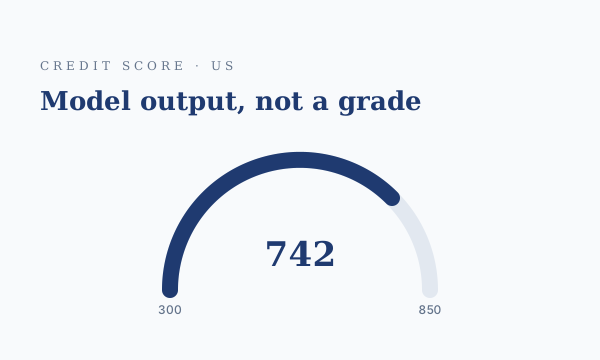
Credit scores are often treated as mysterious, but the two most widely used scoring models — FICO and VantageScore — rest on a short list of factors. FICO, used in most consumer lending decisions in the US, weights those factors clearly enough that you can rank them by impact and focus your effort where it actually pays.
1. Payment history — about 35% of the score
Whether you pay your bills on time is the single largest factor. A single missed payment reported 30 or more days late can drop a score by 60 to 100+ points and stay on your credit report for up to seven years. The mechanical fix is simple: automate at least the minimum payment on every credit account so you never miss one, then pay more when you can.
Late payments, collections, charge-offs, and bankruptcies all fall under payment history. A clean payment record over several years is the fastest way to build a strong score, and the slowest to accidentally damage.
2. Credit utilisation — about 30% of the score
Utilisation is the percentage of your available credit that you are using. If you have a $10,000 total credit limit across all cards and carry $3,000 in balances, your utilisation is 30%. Lower utilisation improves the score; higher utilisation hurts it, often dramatically above 30% and severely above 70%.
The most effective utilisation tactic is to pay down balances before the statement closing date, not just the due date. The score model typically uses the balance reported on the statement, so a balance paid to near-zero before the statement cuts leaves a low reported utilisation regardless of how the card was used during the month.
3. Length of credit history — about 15% of the score
The scoring model rewards long-standing accounts. It considers the age of your oldest account, the age of your newest account, and the average age across all accounts. This is why closing your oldest credit card is usually a mistake — it can lower your average age of accounts and, over time, remove the account entirely from the score calculation.
4. Credit mix — about 10% of the score
A mix of account types (credit cards, an installment loan such as a car loan, a mortgage) helps modestly. This is a small factor and not worth opening accounts you do not otherwise need — it typically becomes relevant only for borrowers pursuing the highest score tier.
5. New credit — about 10% of the score
Each formal credit application (a "hard inquiry") can lower your score by a few points and stays on your report for two years. Multiple hard inquiries in a short period compound the effect. Rate shopping for a single loan (mortgage, auto, student) is usually treated as a single inquiry if done within a two- to 45-day window, depending on the scoring model.
Where to focus your effort
Two habits produce the majority of possible score improvement. First, never miss a payment — automate it. Second, keep utilisation low, ideally below 10% on each card and overall. Everything else is a rounding adjustment on top of those two habits.
A score is a model output, not a personal grade
A lender obtains report data and applies a scoring model and version selected for a particular product. The score shown by a consumer app may use a different bureau, date, or model from the lender’s score. That does not automatically mean either is wrong. Compare the underlying report and the same model context before interpreting a difference.
Published factor percentages are educational descriptions for particular model families, not a formula a reader can reproduce or a promise that one action adds a fixed number of points. Payment status, balances, age, account type, recent applications, and public-record data can interact. The practical goal is accurate reports and low-risk behaviour over time, not gaming one threshold.
Prioritise actions by consequence and certainty
First prevent new late payments with due-date alerts, automatic minimums, and enough cash in the payment account. Second review all reports for inaccurate identity, status, limit, balance, and collection information. Third reduce revolving balances without closing useful accounts impulsively. Only then consider whether new credit is necessary; opening accounts merely for a score can add cost and temptation.
Keep evidence when correcting data and dispute with the reporting company and information provider through official channels. Accurate negative information is generally not removable simply because it is inconvenient, and companies promising a new identity or guaranteed score increase are a warning sign. Readers outside the U.S. must use their local bureaus, regulator, and data-rights process.
FICO versus VantageScore: two models, different weights
The US credit scoring market is dominated by two model families: FICO (developed by Fair Isaac Corporation) and VantageScore (a joint venture of Equifax, Experian, and TransUnion). Most consumer lending decisions — mortgages, auto loans, credit cards — use some version of FICO. VantageScore is more common in free consumer credit monitoring services and in some credit card decisions. Both use the same underlying credit report data but weight factors differently, so a borrower can have meaningfully different scores under each model.
Within each model family, multiple versions exist. FICO 8 is the most widely used, but mortgage lenders often use FICO 2, 4, or 5 (older versions maintained for regulatory reasons). FICO 10T incorporates trending data (how balances change over time). Auto lenders and credit card issuers use industry-specific FICO scores tuned to their loan types. When a "your credit score is X" is shown to you, it is one number from one model on one bureau’s data at one point in time. The lender may see a different number.
Payment history: the 35% weight and how it accumulates damage
Payment history is the single largest FICO factor. A payment is generally reported as late only after 30 days past due; paying 5 or 15 days late incurs late fees from the creditor but usually does not damage credit. Once a payment crosses 30 days, it is reported to the bureaus and typically drops the score 60-110 points, with larger drops for higher starting scores. Additional 60-day and 90-day late notations compound the damage.
The Fair Credit Reporting Act allows most negative items to remain on credit reports for 7 years from the date of the original delinquency (Chapter 7 bankruptcies for 10 years). Their weight in scoring diminishes over time, particularly after 24 months, but recovery is slow. The fastest recovery method is preventing new late payments while old ones age off the report. There is no "trick" to remove accurate late payments; disputes only work if the late notation was reported in error.
Set up minimum-payment autopay on every credit account from an account with a small buffer. This one action prevents nearly all payment-history damage. Some borrowers avoid autopay out of concern about overdrafts; a better solution is a dedicated payment account you keep funded, not manual bill paying that will eventually be forgotten during a busy week.
Credit utilisation: the 30% weight that changes monthly
Utilisation is your total revolving credit balances divided by total revolving credit limits, expressed as a percentage. FICO calculates this on both a total basis and per-account basis; a single card at 90% utilisation hurts even if your total is low. The commonly cited "keep below 30%" threshold is a floor, not an optimum — scores continue improving as utilisation drops toward zero, with the best scores typically occurring around 1-9% utilisation.
Utilisation is calculated from the balance reported to the bureaus, not your average balance during the month. Card issuers typically report the balance at statement close. If you use a card heavily and pay it in full by the due date, your credit report still shows the high statement balance. To optimise the reported utilisation, make an extra payment before the statement closes so the reported balance is lower than the peak-of-month balance.
Credit utilisation has no memory. If your utilisation was 90% last month and 5% this month, the score responds primarily to this month’s number. This is why utilisation is the fastest-moving factor: paying down a high balance can lift a score meaningfully within one billing cycle. Unlike payment history damage, which persists for years, utilisation damage disappears as soon as the balance is paid down.
Credit history length: the 15% you cannot rush
Length of credit history includes the age of your oldest account, the age of your newest account, and the average age across all accounts. The scoring model rewards long-standing accounts, which is why closing your oldest credit card can hurt your score even when it seems like a reasonable simplification. If an old card has no annual fee, keep it open with a small recurring charge on autopay to prevent inactivity closure by the issuer.
You cannot accelerate credit history length except by adding yourself as an authorised user on someone else’s long-standing account, which some scoring versions weight and others do not. For most people, the recommendation is to open a credit account early, use it responsibly, and simply let time pass. The strongest credit profiles typically include accounts more than 15 years old.
Credit mix and new credit: the 10% each
Credit mix rewards having both revolving (credit cards) and installment (car loans, mortgages, personal loans) accounts. It is a modest factor and not worth opening loans you do not need. The mix benefit typically only matters at the margins for borrowers seeking the very highest scores; a strong payment history and low utilisation matter far more.
New credit measures how many hard inquiries you have had recently and how many accounts you have opened. A single hard inquiry typically drops the score by 3-5 points and stays on the report for 2 years, though scoring weight diminishes after 12 months. Multiple inquiries for the same loan type within a short window (typically 14-45 days depending on model) are treated as one inquiry — this is "rate shopping" protection for mortgages, auto loans, and student loans. Credit card applications do not receive this benefit; each is a separate inquiry.
What does NOT affect your score
Income does not appear on credit reports and does not affect credit scores. Lenders may consider income when approving loans, but the credit score itself is calculated only from report data. Similarly, checking accounts, savings accounts, investment accounts, employment status, and demographic information (age, marital status, geographic region) are not factors in FICO or VantageScore calculations.
Checking your own credit report or score is a soft inquiry that has no impact. Lenders "pre-qualifying" you also use soft inquiries. Only formal applications where a lender is deciding whether to extend credit generate hard inquiries. You can check your own score as often as you like without penalty.
Paying off a debt does not automatically remove its history from your credit report. A paid collection may show as "paid collection" but remains for the full 7-year reporting period. Some scoring versions ignore paid collections; others do not. If you are negotiating settlement of a collection, requesting a "pay for delete" (removal in exchange for payment) can help, but the collector may refuse and there is no legal obligation to agree.
Disputing errors on credit reports
Credit reports contain errors more often than most people realise. A 2013 FTC study found that 25% of consumers had errors on at least one report; a 2021 CFPB analysis showed continuing high error rates. You are entitled to a free copy of each of your three credit reports (Equifax, Experian, TransUnion) once per week from AnnualCreditReport.com, the only federally authorised source. Review all three because errors often appear on one report and not the others.
To dispute an error, contact both the credit bureau reporting it and the furnisher (the company that provided the incorrect information). Explain the specific error, provide supporting documentation, and request correction. Bureaus generally must investigate within 30 days. If the investigation upholds the original report, you can add a 100-word statement to your file explaining your position. If the error persists despite documentation, escalation options include CFPB complaints and, in serious cases, lawsuits under the Fair Credit Reporting Act.
Rebuilding after severe damage
After bankruptcy, foreclosure, or extended default periods, credit scores often drop to the low 500s or below. Recovery is possible but requires deliberate patience. The fastest recovery path: pay every bill on time going forward, keep utilisation extremely low, open new credit only sparingly (typically starting with a secured credit card requiring a deposit), and wait for negative items to age off. Meaningful recovery typically takes 2-4 years; full recovery to top scores takes 7-10 years due to the reporting periods for major negative items.
Avoid "credit repair" companies charging monthly fees to dispute items. Anything they can do, you can do yourself for free. Legitimate credit rebuilding is a slow accumulation of positive payment history combined with the aging-off of old damage — a process that no third party can accelerate. Any company promising fast credit repair for a fee is either exploiting the dispute process against accurate information (which the bureaus will eventually reverse) or making promises it cannot keep.
Common credit score mistakes
The most common mistake is checking a free credit score service, seeing a number, and assuming that is what the lender will see. Free services often use VantageScore or an educational FICO variant that differs from the FICO version the lender will pull. Before applying for a major loan, use the same version the lender will use — often available through the paid myFICO service or the credit card issuer’s FICO score access.
The second common mistake is closing credit accounts to "simplify." Each closure reduces total available credit (increasing utilisation) and can reduce credit history length. Unless an account has an annual fee you cannot avoid, keeping it open with a small recurring charge is usually better for the score than closing it.
The third mistake is applying for multiple credit cards or loans in a short period without a specific need. Each application generates a hard inquiry, and the accumulation signals risk to scoring models. Space applications at least 6 months apart when possible, and only apply for products you have a specific plan to use.
Sources and methodology
We use primary and authoritative sources for rules, definitions, and data. Sources and factual claims were last checked September 3, 2026.
- What is a credit score? — Consumer Financial Protection Bureau (United States)
- Credit reports and scores — Consumer Financial Protection Bureau (United States)
- Free credit reports — Federal Trade Commission (United States)
Frequently asked questions
- Does checking my own credit score hurt it?
- No. Checking your own score is a "soft inquiry" and has no effect. Only "hard inquiries" from lenders reviewing a formal application affect your score.
- How long do late payments stay on my report?
- Up to seven years from the date of the delinquency, per the Fair Credit Reporting Act. Their impact on the score diminishes over time, especially as newer positive history accumulates.
- Do FICO and VantageScore use the same factors?
- They use similar factors but weight them slightly differently. A borrower with strong habits usually scores well on both.
Related articles
How to Build Credit From Scratch (No Cosigner Required)
Building a credit history from zero used to require a cosigner or an established relative. Today, three specific tools let almost anyone start in a single afternoon.
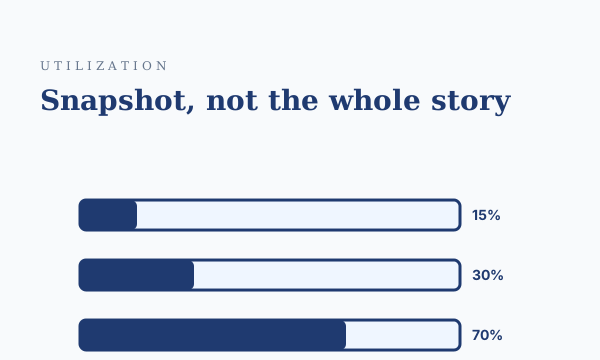
Credit Utilisation: Why 30% Is the Number You Keep Hearing
Credit utilisation is the second-largest factor in your credit score. Understanding how it is calculated — and when it is calculated — is the key to using it.
How to Read Your Credit Report — And What to Do When It's Wrong
Your credit report is the raw material behind every credit score you have. Reading it once a year — and disputing errors — costs nothing and can raise your score meaningfully.