Credit
Credit Utilisation: Why 30% Is the Number You Keep Hearing
Credit utilisation is the second-largest factor in your credit score. Understanding how it is calculated — and when it is calculated — is the key to using it.
Last updated September 3, 2026
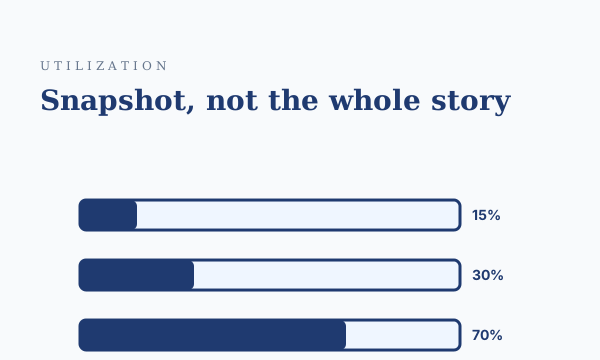
Credit utilisation is the percentage of your available revolving credit that is currently being used. It is the second-largest input into a FICO score, behind only payment history, and it moves faster than any other factor — a single billing cycle can shift it significantly.
How utilisation is calculated
Utilisation is calculated in two ways at the same time. Per-card utilisation looks at each individual credit card: a $600 balance on a card with a $2,000 limit is 30% per-card utilisation. Overall utilisation aggregates all revolving credit: $600 total balance across cards with a combined $10,000 limit is 6% overall utilisation. Both figures affect the score, and a very high balance on one card can hurt even if overall utilisation is low.
The 30% rule — and why 10% is a better target
"Keep utilisation under 30%" is a widely repeated guideline, and 30% is the level above which scores commonly begin to drop noticeably. But scoring models generally reward lower utilisation continuously, not just at 30%. Borrowers targeting the highest scores usually aim for utilisation below 10%, with a small positive balance rather than $0 (which shows the card is being used but not being carried heavily).
Statement date versus due date
The utilisation reported to the bureaus is normally the balance on your statement closing date — not the payment due date. This is the mechanical fact that most people miss. Paying the statement balance in full by the due date avoids interest but does not lower the utilisation reported for that cycle. To lower reported utilisation, pay the balance down before the statement closes.
A practical routine: check your card's statement close date, then set an alert or manual payment about a week beforehand to pay the balance down to your target utilisation. Your statement will then post with a low balance and low reported utilisation.
How to lower utilisation quickly
Four moves work in the short term. First, pay balances down before statement close. Second, request a credit-limit increase on existing cards — the same balance on a larger limit is lower utilisation. Third, open a new card to expand total available credit (accepting a small temporary hit from the hard inquiry and the shorter average age of accounts). Fourth, make multiple payments per month if you use the card heavily but want to keep reported utilisation low.
When utilisation matters most
Utilisation matters most in the weeks leading up to a major credit application (a mortgage, auto loan, or premium credit card). Because the effect is fast, taking utilisation from 40% down to 5% one to two billing cycles before applying can meaningfully raise the score seen by the lender. Return to normal usage afterward — you do not need to keep utilisation at 5% every month, only when a score-sensitive event is coming.
Statement balance, reported balance, and debt are different views
Utilisation is commonly calculated from revolving balances reported to a bureau divided by reported limits. The reporting date is often near statement generation but is issuer-specific and not the same as the payment due date. A card can be paid on time and still report a high balance; paying before reporting may change the snapshot, while paying by the due date controls lateness and, where a grace period applies, interest.
Calculate both total and per-account utilisation because models may consider each. Verify reported limits; a missing or incorrect limit can distort the ratio. Charge cards and other products may be treated differently. The frequently repeated 30% figure is a loose warning level, not a cliff at which a profile becomes safe, and lower reported revolving balances may be associated with lower modeled risk.
Improve cash flow before optimising the snapshot
If balances are carried, prioritise paying expensive debt and preventing late payments rather than making extra purchases to manipulate reporting. A mid-cycle payment can lower the reported amount, but it does not erase spending or interest. Avoid repeated credit-limit requests without checking inquiry and eligibility effects, and do not close an account solely for a short-term score tactic.
When preparing for an important application, inspect reports early, reduce balances sustainably, and avoid unnecessary new accounts. Lenders also evaluate income, debt obligations, affordability, collateral, and their own policy. A lower utilisation ratio can help one input but does not guarantee approval or a particular rate.
How utilisation is calculated with mathematical precision
Credit utilisation is calculated as revolving credit balance divided by revolving credit limit, expressed as a percentage. Only revolving accounts (credit cards, lines of credit, home equity lines of credit) count. Installment loans (car loans, mortgages, student loans, personal loans) are excluded from the utilisation calculation entirely. This is why a person with $100,000 in student loan debt can have low utilisation and a person with $3,000 in credit card debt on a $5,000 limit can have high utilisation.
FICO calculates utilisation two ways and considers both. First, aggregate utilisation across all your revolving accounts (total balances divided by total limits). Second, per-account utilisation on each individual card. A single card at 90% utilisation hurts your score even if your aggregate utilisation is only 15%. The scoring model penalises concentration risk: one maxed card signals financial stress more than modest balances spread across multiple cards.
When utilisation is measured and why it matters
Credit card issuers report your balance to the credit bureaus at a specific point each month, typically on your statement closing date (also called the statement cut date). This is not your payment due date. If your statement closes on the 15th and your due date is the 10th of the following month, the balance reported is whatever was on the card on the 15th — regardless of whether you paid it in full on the 10th.
This timing matters because it means "paying off your card each month" does not guarantee low reported utilisation. If you charge $2,000 on a $3,000 limit card each month and pay in full by the due date, your card issuer reports 67% utilisation and your credit report reflects it — even though you never carry a balance. The fix: make a partial payment before the statement closes so the reported balance is lower than the peak balance during the month.
Optimising utilisation without gaming the system
The score benefits of low utilisation are largely captured below 10%. Going from 30% to 10% typically improves the score more than going from 10% to 1%. Above 30%, damage accelerates. Above 50%, the damage is substantial. Above 90%, utilisation is treated as a serious risk signal comparable to a recent late payment. If you regularly use more than 30% of any card’s limit, the fastest score improvement usually comes from either paying down balances or requesting credit limit increases (which lower utilisation without requiring payment reduction).
For borrowers preparing for a major loan application (mortgage, auto loan), the "AZEO" strategy — All Zeros Except One — is sometimes recommended. This involves paying all cards to zero before statement close except one card, which shows a small balance (typically under 9% of that card’s limit). Some scoring models reward this specific pattern. For borrowers not applying for major credit soon, obsessing over exact utilisation optimisation is not worth the effort; paying balances in full each month and keeping totals modest captures most of the benefit.
Credit limit increases: when and how to request them
A credit limit increase lowers utilisation without requiring payment. If your $5,000 limit card has a $1,500 balance (30% utilisation), increasing the limit to $8,000 drops utilisation to 19% without any change in balance. Most major card issuers allow requests through their app or website. Some perform a hard credit inquiry (which temporarily lowers the score), others use only a soft inquiry. Ask before requesting whether the inquiry type is soft or hard so you can decide accordingly.
Timing matters. Request increases when your income has grown or your payment history with the issuer is strong, both of which support approval. Avoid requesting increases immediately before applying for other credit (the extra available credit may raise flags at other lenders) or immediately after a hard inquiry (which reduces approval odds). Also avoid requesting increases across multiple cards simultaneously; space them at least a few months apart.
The counterintuitive case for keeping unused credit
Closing unused credit cards seems like a simplification but usually hurts utilisation. If you have $20,000 in total credit limits across five cards and close one with a $6,000 limit, your total limit drops to $14,000. If you carry $2,000 in balances, your utilisation jumps from 10% to 14% — before considering that closing the account also shortens your average credit history length.
The counterargument is annual fees. If a card charges $95 annually and you no longer benefit from its rewards, keeping it open costs real money. Options: downgrade the card to a no-fee version from the same issuer (which preserves the account age and limit) or accept the utilisation impact and close the card. Downgrading is almost always available and almost always the right choice for cards you no longer actively use.
Utilisation and the credit score models that ignore it differently
Newer scoring models like FICO 10T and VantageScore 4.0 incorporate trending data: they look at whether your balances are increasing or decreasing over time, not just the current snapshot. A borrower with declining balances is treated more favourably than one with the same current balance but rising trend. This rewards consistent debt reduction and penalises rising balances that a static snapshot would treat identically.
Not all lenders use the newest models yet. Mortgage lenders in particular often use FICO 2, 4, or 5 (older versions) due to regulatory requirements. Before optimising for a specific behaviour, know which model the intended lender will use. Your card issuer or the credit bureau can usually tell you which FICO version they report.
Business credit cards and utilisation
Business credit cards behave differently across issuers. Some report to personal credit bureaus (affecting personal utilisation calculations); others report only to business credit bureaus (not affecting personal utilisation). Some report only if the account defaults. Before charging large business expenses to a card, verify with the issuer whether the account reports to personal bureaus — a business card with high balances can quietly wreck personal utilisation if it reports personally.
The most utilisation-friendly business cards for personal credit are those that report only under adverse conditions. American Express business cards are notable for typically not reporting balances to personal bureaus. Chase, Bank of America, and Capital One business cards vary by product; check the specific card’s reporting behaviour before assuming.
Recovery from high utilisation
Because utilisation is calculated from the most recent reported balance, recovery is fast. Pay down balances by the next statement close date, and the next credit report reflects the improvement. A borrower who reduces utilisation from 75% to 15% typically sees score improvement within 30-45 days. This is dramatically faster than recovery from other negative factors like late payments (2-4 years) or collections (7 years).
For borrowers unable to pay balances down quickly, requesting credit limit increases is the next-best option. If both are impossible, focusing on the single highest-utilisation card first produces the most improvement, because per-account utilisation is a factor separate from aggregate utilisation. Zeroing out one card at 90% while keeping others at 40% may improve the score more than reducing all cards from 40% to 35%.
Common utilisation mistakes
The most common mistake is checking the score before the statement closes, seeing low utilisation, and assuming the score is safe. The score reflects the last reported balance, which may be days or weeks old. If you charged heavily this month but the statement has not closed yet, next month’s score may drop when the higher balance reports.
The second common mistake is applying for a new credit card and immediately transferring a large balance to it. The new card starts with a very high utilisation ratio (often over 90%), which can hurt the score more than the aggregate utilisation improvement from the extra total credit. Balance transfers work best when the receiving card has substantial remaining available credit even after the transfer.
The third mistake is treating utilisation as a fixed target rather than a moving average. Utilisation optimisation matters most in the months before a loan application. Between applications, focus on paying balances in full and letting utilisation vary naturally; obsessive daily optimisation is not worth the effort.
Sources and methodology
We use primary and authoritative sources for rules, definitions, and data. Sources and factual claims were last checked September 3, 2026.
- What is a credit score? — Consumer Financial Protection Bureau (United States)
- Credit reports and scores — Consumer Financial Protection Bureau (United States)
- Credit card resources — Consumer Financial Protection Bureau (United States)
Frequently asked questions
- Does 0% utilisation give the best score?
- Not quite. Scoring models tend to reward a very small positive utilisation (typically 1% to 9%) slightly more than 0%, because it shows the card is active. The difference is small.
- Does utilisation on charge cards matter?
- Traditional charge cards (paid in full each month with no preset limit) are treated differently from revolving cards. Some scoring models exclude them from utilisation calculations; others use a "high balance" figure. Effects vary by model.
- If I pay in full every month, does utilisation still matter?
- Yes, because the statement balance is what usually gets reported. Paying in full by the due date avoids interest but does not automatically lower reported utilisation.
Related articles
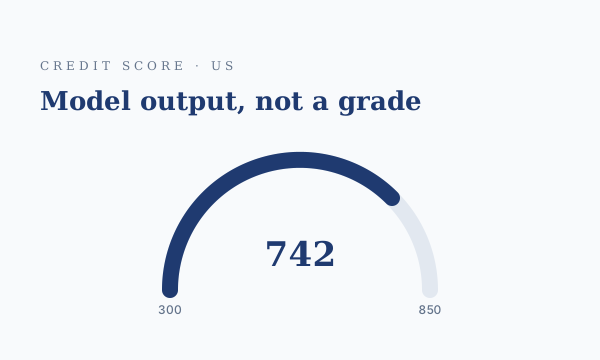
What Actually Affects Your Credit Score (Ranked by Impact)
Credit scores look mysterious but rest on five simple factors, and two of them account for the majority of your score. Focus there first.
How to Build Credit From Scratch (No Cosigner Required)
Building a credit history from zero used to require a cosigner or an established relative. Today, three specific tools let almost anyone start in a single afternoon.
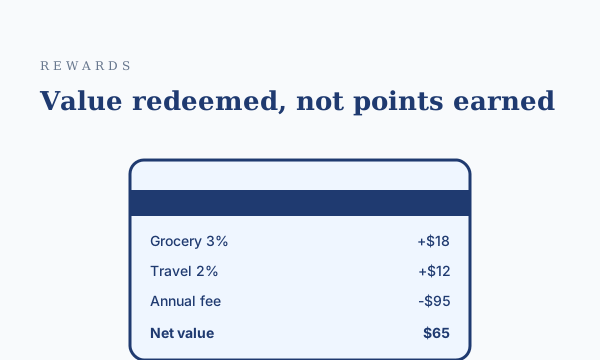
Credit Card Rewards Explained (Without the Hype)
Credit card rewards can be a genuine perk or an expensive distraction. The line between the two is drawn by whether you carry a balance.