Credit
Credit Card Rewards Explained (Without the Hype)
Credit card rewards can be a genuine perk or an expensive distraction. The line between the two is drawn by whether you carry a balance.
Last updated September 3, 2026
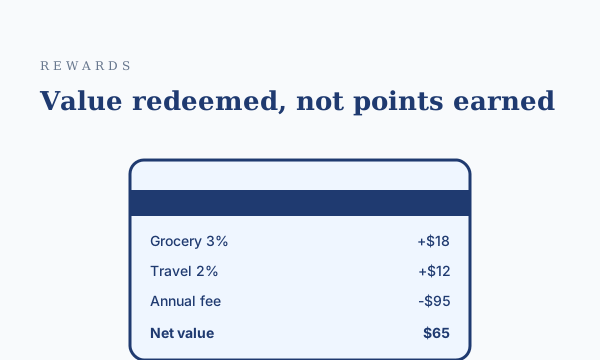
Credit card rewards come in three main flavours: cash back, travel points, and merchandise or statement credits. All of them share a simple economic reality - the issuer earns money on interchange fees and, more importantly, on interest paid by cardholders who carry balances. Rewards are a small fraction of interchange returned to you as an incentive.
That means rewards are a real benefit for cardholders who pay in full every month and a net loss for those who carry balances. There is no other honest way to describe the math.
Cash back
Cash-back cards pay a percentage of every purchase back to you as cash, statement credits, or gift cards. The simplest structure is a flat rate (commonly 1.5 to 2 percent) on every purchase. Some cards pay higher rates in specific categories (groceries, gas, restaurants), sometimes rotating quarterly. For most people, a flat 2 percent card is a strong default because it requires zero effort to optimise.
Travel points
Travel-rewards cards earn points transferable to airline and hotel loyalty programs, sometimes at very favourable rates. The catch: points are only valuable if you actually use them for travel that fits your life. If you would fly economy, a strategic point redemption for business class can produce three to five times the equivalent cash value. If you never travel or hate loyalty-program complexity, a plain cash-back card is worth more to you.
Sign-up bonuses
Most rewards cards offer a large one-time bonus (often $200 to $1,000 equivalent) for spending a required amount within the first few months. For someone with regular monthly expenses that easily hit the minimum, these bonuses are among the highest-return rewards available. Never manufacture spending just to hit a bonus - the interest on unpaid balances or the cost of unnecessary purchases wipes out the reward many times over.
Annual fees
High-end travel cards often carry annual fees of $95 to $695 or more. Whether the fee is worth it depends entirely on whether you use the specific benefits (lounge access, credits, travel insurance) enough to exceed the fee. Do the math honestly at the start of each year; if you did not use the benefits last year, downgrade to a no-fee version.
A sensible default strategy
Three cards cover most needs: a flat 2 percent cash-back card for the bulk of spending, a no-fee category card for one or two high-spend categories (groceries, restaurants), and optionally one travel card if you travel enough for the fee to make sense. Pay every card in full every month, on autopay. That is the whole strategy for most people.
Calculate realised value, not points collected
Start with rewards actually redeemed for outcomes you would otherwise buy. Subtract annual fees, interest, late fees, foreign-exchange costs, lost merchant discounts, and the value of expired or stranded rewards. Promotional bonuses also have spending requirements and deadlines; buying extra items to reach one converts part of the bonus into spending.
Use a conservative redemption value based on your normal method, not an aspirational premium trip with limited availability. Flexible points can be devalued and transfer partners can change. Cash back is easier to measure but still depends on eligible transactions, category caps, exclusions, posting, and redemption minimums in the issuer agreement.
Set guardrails before optimising
Automate the full statement balance from a funded account, monitor the first payment, and maintain alerts for due dates, large transactions, and category caps. Never carry interest-bearing debt for rewards. Track annual-fee renewal and benefits actually used, then make a keep, downgrade, or close decision without assuming a product change preserves every feature or account-history effect.
Limit applications to cards that fit planned spending and a real redemption goal. New accounts can add inquiries, administrative load, fraud surface, and temptation. Issuers can withhold bonuses or close accounts under their terms, and consumer protections differ. Evergreen content should explain evaluation, not list a “best card” that will soon be stale.
How credit card rewards actually work
Credit card rewards are the issuer’s way of sharing merchant interchange fees with consumers. When you swipe a rewards card at a merchant, the merchant pays roughly 1.5-3.5% of the transaction to Visa/Mastercard/AmEx networks, banks, and processors. The issuer returns a portion to you as cashback, points, or miles to incentivize continued card use.
The economics only work in the issuer’s favor if you occasionally carry balances (interest charges) or pay annual fees (guaranteed revenue). Reward-maximizing consumers who pay in full monthly and choose no-annual-fee cards are unprofitable customers — the issuer loses money on each transaction after rewards. This is why issuer marketing pushes premium cards ($95-695 annual fees) with elaborate benefit structures.
For consumers, the math is straightforward: rewards value received minus annual fees paid minus interest paid = net reward benefit. This value is typically positive for disciplined users with no-fee cards, marginal for premium cards used moderately, and negative for anyone who occasionally carries balances (interest charges dwarf any conceivable rewards).
Cashback vs points vs miles: which is best?
Cashback rewards are simplest and most transparent. A 2% cashback card returns $200 per $10,000 spent, immediately as statement credit or bank deposit. No point valuations, transfer partners, or redemption timing to consider. For most consumers who do not travel extensively, cashback is optimal.
Points programs (Chase Ultimate Rewards, American Express Membership Rewards, Capital One Miles, Citi ThankYou Points) offer flexibility. Points can be transferred to airline/hotel programs (often at 1:1 ratio, sometimes better) where they can be worth 1.5-4+ cents each for premium travel redemptions. Someone who could book a $2,000 international first-class flight with 100,000 points ($1,000 face value at 1 cent per point) captured 2x normal value.
Airline miles and hotel points programs offer specialized value for consumers who book significant travel with specific brands. Delta SkyMiles, United MileagePlus, Marriott Bonvoy, Hilton Honors, and similar programs work well for their loyal customers but poorly for casual users. Points can devalue overnight through program changes; award chart pricing often makes redemptions cost 50-100% more points than a year prior.
For travelers who spend 10-30 nights annually in hotels or take 3-5 flights annually, points programs can capture $500-2,000+ additional value versus cashback. For everyone else, cashback typically provides better realized value with less complexity.
The rewards math on annual fees
A card with a $95 annual fee needs to provide at least $95 in value beyond a no-fee alternative to be worth keeping. Typical break-even for cards like Chase Sapphire Preferred ($95 fee, 2x points on dining/travel plus travel benefits): $9,500 annual travel+dining spending at 1x point differential ≈ $95 in bonus value, before considering signup bonuses and other benefits.
Premium cards ($550-695 annual fees like Chase Sapphire Reserve or Amex Platinum) offer credits and benefits totaling $1,000+ face value: airline credits, hotel credits, dining credits, lounge access, Global Entry/TSA PreCheck credit, etc. The catch: you must actually use most of these credits for the math to work. Face value of unused benefits is zero to you.
Realistic annual value analysis: honestly count only benefits you would actually use. A $250 airline incidental credit that requires specific booking behaviors is worth $250 only if you would spend that on airlines anyway. A "free" $200 dinner credit at partner restaurants is worth $200 only if you would eat there anyway. Discount your estimates by 30-50% for realism.
Signup bonuses: often the largest single reward
New card signup bonuses typically require spending $3,000-15,000 within 3-6 months of account opening, in exchange for 30,000-100,000+ points/miles. Best signup bonuses are worth $400-1,500+ in first-year value — often exceeding several years of ongoing rewards from the same card.
To capture signup bonuses without overspending: time card applications with planned large purchases (tax payments, tuition, home improvements, planned travel). Do not manufacture spending you would not otherwise do just to hit signup thresholds — the value of unnecessary purchases far exceeds the bonus value.
Some cards have restrictions on repeat bonuses: Chase has the 5/24 rule (rejects applications if you have opened 5+ credit cards in past 24 months from any issuer) and 48-month rules on some Sapphire products. Read the specific card’s eligibility rules before applying; wasted hard inquiries on rejected applications hurt credit without benefit.
Category bonuses and how to maximize them
Many cards offer 3-6% cashback or 3-6x points on specific categories: dining, groceries, gas, streaming services, drug stores, wholesale clubs. Optimizing across multiple cards for category bonuses can meaningfully improve overall rewards.
Sample optimized setup for typical household: Chase Freedom Unlimited (1.5% on everything as baseline), Chase Freedom Flex (5% on rotating quarterly categories, 3% on dining), Amex Blue Cash Preferred (6% on groceries, $95 fee), Costco Anywhere Visa (3% on gas, 2% at Costco). Total rewards potentially 3-5% weighted average on typical household spending versus 1-2% from a single card.
The optimization has real cost. Managing multiple cards requires: knowing which card to use where, tracking multiple statement dates, ensuring all cards get used (some cards close for inactivity), and managing annual fees on cards you keep. For households spending $50,000+ annually on credit cards, the optimization typically produces $500-1,000+ extra rewards per year. For lower spending levels, a single 2% cashback card often produces comparable net value with far less complexity.
Travel rewards: capturing outsized value
The highest-value credit card rewards typically come from transferring points to airline programs for premium cabin international flights. A $5,000-15,000 cash flight might be bookable for 100,000-250,000 airline miles — a per-point value of 3-6 cents versus the 1-1.5 cents cashback provides.
This optimization requires learning multiple airline programs, following devaluation news, understanding award chart rules, and having flexibility in travel dates and routes. For dedicated travel enthusiasts, this can produce genuine multi-thousand-dollar annual value. For occasional travelers who value simplicity, cashback typically provides better realized outcomes.
Never chase premium travel redemptions if it forces you to travel more than you would otherwise or upgrade to premium cabins you would not otherwise book. "Free" first-class flights that require additional taxes, fees, extended trip duration, and specific date restrictions may cost more in true opportunity cost than a discounted economy ticket to the same destination.
Common credit card rewards mistakes
The most common mistake is paying interest to earn rewards. Any interest paid vastly exceeds any reasonable rewards value. A single $500 balance carried at 22% APR for a year costs $110 in interest — more than most cardholders earn in rewards on $10,000+ in annual spending. Rewards optimization is meaningless if not paired with paying in full monthly.
The second common mistake is opening cards for signup bonuses without discipline to pay them off. If a $5,000 spending requirement pushes you to make purchases you cannot afford to pay in full when the statement arrives, the resulting interest destroys the bonus value multiple times over.
The third mistake is keeping premium annual fee cards after benefits decline or usage drops. Chase Sapphire Reserve at $550/year is worthwhile for someone using the travel credits and lounge access. It is $550 wasted for someone who stopped traveling. Review annual fee cards each renewal period and downgrade or close cards whose benefits no longer justify their cost.
Sources and methodology
We use primary and authoritative sources for rules, definitions, and data. Sources and factual claims were last checked September 3, 2026.
- Credit card resources — Consumer Financial Protection Bureau (United States)
- What is a credit score? — Consumer Financial Protection Bureau (United States)
- Financial education — OECD (Global)
Frequently asked questions
- Does opening a new card hurt my credit score?
- It typically causes a small temporary dip (a few points) from the hard inquiry and shorter average account age. If you keep balances low and pay on time, the impact usually recovers within a few months.
- Are rewards taxable?
- In the US, cash back and points earned from spending are generally treated as rebates, not income, so not taxable. Sign-up bonuses that do not require spending (rare) may be treated differently.
- What is "credit card churning"?
- The practice of opening cards specifically to earn sign-up bonuses. It can generate significant value but requires meticulous tracking and comfort with a temporarily lower credit score. Not recommended for anyone planning a mortgage or auto loan in the next year.
Related articles
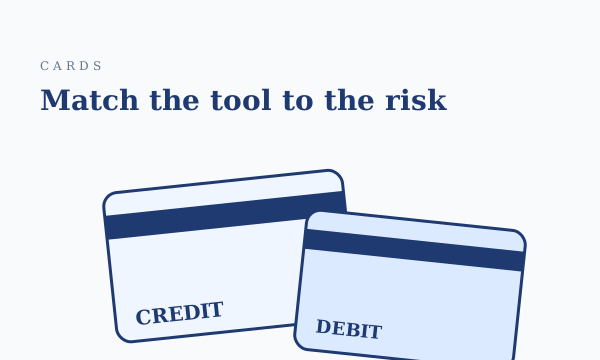
Credit Card vs Debit Card: Which One Should You Actually Use?
For most day-to-day spending, a credit card offers stronger consumer protection and better rewards — but only if used with the discipline of a debit card.
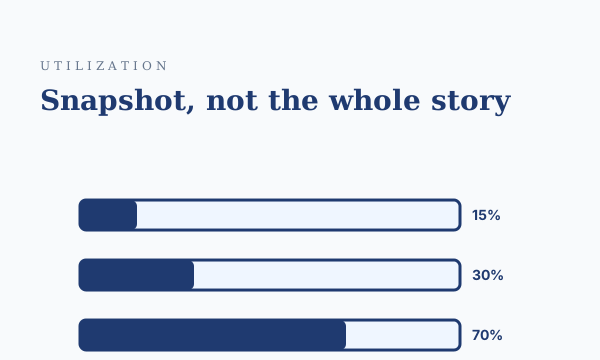
Credit Utilisation: Why 30% Is the Number You Keep Hearing
Credit utilisation is the second-largest factor in your credit score. Understanding how it is calculated — and when it is calculated — is the key to using it.
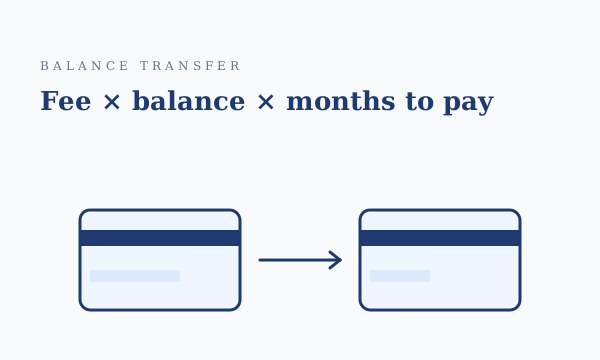
Balance Transfer Cards: When They Save You Money (and When They Don't)
A 0% balance transfer can save hundreds in interest — or cost you more than it saves. The difference comes down to one number and one honest question.