Debt
Balance Transfer Cards: When They Save You Money (and When They Don't)
A 0% balance transfer can save hundreds in interest — or cost you more than it saves. The difference comes down to one number and one honest question.
Last updated September 3, 2026
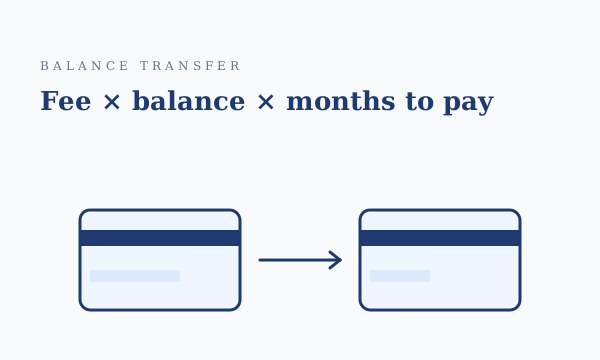
A balance transfer card is a credit card that lets you move debt from one or more existing credit cards onto it, typically at a promotional 0% interest rate for a set period (commonly 12 to 21 months). If used correctly, a balance transfer can dramatically reduce the interest you pay and shorten the time it takes to become debt-free.
Used carelessly, the same card can leave you with more debt than you started with. The line between the two outcomes is narrower than most people realize.
How balance transfers work
You apply for a card that offers a 0% promotional APR on balance transfers. Once approved, you request that the new card issuer pay off the balance on your existing card. Your old card's balance drops to zero (or by the amount transferred) and the same amount appears on the new card. During the promotional period, no interest accrues on the transferred amount.
Almost every balance transfer card charges a one-time transfer fee, usually 3% or 5% of the transferred balance. This fee is added to the transferred amount on the new card, so a $5,000 transfer at 3% starts as a $5,150 balance.
When a balance transfer saves money
Do the math before transferring. Suppose you carry $5,000 on a card at 22% APR and are paying $200 per month. Without a transfer, it takes roughly 33 months to pay off and costs about $1,600 in interest. Transfer that balance to a card offering 0% APR for 18 months with a 3% fee ($150) and continue paying $200 per month: you clear the balance in about 26 months and pay only the $150 fee. Net savings: roughly $1,450.
That is the best-case scenario. The savings shrink if you cannot maintain aggressive payments, or if you leave a balance on the card when the promotional period ends and the standard rate (often 20%+) kicks in on the remainder.
When a balance transfer costs more
Three failure modes are common. First, adding new purchases to the card — most cards charge standard APR on new purchases immediately, and payments are often applied to the promotional balance first, so new purchases sit accruing interest. Second, failing to pay off the transferred balance before the promo ends, leaving high-interest debt with less time. Third, treating the freed-up credit on the old card as an invitation to spend, which doubles the total debt.
How to choose a balance transfer card
Compare four things: the length of the promotional period (longer is safer), the transfer fee (3% is usually better than 5%, but not if the 3% card has a much shorter promo), the standard APR after the promo (in case you carry a small remaining balance), and the credit-limit range (you need a limit high enough to absorb the balance plus fee).
Alternatives to consider
If your credit score is not high enough to qualify for the best balance transfer offers, a personal loan can serve a similar function — a fixed lower rate over a fixed term. Nonprofit credit counselling agencies also offer debt management plans that consolidate payments and often negotiate reduced rates directly with lenders.
Calculate the offer from its disclosure
Record the transfer fee, promotional rate, exact end date, post-promotion rate, eligible balance types, transfer deadline, credit limit, annual fee, and treatment of purchases. The amount transferred may be limited by the new credit line after fees. Do not assume a headline offer applies until the issuer approves the account and confirms the transferred amount.
Compare total cost with keeping the debt where it is: transfer fee + promotional interest + expected residual balance at the later rate. Divide the transferred balance plus fee by the number of payments before expiry to obtain a required monthly target, then test whether that target survives a bad cash-flow month. A transfer that merely moves an unaffordable balance is not a payoff plan.
Control the operational risks
Continue paying the old creditor until the transfer is posted and the statement confirms the remaining balance. Set automatic minimum payments on the new account as a backstop and a separate larger payoff payment. Read how late or returned payments affect promotional terms, and avoid new purchases unless the disclosure makes their grace period and allocation unambiguous.
Do not repeatedly apply for cards or reopen spending on the old account without addressing the budget gap. Product terms change, so this article does not list a permanent “best” offer. Compare current official disclosures on the same date and consider hardship or a structured repayment plan where approval or payoff capacity is weak.
How balance transfer cards actually work
A balance transfer credit card offers a promotional low or 0% interest rate (typically for 12-21 months) on debt transferred from other credit cards. In exchange, the card issuer charges a balance transfer fee (typically 3-5% of the transferred amount). The economics are simple: instead of paying 18-29% interest on existing credit card debt, you pay a one-time 3-5% fee and 0% for the promotional period. If you can pay off the transferred balance during the promotional window, this is one of the cheapest debt payoff strategies available.
The mathematical breakeven: a 3% transfer fee on 18 months of 0% interest is equivalent to roughly a 2% effective annual rate — dramatically better than the 22-29% rates most credit card holders pay. On $10,000 of credit card debt at 24% APR, one year of interest is $2,400. Transferring that debt to a 0% card with a 3% fee costs $300 in fees for 18 months of no interest — potential savings of $3,000+ if fully paid off during the promotional period.
The critical timing calculation
The promotional period is the single most important variable. A 12-month promotional period requires monthly payments of $10,300/12 ≈ $858 to pay off a $10,000 balance transfer (with 3% fee) before interest starts. An 18-month period requires $572/month. A 21-month period requires $490/month. Choose the promotional length based on what you can realistically afford monthly, not the longest available period — longer promotions sometimes carry higher transfer fees.
The consequence of not paying off during the promotional period matters enormously. Some cards charge deferred interest — if any balance remains at the end of the promotional period, interest is retroactively charged on the entire original transferred amount from day one. Other cards simply revert to the standard rate on remaining balances. Read the specific terms; deferred interest cards can produce shockingly large interest charges if the balance is not eliminated on time.
Qualifying for competitive balance transfer cards
The best balance transfer offers (18-21 month 0% periods, 3% fees) require good to excellent credit — typically FICO 700+. Borrowers with lower scores may still qualify but often for shorter promotional periods (6-12 months) and/or higher fees (5%). If your credit is below 650, balance transfer options are limited and may not provide meaningful benefit versus staying with existing cards.
Prequalification tools (offered by most major issuers) let you check likely approval without a hard credit inquiry. Use these to identify promising options before formally applying. Chase, Citi, Discover, Capital One, and Wells Fargo all offer prequalification for their balance transfer cards. Prequalification does not guarantee approval but significantly increases odds compared to blind applications.
Credit utilisation on the new card matters. If you receive a $15,000 credit limit and transfer $10,000, your utilisation on that card is 67% — which can temporarily damage your credit score by 20-40 points until the balance drops below 30% of the limit. This is a short-term cost of a long-term-beneficial move; do not check credit score in the first month post-transfer expecting improvement.
The traps to avoid
The "new spending" trap: many balance transfer cards charge full interest on new purchases even during the balance transfer promotional period, unless the card specifically extends 0% to purchases too. Charging new purchases to a balance transfer card can create interest immediately even while you think you have 0% on the whole card. Best practice: use the balance transfer card only for the transferred balance; use different cards for new purchases during the promotional period.
The "rebuild the old debt" trap: after transferring balances off existing credit cards, those cards have $0 balances but their credit lines remain open. Many transferors find themselves 6-12 months later with the balance transfer card still being paid plus new balances on the previously-paid cards. Freeze credit cards you have paid off — literally freeze them (put them in ice), lock them in the card issuer’s app, or ask the issuer to reduce credit limits to make new charges impossible.
The "minimum payment" trap: balance transfer cards typically require minimum payments that are far below what is needed to pay off the balance during the promotional period. Making only minimum payments guarantees the balance remains at the end of the promotion, triggering full interest. Calculate the required monthly payment to pay off in the promotional period and set that (not the minimum) as an automatic payment.
When balance transfer makes sense vs consolidation loans
Balance transfer beats consolidation loan when: you can pay off the debt in 12-21 months, your credit qualifies for competitive transfer offers, and you have the discipline not to accumulate new credit card debt during payoff. In these situations, the effective 2-4% cost of the transfer beats the 8-15% rate typical of consolidation loans.
Consolidation loans beat balance transfers when: payoff will take longer than 21 months, your credit score does not qualify for competitive transfers, or you want the discipline of a fixed loan structure with no revolving credit access. Consolidation loans also work better for people who need predictability — a fixed 5-year loan is behaviourally different from a "you have 18 months to pay this off before interest kicks in" balance transfer.
Multi-card balance transfer strategies
For large debt loads exceeding a single card’s transfer capacity, some borrowers use multiple balance transfer cards sequentially. Transfer as much as one card allows, pay it off aggressively during the promotional period, then open a second card and transfer the next chunk. This is complex — each new application generates a hard inquiry, credit utilisation ratios shift, and the risk of missing a promotional deadline compounds with each card.
Alternative: some balance transfer cards allow transferring debt from another card at the same issuer. Chase-to-Chase, Citi-to-Citi, Discover-to-Discover balance transfers are typically not allowed — you must transfer between different issuers. Verify allowed transfer sources before assuming the strategy works.
The reality after promotional period ends
The go-to rate (post-promotional rate) is often 18-29% — sometimes higher than the original cards you transferred from. Read the specific go-to rate before applying; if it is higher than your existing card rates, the balance transfer helps only if you actually pay off during the promotional period. Failing to do so may leave you worse off than staying with the original cards.
The account remains open after the promotional period ends. This is generally positive for credit score (age of accounts, available credit) but can be a temptation to continue using the card for new purchases at the high go-to rate. If you have a history of credit card overspending, consider whether keeping the card open serves you — some borrowers do better by closing balance transfer cards after full payoff to remove the temptation.
Common balance transfer mistakes
The most common mistake is not calculating the required monthly payment to pay off during the promotional period, then relying on minimum payments. Minimum payments virtually guarantee remaining balance at promotion end and full interest reversion. Divide (balance + fee) by promotional months to get the required monthly payment; automate that amount from day one.
The second common mistake is transferring balances then continuing to use the original cards. New charges to the "cleared" cards accumulate debt on top of the transferred balance you are paying off. Freezing or closing the original cards prevents this outcome; discipline alone often fails during stress or bad months.
The third mistake is applying for multiple balance transfer cards in a short period. Each application generates a hard inquiry (typically 3-5 point score reduction each), and multiple new accounts signal risk to lenders. Space applications by at least 3-6 months if using a multi-card strategy.
Sources and methodology
We use primary and authoritative sources for rules, definitions, and data. Sources and factual claims were last checked September 3, 2026.
- Credit card resources — Consumer Financial Protection Bureau (United States)
- What do I need to know about consolidating my credit card debt? — Consumer Financial Protection Bureau (United States)
- Debt collection resources — Consumer Financial Protection Bureau (United States)
Frequently asked questions
- Will a balance transfer hurt my credit score?
- The hard inquiry from applying may cause a small temporary drop. Lower utilisation on the old card usually offsets this over time. Closing the old card can hurt more than it helps because it removes available credit.
- Can I transfer a balance to a card I already have?
- Generally no — balance transfer offers are typically only available to new cardholders. Existing cards occasionally offer promotional rates, but the terms are usually less favourable.
- What happens if I do not pay off the balance in time?
- The remaining balance begins accruing interest at the standard rate (often 20%+) from the end of the promo. Some cards charge "deferred interest," where you owe interest retroactive to the transfer date — always check whether the card offers 0% APR or "deferred interest," which are very different.
Related articles
Debt Snowball vs Avalanche: Which Pays Off Debt Faster?
Two popular strategies, one goal: becoming debt-free. Here is how each works, a worked example, and how to choose the one you will actually stick with.
Debt Consolidation: What It Is and When It Actually Helps
Debt consolidation combines several debts into one lower-rate payment. It is a useful tool for the right borrower — and a trap for the wrong one.
What Actually Affects Your Credit Score (Ranked by Impact)
Credit scores look mysterious but rest on five simple factors, and two of them account for the majority of your score. Focus there first.