Credit
How to Build Credit From Scratch (No Cosigner Required)
Building a credit history from zero used to require a cosigner or an established relative. Today, three specific tools let almost anyone start in a single afternoon.
Last updated September 3, 2026
If you have never had a loan or credit card, you probably do not have a credit score at all — you are "credit invisible." Roughly 45 million US adults fall into that category according to Consumer Financial Protection Bureau research, and it makes almost every large financial step (renting an apartment, financing a car, qualifying for a mortgage) harder.
The good news: building a credit history from zero is genuinely straightforward, and the fastest route is almost the same for everyone.
Step 1: Open a secured credit card
A secured credit card looks and works like an ordinary credit card, but it requires a refundable security deposit — usually equal to the credit limit. Deposit $300, get a $300 limit. The card reports to the credit bureaus like any other credit card, so on-time payments build history quickly.
Look for a secured card with no annual fee, reports to all three major bureaus (Experian, Equifax, TransUnion), and a path to "graduate" to an unsecured card and recover your deposit after a period of good payments (typically 6 to 12 months).
Step 2: Use the card lightly and pay it in full
The habit that builds credit is not carrying a balance — it is making on-time payments on an active account with low utilisation. Charge one small recurring expense to the card (a streaming subscription, a phone bill) and set autopay for the full statement balance every month. That single habit demonstrates payment history and low utilisation, the two most powerful score factors.
Never miss a payment. A single 30-day late payment can undo a year of careful score-building.
Step 3: Add a credit-builder loan (optional but effective)
A credit-builder loan is a small loan (often $500 to $2,000) held in a locked savings account while you make monthly payments. When you finish paying, the balance (minus small fees) is released to you. The lender reports each on-time payment to the bureaus, so you build both credit history and a small savings balance in parallel. Credit unions and some community banks offer these; a few fintechs specialise in them.
Step 4: Report your rent (if you already pay it)
Historically, rent payments did not show up on your credit report even though housing was often your largest monthly obligation. Several services (some free, some low-cost) now report your rent history to one or more bureaus. If your landlord uses a rent-payment platform that supports reporting, opting in can produce months of positive history without any additional payments.
What to avoid
Avoid subprime "credit-builder" cards with high fees, and be sceptical of any product that requires a large upfront fee to help you "boost" your score. Legitimate score-building has no shortcuts — it is time plus consistent good habits, and no product can genuinely accelerate that.
What to expect
Most people generate their first FICO score after about six months of reported activity. Reaching a score in the "good" range (roughly 670+) typically takes another six to twelve months of continued on-time payments and low utilisation. Reaching "excellent" (roughly 800+) takes years, mostly through length of history rather than any special tactic.
Choose one reporting product you can verify
Ask which consumer reporting companies receive the account, how often data is sent, every fee, deposit return conditions, graduation terms, and whether a credit check is required. A product that does not report useful payment history cannot perform the intended job. Verify the issuer, read the agreement, and avoid paying large recurring fees for vague “credit building” claims.
Use the account for one small planned expense, keep the matching cash reserved, and automate at least the minimum as a backstop. Pay the full statement balance by the due date when the card has a grace period and the goal is to avoid interest. Do not carry debt because of the myth that interest is required to build credit.
Monitor the file before adding complexity
Allow reporting time, then check the official reports for identity, account ownership, limit, balance, status, and dates. A first score may require a minimum history under the chosen model, but there is no universal day on which every new borrower receives one. Keep applications limited to products that serve a real need and compare approval requirements before a hard inquiry.
Authorised-user status can help, do nothing, or cause harm depending on issuer reporting and the primary account’s history; both people should understand access and responsibility. Rent, telecom, or alternative-data services may charge fees and may not reach the model a lender uses. Build from accurate, inexpensive, sustainable behaviour rather than stacking products.
Why "no credit" is a different problem than "bad credit"
A borrower with no credit history is not the same as a borrower with bad credit — they are essentially invisible to the scoring system. Bad credit means the scoring model has enough data to conclude you are a risky borrower; no credit means the model has too little data to conclude anything. Both create obstacles to loan approval, but the solutions are entirely different. Rebuilding after damage takes years of demonstrating changed behaviour; building from scratch just requires generating the initial data points and letting time pass.
FICO requires at least one account open for six months, at least one account reporting in the past six months, and no death indicators on the file to generate a score. VantageScore can generate scores with as little as one month of reporting data. Once these thresholds are met, initial scores are typically in the 620-680 range for young borrowers with clean but limited files — not great, but adequate to open standard credit products that then accelerate score improvement.
The secured credit card: the foundation product
A secured credit card is a credit card that requires a refundable security deposit, typically equal to the credit limit. Deposit $500, get a card with a $500 limit. The card works like any other credit card — you can charge, pay, and the account reports to credit bureaus. After 6-18 months of on-time payments, most issuers upgrade the account to unsecured (refunding the deposit) and often increase the credit limit.
The best secured credit cards have no annual fees, report to all three major credit bureaus, offer paths to unsecured graduation, and have low deposit requirements. Discover it Secured, Capital One Platinum Secured, and Citi Secured Mastercard are commonly recommended options that meet these criteria. Avoid secured cards with high annual fees, application fees, or that report to only one bureau — these exploit new-credit borrowers who do not know better options exist.
Practical use: charge a small recurring expense (a subscription, one tank of gas, one grocery bill per month) to the secured card and pay in full before the statement closes. This generates positive payment history and low utilisation. Do not use the secured card as a general spending card — the goal is to build history with minimum utilisation, not to prove you can carry balances.
Alternatives to secured cards
Credit builder loans, offered by credit unions and specialty companies like Self, work differently from typical loans. You "borrow" a small amount ($500-2,000), but the money is locked in a savings account. You make monthly payments over 12-24 months; each payment reports to credit bureaus as an on-time payment. At the end, you receive the "borrowed" money back (minus interest and fees). This builds installment loan history and payment history simultaneously.
Authorized user status on a family member’s established credit card can add years of payment history to your credit report instantly — if the primary account has a long clean history. The primary cardholder assumes no legal responsibility for your spending (they still owe the balance); you just receive the account’s history on your report. Some scoring models heavily weight authorized user history; others discount it. Ask parents or spouses with excellent long-standing credit cards whether they will add you.
Some services report rent and utility payments to credit bureaus. Experian Boost adds utility and phone payments to your Experian file (only Experian, not other bureaus). RentTrack and similar services report rent payments for a monthly fee. These help if you have no other credit history but do not replace the value of installment loans and credit cards on your credit file over time.
The 6-month timeline for initial score generation
From opening your first credit account, expect roughly 6 months before your FICO score becomes available. During this period, use the account responsibly: charge small amounts, pay in full and on time, keep utilisation under 30% (ideally under 10%). Check your credit report at AnnualCreditReport.com after 3-6 months to verify the account is reporting correctly.
Initial scores may be modest (620-680 typical). This is not a failure — it reflects the limited data available. Continued responsible use over the next 6-24 months typically pushes scores into the 700+ range. The single most powerful action during this period is opening a second credit account (often a second credit card or an installment loan) after the first has established 6-12 months of positive history.
The mix that produces strong scores
FICO rewards "credit mix" — having both revolving accounts (credit cards) and installment accounts (car loans, student loans, mortgages). The typical progression from zero: (1) secured credit card, (2) unsecured credit card once qualified, (3) second credit card after 12 months, (4) auto loan or personal loan for a legitimate need, (5) mortgage when appropriate. This progression builds mix organically over 3-5 years.
Do not open loans you do not need just for credit mix. Credit mix is a minor factor (roughly 10% of FICO). Opening unnecessary loans generates hard inquiries, increases debt obligations, and may cost more in interest and fees than the modest score benefit is worth. Focus on responsible use of accounts you would open anyway.
Common credit building mistakes
The most common mistake is applying for multiple credit cards early in the credit building process. Each application generates a hard inquiry (small negative impact) and, if approved, reduces the average age of accounts. Two rejected applications and one approved account is worse than one approved application. Use prequalification tools when available to identify which cards are likely to approve you before formally applying.
The second common mistake is carrying balances to "build credit." This is a myth. Carrying balances costs you interest without helping your credit score. FICO calculates utilisation from reported balance; you can pay in full each month and still show a reported balance from mid-cycle spending. Never carry a balance to improve credit — always pay in full when possible.
The third mistake is closing the first credit card once you get better cards. That first account is establishing your credit history length — often the oldest account on your report years later. Keep it open with a small recurring charge (like a subscription paid off in full monthly) even after you have better cards. Only close if the card charges an annual fee you cannot avoid.
Timeline expectations
Month 0-6: open first secured card, use responsibly, wait for initial score generation. Month 6-12: initial score of 620-680; consider opening a second credit account (unsecured card after graduation, credit builder loan). Month 12-24: scores typically climb to 680-730 with responsible use of multiple accounts. Month 24-36: qualifying for premium credit products becomes possible; scores of 730+ achievable. Year 3-5: scores of 750-800+ common for borrowers who maintained responsible habits.
These timelines assume no negative events — late payments, collections, or high utilisation will delay progress significantly. A single 30-day late payment can drop a score 60-110 points and take 2+ years to fully recover from. Prevention through automation matters more than optimisation.
Building credit as a young adult
Under the CARD Act of 2009, borrowers under 21 need either verifiable independent income or a co-signer to open a credit card. Many college students without significant income are stuck at the co-signer requirement. Some issuers offer student credit cards with lower thresholds; some parents co-sign for a first card that transitions to individual ownership at 21.
Federal student loans, if any, count as installment credit and start building history from disbursement. Even in deferment or grace period, on-time monthly reporting (or accurate no-payment-required reporting) contributes to credit history length. Do not default or ignore student loans thinking "I have no credit score yet" — the accounts are visible and default damages will follow you.
Building credit as an immigrant
Immigrants to the US typically arrive with no US credit history regardless of financial responsibility elsewhere. The rebuilding process is the same as starting from scratch: secured cards, credit builder loans, and time. Some issuers offer credit cards to individuals with Individual Taxpayer Identification Numbers (ITINs) rather than Social Security Numbers — including some cards from Petal, Nova Credit, and mainstream issuers.
Nova Credit specifically imports credit history from certain countries (Canada, UK, India, Mexico, Australia, others) into a format US lenders may consider. American Express and some other issuers use Nova Credit data for credit decisions. This can accelerate the path from "no US credit" to "creditworthy US applicant" for immigrants from covered countries.
Sources and methodology
We use primary and authoritative sources for rules, definitions, and data. Sources and factual claims were last checked September 3, 2026.
- What is a credit score? — Consumer Financial Protection Bureau (United States)
- Credit reports and scores — Consumer Financial Protection Bureau (United States)
- Free credit reports — Federal Trade Commission (United States)
Frequently asked questions
- Do I need a job to open a secured credit card?
- You need some source of income to demonstrate ability to pay, but it does not have to be a traditional job. Verify each issuer's requirements.
- Will opening a secured card hurt my credit?
- The initial hard inquiry may cause a small temporary dip if you already have a score. If you have no score, there is no score to dip.
- When can I get my security deposit back?
- When the card is closed in good standing, or when the issuer "graduates" the account to unsecured status (typically after 6–12 months of on-time payments, depending on the issuer).
Related articles
What Actually Affects Your Credit Score (Ranked by Impact)
Credit scores look mysterious but rest on five simple factors, and two of them account for the majority of your score. Focus there first.
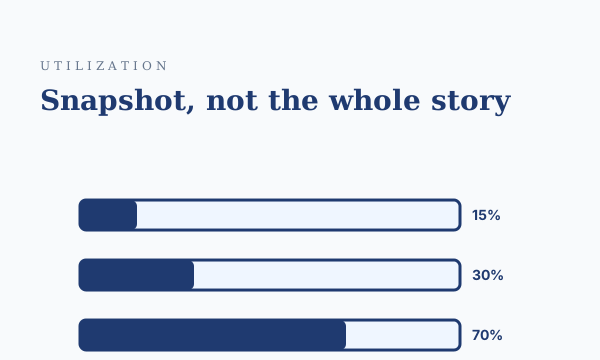
Credit Utilisation: Why 30% Is the Number You Keep Hearing
Credit utilisation is the second-largest factor in your credit score. Understanding how it is calculated — and when it is calculated — is the key to using it.
Credit Card vs Debit Card: Which One Should You Actually Use?
For most day-to-day spending, a credit card offers stronger consumer protection and better rewards — but only if used with the discipline of a debit card.