Credit
How to Read Your Credit Report — And What to Do When It's Wrong
Your credit report is the raw material behind every credit score you have. Reading it once a year — and disputing errors — costs nothing and can raise your score meaningfully.
Last updated September 3, 2026
Your credit report is the underlying record that credit scores are calculated from. Three major bureaus — Equifax, Experian, and TransUnion — each maintain their own report on you, and lenders may pull from any or all of them. Errors are common (a Federal Trade Commission study found that roughly one in five consumers had a meaningful error on at least one report), so an annual check is a small habit with a real payoff.
Where to get your report
AnnualCreditReport.com is the only federally authorised source of free credit reports in the US. All three bureaus currently allow free weekly reports at that site. Do not use lookalike sites — several charge for reports that are legally free.
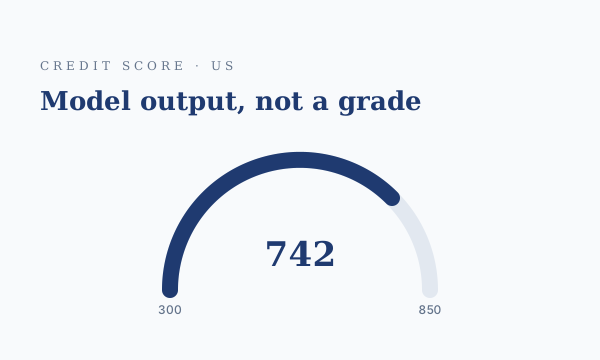
Your credit report does not include your credit score. Many banks and credit-card issuers now offer a free FICO or VantageScore in their app or online portal.
The four main sections of a report
Personal information
Name, current and past addresses, date of birth, employers, and sometimes phone numbers. Errors here can be minor (a misspelled name) or serious (an unfamiliar address, which may indicate identity theft). Investigate anything you do not recognise.
Credit accounts
Each open and closed account you have had in recent years, with monthly payment history, balance history, credit limit or original loan amount, and account status. This section drives the score, and errors here are the highest-priority items to dispute.
Public records
Certain public records that affect creditworthiness, most notably bankruptcies. Judgments and tax liens have been excluded from most credit reports since 2017–2018, so bankruptcies are now the primary public record likely to appear.
Inquiries
Every hard inquiry (a lender pulling your report for a formal application) is listed for two years. Soft inquiries (your own check, prescreened offers) are shown to you but not to lenders.
Common errors to watch for
Six errors show up more than any others. Accounts that are not yours. A wrong balance or credit limit. A paid-off account still showing as owed. An account listed as late that was paid on time. Duplicate accounts (the same debt listed twice). An account that should have "aged off" the report (most negative items fall off after seven years; Chapter 7 bankruptcy after ten).
How to dispute an error
Under the Fair Credit Reporting Act, you can dispute an item with the bureau reporting it, the creditor that furnished the information, or both. Filing with the bureau is usually simplest — each bureau offers online dispute forms. Include copies (never originals) of any supporting documents. The bureau generally has 30 days to investigate and respond.
If the dispute is upheld, the item is corrected or removed and the bureau will send you an updated report. If the dispute is denied but you disagree, you have the right to add a brief statement of dispute to your file and to escalate to the Consumer Financial Protection Bureau, which accepts complaints against both bureaus and creditors.
How often to check
An annual check is a reasonable minimum. If you are preparing for a major loan (mortgage, auto), check all three reports several months in advance so you have time to dispute anything found. Ongoing free monitoring is available through Credit Karma, Experian, and many credit-card issuers.
Audit the report in a fixed order
Start with identity information and addresses for signs of mixed files or fraud. Then review every account for ownership, status, opening date, limit, balance, payment history, and closure. Check collections and inquiries last. Compare all available reports because a lender may report to one company and not another, and the same error can appear differently.
Separate unfamiliar from inaccurate. An account may appear under a bank’s legal name, a transferred servicer, or a debt buyer. Research the entry through official contact information before disputing it as fraud. Save the complete report, confirmation number, and date securely; a live portal can change while a dispute is pending.
Make a precise, evidenced dispute
Identify the exact field, explain why it is wrong, state the correction requested, and attach only relevant copies of statements, identity documents, cancellation letters, or payment proof. Dispute with the reporting company and, where appropriate, the company that supplied the data. Keep originals and a timeline of submissions and responses.
Do not dispute accurate information in the hope it disappears, and avoid businesses selling guaranteed deletion. If identity theft is involved, use the official identity-theft process and consider available freezes or fraud alerts. Escalation rights and response periods depend on facts and current law, so follow CFPB and FTC instructions rather than a generic countdown.
Where to get free official credit reports
AnnualCreditReport.com is the only federally authorized source for free credit reports from all three major bureaus (Equifax, Experian, TransUnion). Under federal law, you are entitled to at least one free report from each bureau every 12 months. Since 2020, the bureaus have voluntarily provided free weekly reports through the same website — a policy that has been extended multiple times and remains in effect as of 2024.
Avoid the many websites and apps that offer "free credit reports" — most are marketing tools for paid subscription services (credit monitoring, identity theft protection) that may automatically enroll you at monthly fees. Legitimate free reports come only from AnnualCreditReport.com or directly from creditors that provide free FICO score access as an account benefit.
Reviewing all three bureau reports matters because errors often appear on one bureau’s report but not the others. A creditor may report to Equifax but not Experian, or an identity thief may open accounts using data from only one bureau. Checking all three provides complete visibility into your credit files.
What actually appears on a credit report
Personal identifying information: your name (and any variations), current and past addresses, Social Security number (last four digits typically), date of birth, employers. Errors in this section can indicate identity theft or mixed files with someone else’s data.
Account information: every credit account associated with you — credit cards, mortgages, auto loans, student loans, personal loans, and some retail store accounts. Each entry shows creditor name, account number (typically partially redacted), account status (open, closed, in collections), payment history (typically 24-84 months of monthly payment status), credit limit or original loan amount, current balance, and date of last activity.
Public records: bankruptcies (7-10 years depending on chapter), civil judgments (removed from reports in 2017 under NCAP), and tax liens (removed from reports in 2018 under NCAP). Bankruptcy remains the primary public record still appearing on reports.
Inquiries: hard inquiries (from credit applications, typically 2-year impact on score, remains on report 2 years) and soft inquiries (from account reviews, pre-approvals, self-checks — visible only to you, no score impact).
Collections: debts sold to third-party collection agencies. These typically appear as separate entries from the original creditor’s tradeline and can significantly damage credit scores. Paid collections may or may not be removed depending on scoring model and negotiations with collectors.
How to systematically audit each report
Download each bureau’s report as a PDF and save copies dated with the review date. This creates a permanent record of what appeared at that point in time — essential if you later need to dispute items or reference historical data.
Section-by-section review process: (1) personal information for accuracy; (2) each open account for correct balance, credit limit, payment history, and account status; (3) each closed account for accurate closure date and final status; (4) each collection or public record for legitimacy and accuracy; (5) hard inquiries for authorization — any hard inquiry you did not authorize is potentially fraudulent.
Common errors that harm credit scores: outdated addresses (may enable identity theft), incorrect account statuses (open showing as closed), balance errors (typically too high), missed payment notations for payments actually made on time, and duplicate accounts (same account reported twice, doubling apparent debt).
Disputing errors with the credit bureaus
The Fair Credit Reporting Act requires bureaus to investigate disputed items within 30 days of receiving the dispute (45 days if additional information is provided during the investigation). File disputes online through each bureau’s dispute portal, by mail, or by phone. Online is fastest; mail creates a documented paper trail.
For each disputed item, specify: the account or item in dispute, the specific error (wrong balance, incorrect status, unrecognized account), and the correction requested. Attach supporting documentation: statements showing accurate balances, letters from creditors confirming account status, identity theft affidavits for fraudulent accounts.
The bureau contacts the furnisher (the company that provided the information) for verification. If the furnisher confirms the disputed information as accurate, the bureau typically leaves it on the report. If the furnisher fails to respond within the required timeframe or acknowledges the error, the bureau must correct or remove the item.
If your dispute is denied and you believe the item is genuinely wrong, escalate: (1) file a dispute directly with the furnisher (creditor) providing the incorrect information; (2) file a complaint with the Consumer Financial Protection Bureau; (3) consult a consumer protection attorney if the error causes measurable harm (denied credit, higher interest rates).
Fraud alerts and credit freezes
Fraud alerts require creditors to verify your identity before opening new credit in your name. Initial fraud alerts last one year; extended alerts (requiring proof of identity theft) last seven years. Placing a fraud alert with one bureau automatically shares it with the other two.
Credit freezes lock your credit report so creditors cannot access it to open new accounts. Under 2018 federal law, freezes are free at all three bureaus. You must temporarily lift the freeze when applying for new credit yourself. Freezes are more restrictive than fraud alerts but provide stronger protection against identity theft.
Recommended practice for identity theft prevention: place credit freezes at all three bureaus preemptively (before any theft occurs), lifting temporarily only when applying for credit. This dramatically reduces the risk of unauthorized accounts being opened even if your personal information is compromised.
Credit monitoring services: what they actually provide
Free credit monitoring services (Credit Karma, Experian Credit Boost, some credit card issuer benefits) notify you when changes appear on your credit report — new accounts, credit inquiries, address changes, new negative items. This provides early warning of potential identity theft without preventing it.
Paid credit monitoring services ($10-30/month typically) add features: three-bureau monitoring, higher-dollar identity theft insurance, dark web scanning, credit score simulators. Some are worthwhile for people with past identity theft or public visibility; most are overpriced for average consumers who could achieve similar protection through free credit freezes.
Identity theft insurance included in paid services often has significant limitations. Coverage may exclude the actual financial losses (only paying for time spent on recovery) or require extensive documentation before paying claims. Read policy details carefully before assuming coverage would actually help in a real incident.
How often to check reports
For most people, checking all three bureau reports annually is sufficient — enough to catch major errors and identity theft while not creating excessive time investment. Stagger the checks: Equifax in January, Experian in May, TransUnion in September — providing quarterly touchpoints without checking all three at once.
Higher frequency (monthly or quarterly) makes sense during specific circumstances: after identity theft or data breach involving your information, when preparing for a major loan application, or when actively working to improve credit scores and wanting to track progress.
Free weekly access through AnnualCreditReport.com (extended policy from pandemic era) allows more frequent checks without cost. This is particularly useful during active credit-building or dispute resolution periods where you want to see changes as they occur.
Common credit report mistakes
The most common mistake is never checking credit reports. Millions of Americans have never reviewed their own credit reports. Errors accumulate, identity theft goes undetected, and mysterious credit denials happen without understanding why. First-time reviewers frequently find surprising errors that have been damaging their credit for years.
The second common mistake is disputing items you dislike but that are accurate. Bureaus and creditors verify disputed items — if the item is accurate, the dispute is denied and the item remains. Attempting to game the system by disputing accurate negative information wastes effort. Focus disputes on genuine errors and let accurate negative information age off naturally.
The third mistake is using unofficial "free credit report" websites that enroll you in paid subscriptions. AnnualCreditReport.com is the only source federally required to be free without conditions. Anything else asking for credit card information "for verification only" is typically a subscription trap.
Sources and methodology
We use primary and authoritative sources for rules, definitions, and data. Sources and factual claims were last checked September 3, 2026.
- Credit reports and scores — Consumer Financial Protection Bureau (United States)
- Free credit reports — Federal Trade Commission (United States)
- What is a credit score? — Consumer Financial Protection Bureau (United States)
Frequently asked questions
- Is my credit report the same as my credit score?
- No. The report is the underlying record. The score is a number calculated from that record using a scoring model like FICO or VantageScore.
- How long do disputes take?
- The bureau generally has 30 days from receipt of your dispute to investigate and respond, extendable to 45 days in some circumstances.
- Can I remove accurate negative items?
- Generally no. Accurate negative information stays on your report for the period allowed by law (typically seven years for late payments, ten years for Chapter 7 bankruptcy) regardless of any dispute.
Related articles
What Actually Affects Your Credit Score (Ranked by Impact)
Credit scores look mysterious but rest on five simple factors, and two of them account for the majority of your score. Focus there first.

How to Build Credit From Scratch (No Cosigner Required)
Building a credit history from zero used to require a cosigner or an established relative. Today, three specific tools let almost anyone start in a single afternoon.
Credit Utilisation: Why 30% Is the Number You Keep Hearing
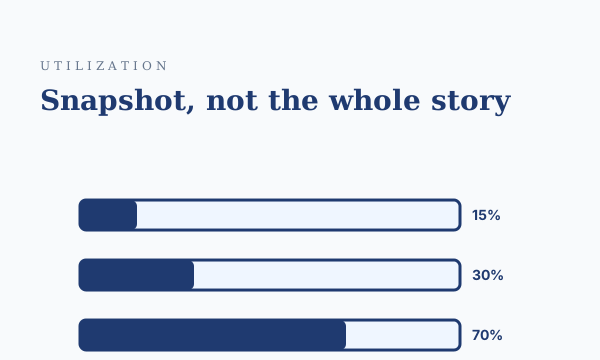
Credit utilisation is the second-largest factor in your credit score. Understanding how it is calculated — and when it is calculated — is the key to using it.