Saving
How Much Should You Put Down on a House?
The 20 percent rule you keep hearing is not required. Here is how to decide the right down payment for your situation, balancing interest, insurance, and opportunity cost.
Last updated September 3, 2026
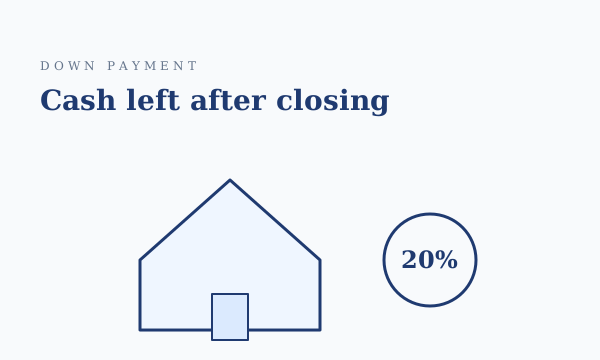
The traditional advice is to put 20 percent down on a house. That advice is not wrong, but it is also not required, and treating it as a hard rule can delay homeownership for years without a corresponding financial benefit. This guide walks through what the down payment actually controls and how to decide the right amount for your situation.
What the down payment controls
The down payment is the portion of the purchase price you pay in cash at closing. The rest is financed with a mortgage. Three things move with the down payment: the loan amount (and therefore the monthly payment), the interest rate offered (larger down payments sometimes qualify for slightly better rates), and whether private mortgage insurance is required.
PMI: the sub-20 percent cost
Conventional loans typically require PMI when you put less than 20 percent down. PMI protects the lender if you default and typically costs 0.5 to 1.5 percent of the loan amount per year, paid monthly. On a $300,000 loan, that is roughly $125 to $375 per month. PMI is not permanent: you can request removal once your equity reaches 20 percent, and it automatically ends at 22 percent equity by federal law.
FHA loans have their own mortgage insurance (MIP) that works differently and often lasts the life of the loan. If you use an FHA loan to buy in with a small down payment, plan to refinance to a conventional loan once you have built enough equity, or accept MIP as part of the ongoing cost.
The case for 20 percent down
A 20 percent down payment eliminates PMI, gives you immediate equity that protects you if home values fall, reduces the monthly payment, and lowers total interest paid over the life of the loan. For someone with the cash reserves to do it comfortably (with an emergency fund intact), it is a sound choice.
The case for less than 20 percent
Waiting until you have 20 percent saved can take years, during which you are paying rent and potentially missing home-price appreciation. If you have stable income, a solid emergency fund, and a mortgage payment that fits comfortably in your budget even with PMI, buying with 5 or 10 percent down and eliminating PMI later can make more sense than waiting.
It also matters what else you could do with the extra cash. Putting an additional $40,000 into a down payment locks that money into home equity, which is illiquid. Investing it in tax-advantaged retirement accounts often produces higher expected long-term returns than the mortgage interest and PMI you would avoid.
A practical framework
Three checks: keep a full emergency fund untouched after closing; keep the total monthly housing cost (mortgage, insurance, taxes, PMI) at or below about 28 percent of gross income; and put down whatever is left in cash beyond those two commitments. If that lands you at 8 percent down, that is fine. If it lands you at 25 percent, that is also fine.
Optimise cash left after closing, not just the percentage down
Build a uses-of-cash sheet: down payment, lender and legal fees, taxes, inspections, moving, immediate repairs, furnishings, and an emergency reserve that remains untouched. A larger down payment can reduce borrowing but still be unsafe if it leaves no liquidity. Compare complete loan estimates at several down-payment levels rather than assuming the traditional round number is always best.
For each option, record the interest rate, total financed amount, required mortgage insurance or guarantee fee, cash due, and the date any insurance can end. Then model a higher maintenance year and a temporary income loss. The affordable option is the one that survives those cases without relying on a credit card—not merely the one with the lowest scheduled payment.
Put opportunity cost in the right risk category
Money added to the down payment earns a return roughly equal to avoided borrowing cost, adjusted for tax and fees, but becomes home equity that is costly to access. Money kept in cash earns less but provides resilience. Money invested has higher expected return only with risk and a long horizon. Do not justify a thin reserve by comparing guaranteed mortgage cost with an optimistic market average.
Verify local programmes directly with the housing authority or lender and compare effective cost, not advertised minimum down payment. Assistance may be a grant, forgivable loan, shared-equity claim, or second lien. Read occupancy, resale, and repayment conditions before treating it as free money.
The 20% down payment myth and reality
The widespread belief that you need 20% down to buy a home is a myth that has kept many first-time buyers out of the market unnecessarily. The 20% figure comes from the threshold at which private mortgage insurance (PMI) is no longer required by most conventional lenders. It is a useful target, but it is not a requirement. FHA loans require as little as 3.5% down; conventional loans from many lenders accept 3-5% down; VA loans (for eligible veterans) require 0% down; USDA rural loans (for eligible properties and buyers) require 0% down.
The trade-offs are real. Lower down payments mean higher monthly payments (borrowing more), often mandatory mortgage insurance (adding cost), and higher long-term interest paid. But they also mean buying sooner, starting to build equity earlier, and not depleting savings entirely. For many first-time buyers, a 5-10% down payment with PMI produces better long-term outcomes than waiting 5-7 more years to save 20% while paying rent.
Mortgage insurance mechanics: PMI, MIP, and funding fees
Private mortgage insurance (PMI) is required on conventional loans with less than 20% down. Cost varies by loan-to-value ratio and credit score, typically 0.3-1.5% of the loan amount annually. On a $400,000 loan, that is $100-500 per month. PMI can be paid monthly (added to the mortgage payment), upfront (a lump sum at closing), or as a combination. Monthly PMI is the most common and can be cancelled once you reach 20% equity — either by paying down principal or through home appreciation.
FHA loans carry Mortgage Insurance Premium (MIP), which behaves differently. Upfront MIP is 1.75% of the loan amount, financed into the loan. Annual MIP is 0.55-0.85% of the loan amount, paid monthly. Critically, MIP on loans originated after June 2013 with less than 10% down lasts for the full loan term — it cannot be cancelled by reaching 20% equity. FHA borrowers seeking to eliminate MIP typically refinance to a conventional loan once they have sufficient equity.
VA loans have no monthly mortgage insurance but charge a one-time "funding fee" at closing (2.15-3.3% of the loan amount, depending on down payment and whether it is a first-time or subsequent VA loan). The funding fee can be financed into the loan. Certain disabled veterans are exempt from the funding fee entirely.
How much to actually save: beyond the down payment
The down payment is only one component of home purchase cash needs. Closing costs typically run 2-5% of the purchase price, covering lender fees, appraisal, title insurance, transfer taxes, escrow setup, and other charges. On a $400,000 home, closing costs of $10,000-20,000 are typical. Some can be rolled into the loan or paid by seller concessions, but many buyers pay them out of pocket.
Moving costs, immediate repairs, essential furnishings, and utility deposits add another $2,000-10,000 for most buyers. And critically, an emergency fund must remain intact after closing — depleting all cash reserves for a bigger down payment leaves you one furnace failure away from credit card debt. A general rule: reserve 3-6 months of expected mortgage payments in liquid savings, separate from the down payment and closing costs, before purchase.
The total cash target: down payment + closing costs + moving/setup + 3-6 months of housing payments as reserve. A buyer targeting a $400,000 home with 5% down needs roughly $20,000 down + $15,000 closing + $5,000 setup + $15,000 reserve = $55,000 total. This is dramatically more than the "5% down = $20,000" figure that gets quoted in isolation.
Where to hold down payment savings
Money you plan to use within 2 years should not be in the stock market. Historical drawdowns show that a diversified equity portfolio can drop 30-50% in short periods; if you need the money in 18 months, you cannot afford that risk. Down payment savings should be in high-yield savings accounts, money market funds, short-term CDs, or Treasury bills — instruments where principal is protected and returns come from interest, not appreciation.
Money you might use in 3-5 years is a grey area. Some buyers hold 100% cash for the entire down payment savings period; others allocate 20-40% to short-duration bond funds for slightly higher expected returns while keeping the majority in cash. The right allocation depends on how flexible your timeline is — if you can delay purchase by 2-3 years if markets are unfavourable, some risk exposure is defensible; if the purchase date is fixed, cash-equivalent instruments are the right choice.
Down payment assistance programs
Every US state has some form of down payment assistance for first-time buyers, and many cities have additional programs. These typically take the form of grants (money you do not repay), forgivable loans (forgiven after living in the home for 5-10 years), or deferred-payment second mortgages (no payments until you sell or refinance). Income limits, purchase price limits, and geographic restrictions vary by program.
Programs are typically administered by state Housing Finance Agencies (HFAs) and can be combined with FHA, VA, or conventional loans. First-time buyer status is defined generously — most programs consider you a first-time buyer if you have not owned in the past 3 years. Search "[your state] Housing Finance Agency" and "[your city] first-time homebuyer" to find local programs. Some programs have long processing times, so start research early in the home-buying process.
The buy vs continue-renting analysis
The financial case for buying vs renting depends on many variables: mortgage rate, home price growth, rent growth, tax situation, and how long you will stay in the home. The rough rule: buying tends to make financial sense when you will stay 5+ years and rent for a comparable property exceeds your prospective total mortgage payment (P&I + taxes + insurance + PMI + maintenance) by a meaningful margin.
The New York Times Buy vs Rent calculator (freely available online) walks through the variables in detail and produces a personalised analysis. Use it with realistic inputs — most people underestimate maintenance costs (rule of thumb: 1-2% of home value annually) and overestimate home appreciation. If the analysis is close, non-financial factors (stability, ability to customise, community ties) may tip the decision toward buying even when pure math is neutral.
Common down payment mistakes
The most common mistake is depleting emergency savings for a bigger down payment. Reaching 20% down by using every dollar of emergency reserves leaves the household one shock away from serious problems. Better to accept PMI temporarily and preserve reserves; PMI can be cancelled later, but rebuilding emergency reserves after they are drained during a crisis is much harder.
The second common mistake is misunderstanding the tax deduction for mortgage interest. Since 2018, the standard deduction has increased significantly, and only about 10% of taxpayers itemise. Most buyers do not receive any tax benefit from mortgage interest deduction unless they have other significant itemisable expenses. Do not justify a larger mortgage based on assumed tax benefits without confirming you will actually itemise.
The third mistake is skipping the home inspection to make an offer more competitive. In competitive markets, some buyers waive inspection contingencies to strengthen offers. This can save deal-breaking negotiations but exposes buyers to discovering major structural, electrical, or plumbing issues after closing — expenses that can quickly exceed the down payment savings. Consider a pre-offer inspection instead of no inspection when possible.
Sources and methodology
We use primary and authoritative sources for rules, definitions, and data. Sources and factual claims were last checked September 3, 2026.
- Mortgages key terms — Consumer Financial Protection Bureau (United States)
- Primary Mortgage Market Survey — Freddie Mac (United States)
- An essential guide to building an emergency fund — Consumer Financial Protection Bureau (United States)
Frequently asked questions
- Do first-time buyers qualify for low-down-payment loans?
- Yes. FHA loans allow as little as 3.5 percent down, and some conventional programs allow 3 to 5 percent for qualifying buyers. Each program has its own trade-offs on rate and insurance.
- Is PMI tax-deductible?
- PMI deductibility has changed several times based on tax law. Check the current-year rules and your specific tax situation before assuming a deduction.
- Should I put down 20 percent or invest the difference?
- Depends on the mortgage rate versus expected long-term investment returns and your risk tolerance. Historically, long-term stock returns have exceeded typical mortgage rates, but the mortgage savings are guaranteed while investment returns are not.
Related articles
How Much Emergency Fund Do You Really Need?
The standard "three to six months of expenses" is a starting point, not a rule. Here is how to size your emergency fund based on your real situation.
When Does It Make Sense to Refinance a Mortgage?
The old rule of "refinance if rates drop 1 percent" is a rough shorthand for a math question that has a clean answer once you calculate the breakeven point.
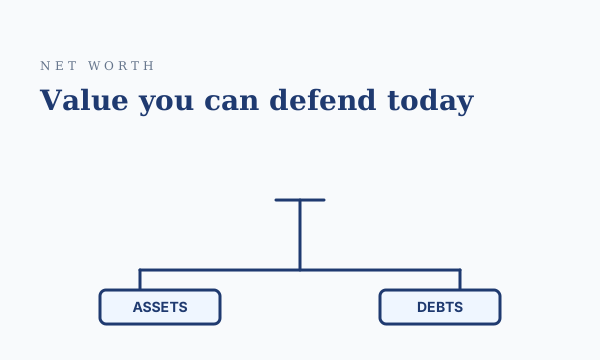
How to Calculate Your Net Worth (And Why It Matters More Than Income)
Income tells you what you earn. Net worth tells you what you actually have. It is the single most useful number for tracking your long-term financial progress.