Saving
CDs vs High-Yield Savings: Which Is Better for Your Cash?
Certificates of deposit lock in a rate but lock up your money. High-yield savings stay flexible but the rate can drop. Here is how to choose between them.
Last updated September 3, 2026
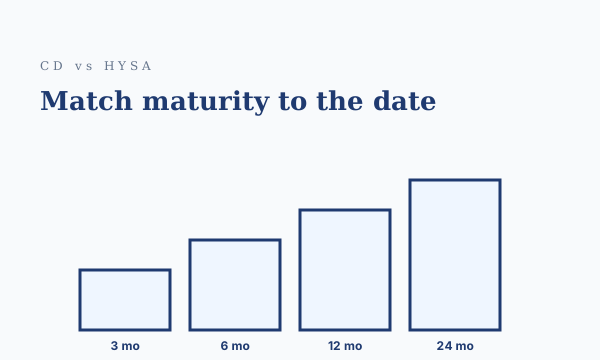
Certificates of deposit (CDs) and high-yield savings accounts (HYSAs) both offer safe places to hold cash and earn interest, but they behave very differently. A CD locks in a fixed rate for a set term — six months, one year, five years — in exchange for less flexibility. An HYSA pays a variable rate but lets you move money in and out whenever you like.
Choosing between them comes down to two questions: how sure are you about when you will need the money, and where do you expect interest rates to move?
How CDs work
When you open a CD, you deposit a lump sum for a fixed term at a fixed rate. In exchange for committing to leave the money untouched, banks typically pay a higher rate than a standard savings account. At the end of the term (the "maturity date"), you can withdraw the principal plus interest or roll it into a new CD.
Withdraw the money early and you will normally pay a penalty — commonly three to twelve months of interest, depending on the term. On a short-term CD held only a few months, that penalty can eat every dollar of interest earned and then some.
How HYSAs work
A high-yield savings account has no term. The rate is variable and can change at any time as broader interest rates move. You can add or withdraw money whenever you like, subject to any per-day transfer limits your bank imposes.
That flexibility is the key selling point — but it comes with rate risk. If rates fall, so does the interest your HYSA earns, sometimes within days.
When a CD makes more sense
CDs are a good fit when you know exactly when you will need the money and want to lock in today's rate. Common examples include a tax bill due in nine months, a down payment planned for eighteen months out, or a large purchase scheduled two years ahead. A CD that matures a week before the expense guarantees the rate and removes market-timing anxiety.
CDs are also useful in a falling-rate environment. If you believe short-term rates will decline meaningfully over the next year, locking in today's higher rate for a longer term can preserve your yield.
When an HYSA makes more sense
An HYSA is the right tool for money whose timing is uncertain: emergency funds, general savings, sinking funds, and any cash you might need on short notice. It is also better in a rising-rate environment, because your yield rises as rates do without any action from you.
CD laddering: getting some of both
A CD ladder combines several CDs of different terms so that one matures regularly. A simple five-year ladder buys equal amounts of one-, two-, three-, four-, and five-year CDs. Each year one matures, and you renew it as a new five-year CD. After the ladder is fully built, you get a five-year CD's higher rate but a portion of the money becomes accessible every year without penalty.
The bottom line
Neither product is universally better. CDs pay a small premium for giving up flexibility; HYSAs pay slightly less but keep every option open. Match the tool to the job — and never lock money into a CD if there is a real chance you will need it before the term ends.
Match the maturity date to the cash-flow date
Start with when the money may be spent. Cash needed on an exact date can fit a term deposit that matures shortly beforehand; cash with an uncertain date needs liquidity. Compare the guaranteed interest from the fixed term with a range of plausible savings-account rates, but include early-withdrawal penalties and the chance that a bank will not allow a partial withdrawal.
A ladder reduces one large timing bet. Divide the amount across several maturities, then renew only the portion that is not needed. This improves access but creates more renewal decisions and may not be worth the administration for a small balance. Turn off automatic renewal unless you understand the grace period, the new rate, and how to withdraw at maturity.
Measure protection and reinvestment risk
Confirm whether principal and accrued interest count toward the local deposit-protection cap and whether multiple brands share one banking licence. A brokered or marketplace deposit can have different recordkeeping and access arrangements from an account opened directly. Keep cash below applicable limits across each legal institution, not merely each app or brand.
Fixed rates protect against falling rates but create reinvestment risk when the term ends; flexible rates can fall immediately but let you move. Neither is universally safer. The decision should follow the spending deadline, penalty terms, guarantee coverage, and currency—not a prediction about central-bank policy.
How CDs and HYSAs differ mechanically
A certificate of deposit (CD) is a time deposit: you agree to leave a specific amount of money with the bank for a specific term (from a few months to five years or more), and in exchange the bank pays a fixed interest rate. A high-yield savings account (HYSA) is a demand deposit: your money remains accessible, and the bank pays a variable interest rate that can change at any time. The trade-off is straightforward: CDs offer rate certainty in exchange for liquidity restrictions; HYSAs offer liquidity in exchange for rate uncertainty.
The mechanical difference also affects tax treatment in some jurisdictions and beneficiary rules. CDs are typically evidenced by a written certificate or account agreement with specific maturity and early-withdrawal terms; HYSAs are ordinary bank deposits governed by the deposit agreement. Both are covered by deposit insurance (FDIC in the US up to $250,000 per depositor per insured bank per ownership category; NCUA for credit unions), but the specific counting rules for coverage differ between account types when a depositor holds both.
When a CD makes more sense than an HYSA
CDs are the right choice when you know exactly when you will need the money and you want to lock in a rate. Someone saving for a house down payment 18 months out, a tax bill due in 6 months, or a tuition payment 12 months away can match the CD term to the need date and eliminate the risk that rates drop before they need the money. The certainty is genuinely valuable when the timing is genuinely fixed.
CDs also make sense in high-rate environments when you expect rates to fall. If the current 12-month CD rate is 5.5% and short-term rates are expected to decline to 3-4% over the next year, locking in 5.5% for a year captures value that will disappear from HYSAs as rates drop. This is a rate-prediction bet, not a certainty, but the CD locks in the higher rate regardless of what actually happens.
A third case: CDs can be useful for behavioural reasons. Someone who repeatedly raids their HYSA for non-emergency spending may benefit from the "friction" of a CD, where accessing the money early triggers an interest penalty. This is not the most sophisticated financial planning, but if it prevents money leakage, it may produce better real-world outcomes than an HYSA that gets tapped every few weeks.
When an HYSA makes more sense than a CD
HYSAs are the right choice when you might need the money on short notice, when the amount you can save is unpredictable, or when you want the flexibility to add or withdraw money regularly. The emergency fund is the canonical case: by definition, you cannot predict when you will need it, and locking it in a CD undermines its entire purpose. Similarly, a savings buffer for irregular income should be immediately accessible, not tied up for 6 or 12 months.
HYSAs also make more sense when rates are rising. A CD locked at 3.5% for 12 months looks great when it opens; it looks less great when HYSA rates rise to 5% three months later and stay there. The CD holder is stuck at the lower rate until maturity; the HYSA holder captures the increase immediately. In rising-rate environments, the flexibility of the HYSA has quantifiable value.
The break-even between CDs and HYSAs depends on the rate spread and the term. If a 12-month CD pays 4.5% and the HYSA pays 4.2%, the CD earns roughly $30 more per $10,000 over the year — often not worth the loss of liquidity. If the spread is 5.5% CD vs 4.0% HYSA, the CD earns $150 more per $10,000, which starts to be meaningful. Do the math for your specific situation and balance, not the generic advice.
CD ladders: capturing yield without full lockup
A CD ladder addresses the CD liquidity problem by dividing money across multiple CDs with staggered maturity dates. A $10,000 five-year ladder might be $2,000 each into 1-, 2-, 3-, 4-, and 5-year CDs. Each year, one CD matures and can either be spent or reinvested into a new 5-year CD at whatever the then-current rate is. After five years, the entire portfolio consists of 5-year CDs (which typically pay the highest rates), but with one maturing each year for liquidity or reinvestment.
The ladder is a middle path: it captures more yield than a pure HYSA (because long-term CDs typically pay more than short-term rates) but retains more liquidity than a single long CD (because a portion matures each year). It also dollar-cost-averages the reinvestment rate — if rates rise, new CDs capture higher yields; if rates fall, the older CDs still earning the higher rates provide time to plan.
Ladder complexity is a real cost. Managing 5 CDs across 5 maturity dates means more paperwork, more autopilot decisions, and more chances to miss a maturity notification and end up in an automatic renewal at a lower rate. For balances under $10,000, the ladder complexity often exceeds the benefit; for balances over $50,000, the extra yield can justify the effort.
Early withdrawal penalties: knowing the real cost
Every CD has an early withdrawal penalty. Typical penalties are 90 days of interest for CDs under 12 months, 180 days for 1-2 year CDs, and 12 months of interest for longer CDs. Some banks impose penalties larger than the interest earned to date, meaning early withdrawal can actually reduce your principal — a nasty surprise for depositors who assumed the penalty was capped at accrued interest.
Read the specific early withdrawal terms before opening a CD. If you might need the money before maturity, compare the CD rate net of the potential penalty against the HYSA rate. A 5% CD that becomes a 3% effective rate after early withdrawal may not be worth choosing over a 4.5% HYSA. Some banks offer "no-penalty CDs" with slightly lower rates in exchange for waiving the early withdrawal penalty — a middle option worth considering for uncertain-timing money.
Deposit insurance details for both
FDIC insurance covers up to $250,000 per depositor per insured bank per ownership category. "Per depositor per bank" means one person with $250,000 at Bank A and $250,000 at Bank B is fully covered; the same person with $500,000 at Bank A is only insured for half. "Per ownership category" means the same person may have $250,000 in single-ownership deposits AND $250,000 in joint-ownership deposits at the same bank, both fully insured.
CDs and HYSAs at the same bank count together toward the $250,000 limit; they are not separately insured just because they are different account types. If you hold $200,000 in a CD and $100,000 in an HYSA at the same bank, only $250,000 is insured — the last $50,000 is uninsured. High-balance depositors need to spread deposits across multiple banks or use IntraFi/CDARS services that automatically distribute deposits to maintain full insurance coverage.
Common CD vs HYSA mistakes
The most common mistake is choosing based on advertised rates without considering the underlying purpose of the money. A 5.5% CD looks better than a 4.2% HYSA on paper — but if the money is for emergencies, the CD is wrong regardless of rate. Purpose determines account type; rate only decides which specific provider within the right category.
The second common mistake is ignoring automatic renewal. Most CDs automatically renew at maturity if you do not provide instructions during the (usually 7-10 day) grace period. The renewal rate is typically the current standard rate for that term, which may be dramatically different from the original rate. Set calendar reminders for CD maturities to actively decide whether to renew, cash out, or move to a different product.
The third mistake is not shopping for HYSA rates. HYSA rates vary by 100-200 basis points across major providers at any given time. A depositor with $50,000 in a 3.5% HYSA is earning $500 less annually than the same money in a 4.5% HYSA — real money for essentially the same product with the same insurance. Check comparison sites quarterly and switch when the spread is large enough to justify the effort.
Sources and methodology
We use primary and authoritative sources for rules, definitions, and data. Sources and factual claims were last checked September 3, 2026.
- Deposit insurance at a glance — Federal Deposit Insurance Corporation (United States)
- Share insurance coverage — National Credit Union Administration (United States)
- Bank accounts and services — Consumer Financial Protection Bureau (United States)
Frequently asked questions
- Are CDs safe?
- Yes, when opened at an FDIC-insured bank or NCUA-insured credit union. Coverage limits are the same as for a savings account (typically $250,000 per depositor, per institution, per ownership category).
- What is a "no-penalty CD"?
- A CD that allows one full early withdrawal with no penalty, usually starting a week after opening. Rates on no-penalty CDs are typically slightly lower than standard CDs.
- Are CD earnings taxed?
- Yes. In the US, CD interest is reported on Form 1099-INT and is generally taxed as ordinary income in the year it is credited, even if the CD has not yet matured.
Related articles
High-Yield Savings Accounts: How They Work and How to Choose One
High-yield savings accounts pay roughly ten to twenty times more interest than traditional bank accounts. Here is how they work, how they are insured, and how to pick a good one.
How Much Emergency Fund Do You Really Need?
The standard "three to six months of expenses" is a starting point, not a rule. Here is how to size your emergency fund based on your real situation.
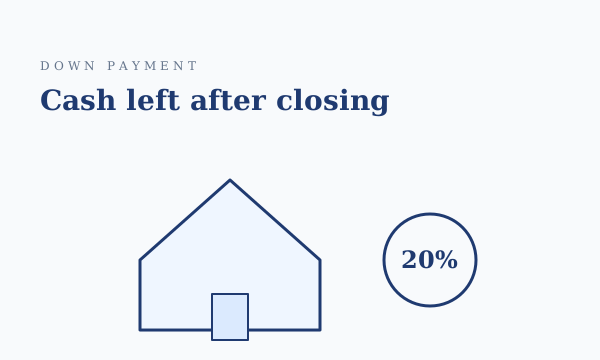
How Much Should You Put Down on a House?
The 20 percent rule you keep hearing is not required. Here is how to decide the right down payment for your situation, balancing interest, insurance, and opportunity cost.