Investing
Dollar-Cost Averaging: The Boring Strategy That Usually Wins
Dollar-cost averaging removes market timing from investing. It rarely produces the best possible outcome, but it very often produces a good one — which matters more.
Last updated September 3, 2026
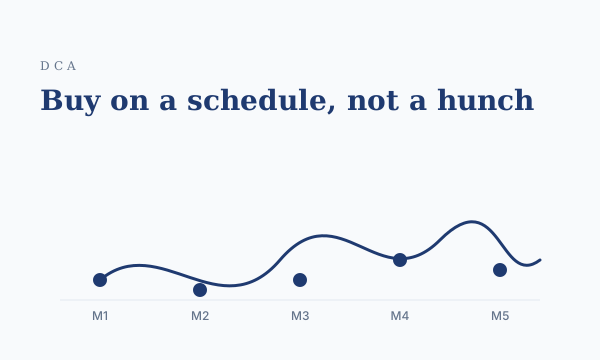
Dollar-cost averaging (DCA) is the practice of investing a fixed dollar amount on a regular schedule — for example, $500 every two weeks — regardless of what the market is doing. It is the default approach built into most workplace retirement plans, which is why millions of people are already using it whether they know the term or not.
DCA is not about maximizing returns. It is about removing decisions from a process that people are consistently bad at handling emotionally.
How DCA works — a worked example
Suppose you invest $200 per month into the same index fund. In month one the share price is $50, so you buy four shares. In month two the price falls to $40, so your $200 buys five shares. In month three it recovers to $55, so you buy roughly 3.6 shares. Over three months you invested $600 and bought 12.6 shares at an average cost of about $47.60 per share — lower than the simple average price ($48.33) because you automatically bought more shares when they were cheaper.
DCA versus lump-sum investing
If you have a lump sum ready to invest today, is it better to invest it all at once or to spread it over several months of DCA? A Vanguard study covering roughly a century of US, UK, and Australian market data found that lump-sum investing outperformed twelve-month DCA about two-thirds of the time. The intuition is simple: markets rise more often than they fall, so getting the money in early captures more of that upside on average.
The one situation where DCA outperforms is when the market drops meaningfully soon after you invest — because you would then be buying more shares at lower prices with the remaining tranches. But you cannot predict that in advance, which is exactly the problem DCA was designed to sidestep.
Why DCA still wins for most people
The mathematical case for lump-sum investing assumes you can invest and hold without panicking. In practice, many people who invest a large sum right before a decline sell at the bottom out of fear, locking in losses they would not have taken if they had eased in. DCA removes the "did I pick the right day?" question and replaces it with a schedule you can defend to yourself in any market. For most investors, the emotional benefit is worth the small expected-return trade-off.
DCA in a workplace retirement plan
If you contribute to a 401(k), 403(b), or similar plan from every paycheque, you are already dollar-cost averaging. You do not need to layer another strategy on top. The main decision is simply to keep contributing at the same rate through both bull and bear markets — the worst outcomes historically come from stopping contributions during downturns and missing the recovery.
When to consider lump-sum instead
If you receive a large one-off amount (a bonus, an inheritance, a windfall) and your asset allocation is otherwise stable, statistics favour investing the full amount promptly. If the emotional weight of that decision is heavy, splitting the sum over three to six months is a reasonable compromise that captures most of the expected return while limiting regret.
Separate ongoing contributions from a lump-sum decision
Investing each paycheque is not the same problem as slowly deploying cash already available. The first is a savings habit: money is invested when earned. The second deliberately leaves part of an investable lump sum in cash, which may reduce regret and short-term timing risk but also delays market exposure. Name the decision correctly before comparing outcomes.
For a lump sum, define the schedule, interval, temporary cash location, and conditions that would change the plan. A vague promise to “wait for clarity” is market timing without a rule. Compare the expected opportunity cost of holding cash with the behavioural benefit of a staged entry, and keep the staging period finite.
Automation does not repair a bad portfolio
Regular purchases can smooth entry prices, but they do not make an expensive, concentrated, leveraged, or unsuitable asset safe. First select a diversified allocation consistent with the goal and time horizon. Then ensure transaction and foreign-exchange costs are not large relative to each contribution; less frequent purchases may be rational where fixed costs exist.
Measure success by adherence, savings rate, allocation, and all-in cost—not whether the latest purchase is above water. Rebalance using new contributions where possible. If income is irregular, use a percentage of each payment or invest after a minimum cash floor instead of forcing a monthly amount that repeatedly needs to be reversed.
What dollar-cost averaging actually is
Dollar-cost averaging (DCA) is investing a fixed dollar amount at regular intervals regardless of market conditions. The key insight: with a fixed dollar amount, you automatically buy more shares when prices are low and fewer shares when prices are high. Over time, this produces a lower average cost per share than the average market price over the same period.
Example: you invest $500 monthly in an ETF. In January the ETF costs $50 (you buy 10 shares), February $40 (12.5 shares), March $60 (8.33 shares), April $50 (10 shares). Total invested: $2,000. Total shares: 40.83. Average cost per share: $48.98. Average market price during the period: $50. DCA produced a $1.02/share advantage automatically through the mathematics of buying more shares when cheap.
This mathematical advantage exists whenever prices are volatile. It disappears in perfectly steady markets (rare) and can reverse in steadily rising markets (where you would have been better off investing everything upfront). But over long periods of typical market volatility, DCA reliably reduces average cost per share versus attempting to time markets.
DCA vs lump-sum investing: the honest research
Academic research consistently shows that for someone with a lump sum of money to invest, investing it all at once typically produces higher returns than spreading it across 6-12 months. A 2012 Vanguard study analyzing global markets over 65 years found lump-sum investing outperformed DCA about two-thirds of the time. The reason: markets rise most days; delaying investment means missing more returns than losses.
This is often cited to argue "DCA is inferior to lump-sum." That framing misses the real use case. Most investors do not have lump sums to invest — they have paychecks that arrive regularly. Investing each paycheck as it arrives is not DCA in the strict sense (there is no lump sum being spread out); it is simply investing income as it arrives, which is optimal for that use case.
DCA vs lump-sum matters when you receive a large one-time amount (inheritance, sale of business, tax refund, bonus, insurance settlement). In this narrow case, the mathematical evidence favors lump-sum investing — accepting that you might buy at a market top and endure a subsequent decline in exchange for the higher expected long-run return. The exception: if the emotional stress of possibly buying at a top would cause you to sell during the eventual decline, DCA may produce better real-world outcomes by preventing catastrophic behavioral mistakes.
Setting up automatic DCA
The practical implementation: set up automatic monthly transfers from checking account to investment account for a fixed dollar amount. Configure the investment account to automatically purchase your chosen fund with the transferred cash. Most major brokerages support this end-to-end automation. Once set up, no ongoing decisions are required.
Contribution frequency: monthly is standard and typically optimal. Bi-weekly (matching typical payroll) captures slightly more DCA benefit but adds negligible practical difference. Weekly or daily contributions add complexity without meaningful benefit for most investors. Annual contributions capture the least DCA benefit and expose contributors to timing risk (a single bad day of buying can dominate returns for the year).
Amount: whatever fits your budget consistently. Consistency matters more than amount. $100/month for 30 years accumulates far more than $500/month for 6 months followed by nothing. Start small if needed; increase with every raise. Aim for 15-20% of gross income going to retirement investments long-term.
DCA in retirement accounts
Retirement account contributions (401(k), IRA) are naturally dollar-cost averaged through payroll deductions or automated bank transfers. Someone contributing $500 monthly to a 401(k) is dollar-cost averaging by definition — buying investments with each paycheck at whatever the current market price is.
Do not try to "time" retirement contributions by pausing during volatile periods. The volatile periods are exactly when DCA delivers its greatest mathematical benefit. Someone who paused contributions during 2008-2009 (thinking they would wait for the market to recover before resuming) missed the greatest buying opportunity of a generation. Automation removes this temptation by making the decision once, in advance.
Increase contributions after every raise. Someone whose 401(k) contribution stays at 5% throughout their career effectively decreases contribution as a percentage of raised salary each year. Setting automatic contribution increases (many 401(k) plans offer this feature — often called "auto-escalation") captures raises for retirement without requiring active decisions.
DCA with taxable investing
For taxable brokerage accounts, DCA works identically to retirement accounts — automatic monthly transfers into diversified investments. The tax considerations are minor at the contribution stage; you owe taxes on dividends (generally quarterly) and capital gains only when you sell (potentially decades later).
For a lump sum in a taxable account (inheritance, home sale proceeds), the DCA vs lump-sum question is more nuanced due to tax basis considerations. Investing all at once establishes cost basis at the current price; DCA establishes multiple cost basis levels over time. This can matter for tax-loss harvesting strategies later but is generally a minor consideration compared to the mathematical advantage of full investment.
A hybrid approach for large lump sums: invest 40-60% immediately for the return-optimization benefit, DCA the remainder over 3-6 months to smooth entry. This captures most of the expected return advantage of lump-sum while reducing the psychological risk of buying at a top. Not mathematically optimal but often behaviorally realistic.
DCA and market timing temptations
Every DCA investor eventually faces the temptation to time the market. "The market seems high — I should pause contributions and wait for a dip." "The market is dropping — I should stop until it stabilizes." Both instincts feel intelligent but statistically produce worse outcomes than steady contributions.
Historical data on missing "best days" is dramatic. Someone invested in the S&P 500 from 2003-2022 who stayed fully invested earned 9.8% annualized. Missing just the 10 best days (out of ~5,000 trading days) reduced returns to 5.6%. Missing the 20 best days dropped returns to 2.6%. Missing 30 best days produced 0.4% — barely positive over 20 years.
The best days often occur near the worst days, during market volatility. Anyone trying to avoid the worst days almost inevitably misses many of the best days too, because they occur clustered together. DCA removes this timing decision entirely by continuing to buy regardless of conditions.
When DCA is genuinely wrong
For short-term goals (money needed within 1-3 years), no investment strategy — DCA or otherwise — is appropriate for the stock market. Money needed soon should be in cash-equivalent instruments. DCA into stocks with money you need in 18 months is speculation, not investing.
For emergency funds, DCA is inappropriate. Emergency funds require immediate accessibility and stable value. Investing an emergency fund in the stock market (even via DCA) exposes it to 20-30% drops at exactly the moment it might be needed. Complete the emergency fund in cash first, then DCA remaining income into investments.
For high-interest debt (credit cards, payday loans), aggressive debt payoff typically outperforms DCA into investments. Guaranteed 20% return from paying off credit card debt beats expected 7% return from stocks over any reasonable time horizon. Complete high-interest debt payoff before starting DCA into investments beyond employer match capture.
Common DCA mistakes
The most common mistake is stopping DCA during downturns. This defeats the primary mathematical benefit — buying more shares when cheap. Continue automated contributions regardless of market conditions; do not adjust based on daily headlines.
The second common mistake is DCA into concentrated positions (single stocks, single sectors, cryptocurrency). DCA does not eliminate concentration risk — it just spreads the entry over time. A DCA plan into a single technology stock can still produce catastrophic losses if that company fails. DCA into broad market index funds captures the mathematical benefits of averaging while avoiding single-security risk.
The third mistake is manually adjusting contribution amounts based on market sentiment. "The market feels high, I will contribute less this month." This is market timing wearing the clothes of DCA. Set the amount, automate the contribution, and increase only with raises or life changes — not with market movements.
Sources and methodology
We use primary and authoritative sources for rules, definitions, and data. Sources and factual claims were last checked September 3, 2026.
- Introduction to investing — Investor.gov, U.S. Securities and Exchange Commission (United States; concepts broadly applicable)
- Asset allocation and diversification — Investor.gov, U.S. Securities and Exchange Commission (United States; concepts broadly applicable)
- Investor education gateway — IOSCO (Global)
Frequently asked questions
- Is dollar-cost averaging always better than a lump sum?
- No. Historically, lump-sum investing has produced slightly higher returns on average. DCA's main benefit is behavioural — it reduces the emotional cost of investing at a market peak.
- Does DCA work in retirement withdrawals?
- The reverse concept exists ("dollar-cost withdrawing") but is less commonly used. Systematic withdrawal strategies focus more on sequence-of-returns risk than on the pace of selling.
- Can I DCA into individual stocks?
- Yes, but the strategy provides less benefit for a concentrated position because your risk still depends heavily on one company. DCA is most useful when applied to diversified index funds.
Related articles
How to Start Investing With $100
You do not need thousands to begin. Here is a beginner-friendly path to putting your first $100 to work — and why starting small still matters.
Index Funds Explained: The Simplest Way to Invest
Index funds now hold more money than all actively managed US mutual funds combined. Here is why they became the default recommendation for long-term investors.
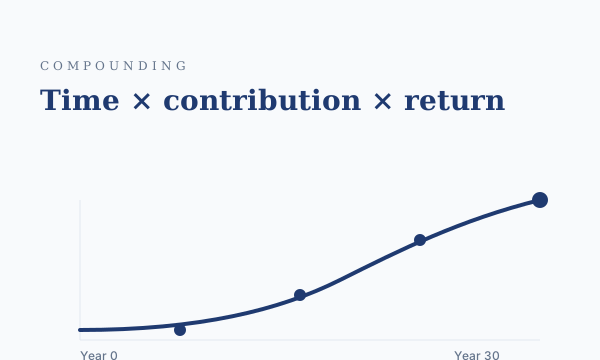
Compound Interest: The Single Most Important Idea in Personal Finance
Compound interest is the reason small consistent savings become large amounts over time, and also the reason small consistent debts become impossible ones. Here is how it works.