Investing
Index Funds Explained: The Simplest Way to Invest
Index funds now hold more money than all actively managed US mutual funds combined. Here is why they became the default recommendation for long-term investors.
Last updated September 3, 2026
An index fund is a mutual fund or ETF that tries to match — rather than beat — the performance of a specific market index, such as the S&P 500. Instead of paying a team of managers to pick "winning" stocks, an index fund simply owns all (or a representative sample) of the stocks in its target index and mirrors that index's returns.
That deceptively simple approach has quietly become the dominant way individual investors put money in the market, for reasons rooted in decades of academic research.
Why matching the market usually beats trying to beat it
The S&P Dow Jones "SPIVA" scorecards, published twice a year, consistently show that more than 80% of actively managed US large-cap funds fail to beat the S&P 500 over any given fifteen-year period. The gap widens as the timeframe lengthens. Two things drive this: fees and reversion. Active funds charge more to pay their managers, and even funds that outperform in one year rarely repeat the feat consistently.
Index funds sidestep both problems. They charge fees measured in single-digit basis points (0.03% is common) and by design own the whole market, which means their performance simply is the market's performance — minus that tiny fee.
How index funds work
Behind the scenes, an index fund holds every stock in its target index in roughly the same proportion. When you buy one share of a broad index fund, you effectively own a tiny piece of every company in the index. When companies are added to or removed from the index, the fund rebalances automatically. You do not need to do anything.
Index fund versus ETF
Historically, index funds were structured as mutual funds and ETFs (exchange-traded funds) were separate products. Today, the same index is often available in both formats from the same provider. The differences are small: ETFs trade throughout the day like stocks and are usually slightly more tax-efficient in taxable accounts, while mutual-fund versions can accept exact-dollar contributions and are easier to automate at some brokers. For most investors, either is fine — pick whichever your brokerage supports well.
Choosing an index fund
Focus on three things: what index it tracks, the expense ratio, and the provider's reputation. For a beginner, a total-US-market or S&P 500 fund from a major provider (Vanguard, Fidelity, Schwab, iShares) is a defensible default. Total-international-market and total-bond-market funds cover the other main asset classes if you want diversification beyond US stocks.
Common misconceptions
Two myths persist. First, that index funds are "just average" — but average, when it consistently beats 80%+ of professional managers, is quietly excellent. Second, that index funds cause market bubbles — this is contested, and there is little evidence they meaningfully distort prices at current levels of adoption.
The index name is not a complete strategy
Read the index methodology: eligible markets, company-size rules, weighting, rebalancing, and treatment of dividends. Two funds called “global” can differ sharply if one excludes emerging markets or gives one country most of the weight. Market-cap weighting is common, not neutral; it deliberately allocates more to companies whose market values are larger.
Then read the fund documents. Compare expense ratio, tracking difference, securities-lending policy, replication method, assets, bid-ask spread, tax domicile, and whether income is distributed or reinvested. Tracking difference—the return gap from the benchmark after costs and implementation—can reveal more than the headline expense ratio alone.
Avoid accidental concentration
Owning several index funds does not guarantee diversification. A broad-market fund, large-company fund, and technology fund may hold many of the same companies. Look through to regions, sectors, currencies, and top positions, then assign each holding a clear job. Complexity without a new source of diversification is duplication.
Choose the benchmark that matches the goal and risk capacity, not the one with the best recent chart. A fund can track perfectly and still be inappropriate. Verify how your country taxes distributions, realised gains, estate transfers, and foreign-domiciled funds; those rules can outweigh a small fee difference and cannot be inferred from U.S. examples.
How an index is actually built
An index is a rulebook. A committee or algorithm defines which securities are eligible, how they are weighted, when they are rebalanced, and how corporate actions like mergers or delistings are handled. Two funds tracking indexes with the word "S&P" in the name can therefore hold very different companies with very different weightings. Before comparing expense ratios, read the index methodology document — it is usually free on the index provider’s website and reveals what you are actually buying.
Market-cap weighting is the most common approach. Each company’s weight in the index is proportional to its total market value. This means larger companies dominate the index; the top 10 holdings of a broad US market index often account for 25% or more of total weight. Equal-weighted indexes address this by giving every company the same weight, which increases exposure to smaller companies and requires more frequent rebalancing. Factor-tilted or "smart beta" indexes weight companies by metrics such as low volatility, value, or dividend yield. None of these approaches is inherently superior; each expresses a different theory of the market.
Tracking error and why the fund’s return will not match the index
A fund tracking an index will underperform the index over time, on average, by roughly its expense ratio. That is normal. The gap between fund return and index return is called tracking error (or, more precisely, tracking difference measured after fees). A well-run fund keeps tracking difference within a few basis points of expenses. A poorly run fund shows tracking difference much larger than fees, indicating problems with sampling, cash drag, or execution costs.
Compare tracking difference over multiple periods before choosing between two funds that track the same benchmark. Some providers publish this data directly; others require you to calculate it from historical returns. A fund that consistently beats its index by a small margin is usually earning securities-lending revenue that offsets some fees. A fund that consistently lags by more than fees may be worth avoiding even if the headline expense ratio is competitive.
ETF versus index mutual fund: choosing the wrapper
Both wrappers can track the same index at similar cost. ETFs trade like stocks throughout the day; index mutual funds price once daily after market close. ETFs generally have lower minimum investments and often better tax efficiency in taxable accounts due to their creation and redemption mechanism. Index mutual funds allow automatic recurring investments in exact dollar amounts, which is convenient for payroll deductions and dollar-cost averaging plans.
For most long-term investors in tax-advantaged accounts (IRA, 401(k), HSA), the wrapper choice is essentially cosmetic — pick whichever your provider offers with the lowest total cost and best fit for your contribution mechanics. In taxable accounts, the tax efficiency of ETFs can matter more, particularly for funds with high turnover or those holding assets that generate significant capital-gains distributions.
International diversification: how much and why
US-based investors often hold portfolios heavily concentrated in US markets, sometimes 90% or more of equity exposure. Global market weighting would allocate roughly 40% to non-US developed and emerging markets, based on the total market capitalisation of foreign stocks. The "correct" allocation is debated: some argue home-country bias makes sense due to currency alignment and lower costs, while others argue diversification benefits require full global exposure.
A defensible middle path allocates 20-40% of equity exposure to international stocks, split roughly two-thirds developed markets and one-third emerging markets by market cap. This captures most of the diversification benefit while keeping currency risk manageable. Use a single total-international-market fund rather than country-specific funds unless you have a specific thesis you can articulate and defend in writing.
Bond index funds: the second half of a diversified portfolio
Bond indexing is more complex than equity indexing because the universe is larger, less liquid, and includes securities that trade infrequently. Total bond market index funds typically hold thousands of individual bonds and sample the index rather than replicating it fully. The result: tracking difference is usually larger for bond funds than for equity funds, but the diversification benefit remains real.
The two decisions that matter most for bond exposure are duration (interest-rate sensitivity) and credit quality. Longer duration means more price movement when interest rates change; higher credit quality means lower default risk but also lower yield. A total bond market index provides intermediate duration and mostly investment-grade credit — a reasonable default for the bond portion of most portfolios. Add short-duration Treasuries for near-term goals and inflation-protected securities if you want direct inflation hedging.
Sector, thematic, and single-country funds: the traps
Sector funds (technology, healthcare, energy) and thematic funds (clean energy, artificial intelligence, cybersecurity) often launch after a period of strong performance and attract money from investors chasing those returns. Historical evidence shows that fund flows into hot themes systematically underperform the broader market. If you cannot articulate a specific reason why you have better information than the market about a sector’s future, you probably do not, and adding these funds to a diversified portfolio usually adds cost and volatility without improving expected returns.
Single-country funds (Japan, India, Brazil) concentrate currency, political, and economic risk in one place. Broad emerging-markets and developed-markets international funds already include exposure to these countries in proportion to their global weight. Overweighting a single country requires a specific investment thesis and typically only makes sense as a small satellite position, not a core holding.
Rebalancing: the discipline that captures the diversification premium
Diversification only produces its full benefit when you rebalance. Over time, higher-performing assets grow to a larger share of your portfolio than intended, increasing risk. Rebalancing sells some of the outperformers and buys the laggards, mechanically implementing "buy low, sell high" without requiring any market prediction. The choice is not whether to rebalance but how often.
Two common approaches: calendar-based (rebalance every 6 or 12 months regardless of drift) and threshold-based (rebalance when any allocation moves more than 5 or 10 percentage points from target). Both work. In taxable accounts, prefer directing new contributions to underweight assets rather than selling appreciated positions, which triggers capital gains tax. In tax-advantaged accounts, rebalance freely.
Common index fund mistakes
The first mistake is holding multiple funds that duplicate each other. Adding an S&P 500 fund on top of a total US market fund does not increase diversification; it just increases concentration in large-cap stocks. Map every fund’s holdings and geography before adding another to the portfolio.
The second mistake is chasing tiny expense-ratio differences at the cost of consolidation. Moving a $10,000 balance from a 0.10% fund to a 0.03% fund saves $7 per year — not enough to justify tax consequences, wire fees, or the mental load of tracking another provider. Focus on consistency and simplicity above the fourth decimal place of fees.
The third mistake is abandoning the index approach during market downturns. The historical case for indexing rests on decades of evidence that most active managers underperform their benchmarks after fees. That evidence does not evaporate during a bad year. If a downturn tempts you to switch to an "active manager who navigates volatility," that is the exact moment to reread the case for staying the course.
Sources and methodology
We use primary and authoritative sources for rules, definitions, and data. Sources and factual claims were last checked September 3, 2026.
- Mutual funds and exchange-traded funds — Investor.gov, U.S. Securities and Exchange Commission (United States; concepts broadly applicable)
- Asset allocation and diversification — Investor.gov, U.S. Securities and Exchange Commission (United States; concepts broadly applicable)
- Investor education gateway — IOSCO (Global)
Frequently asked questions
- Are index funds risky?
- They have the same market risk as their underlying index. A total-stock-market fund can fall in a bear market, sometimes by 30% or more. Over long horizons (a decade or more), broad markets have historically recovered and grown, but no return is guaranteed.
- What is a "total market" fund?
- A fund that tracks essentially every publicly traded stock in a country (or globally). It is the broadest available diversification within a single fund.
- Should I own more than one index fund?
- You do not need to. A single total-market fund is enough for many investors. Some prefer a two- or three-fund portfolio splitting US stocks, international stocks, and bonds for extra diversification.
Related articles
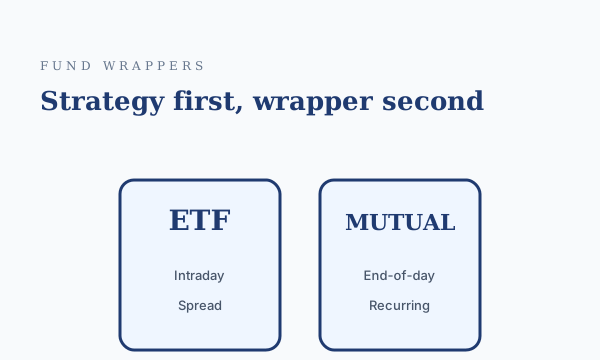
ETF vs Mutual Fund: What Actually Matters for Long-Term Investors
ETFs and mutual funds can hold identical portfolios. The differences that matter for long-term investors come down to how each is bought, taxed, and automated.
How to Start Investing With $100
You do not need thousands to begin. Here is a beginner-friendly path to putting your first $100 to work — and why starting small still matters.
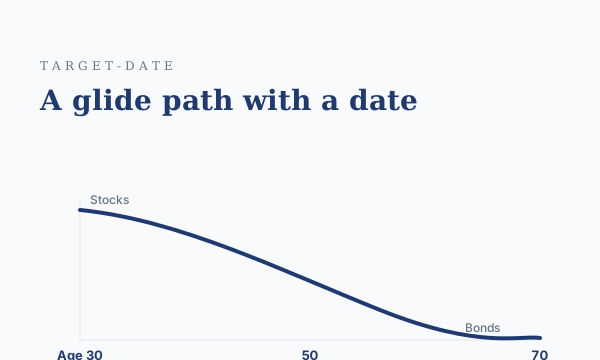
Target-Date Funds: One-Fund Retirement Portfolios, Explained
A target-date fund is a single fund that holds an entire retirement portfolio and adjusts it automatically over time. For many workers it is the simplest correct choice available.