Investing
Target-Date Funds: One-Fund Retirement Portfolios, Explained
A target-date fund is a single fund that holds an entire retirement portfolio and adjusts it automatically over time. For many workers it is the simplest correct choice available.
Last updated September 3, 2026
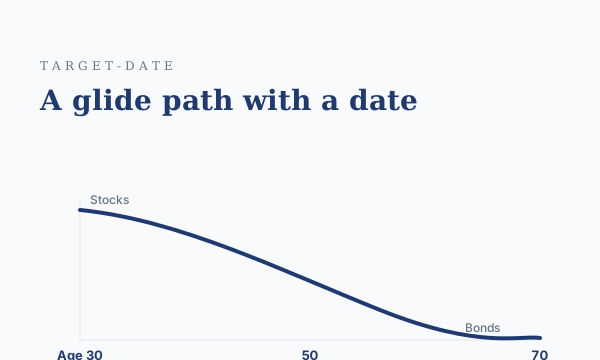
A target-date fund (TDF) is a single mutual fund or ETF that holds a full retirement portfolio (stocks, bonds, sometimes international and real estate) and gradually shifts its mix from mostly stocks to mostly bonds as a chosen retirement year approaches. The retirement year appears in the fund name, for example Target Date 2055.
For workers who want a defensible retirement portfolio without spending time on asset allocation, a low-cost target-date fund is often the correct default.
How the glide path works
Early in your career (three or four decades from retirement), a TDF holds mostly stocks, often 85 to 90 percent, because you have time to ride out downturns. As the target date approaches, the fund automatically sells stocks and buys bonds according to its published glide path, aiming to reduce volatility as your ability to recover from a drawdown shrinks.
Different providers use different glide paths. Some become very conservative at the target date; others continue to reduce stock exposure for years afterward. Read the fund prospectus for the specific glide path.
Why a TDF is often the right default
Three reasons. First, it is fully diversified from day one, which is difficult to replicate with individual funds unless you know what you are doing. Second, it rebalances automatically, so you never have to sell winners and buy losers to maintain your target allocation. Third, it enforces discipline: because the mix is set by the fund, you cannot casually chase last year performance.
When a TDF is not the right choice
If you want more control (a heavier international allocation, a specific bond duration, a tilt toward small-cap or value stocks), a TDF is too rigid. If your workplace plan only offers expensive TDFs (expense ratios above about 0.5 percent), a cheaper self-built three-fund portfolio may serve you better. And if you already own a TDF, adding other funds around it usually undermines the automatic glide path.
How to choose a target year
The standard rule is to pick the fund closest to the year you turn 65. Someone born in 1990 might choose 2055. If you plan to retire earlier or later, adjust accordingly, but do not overthink it. A TDF five years off from your actual retirement is not a meaningful mistake.
Compare the glide path, not only the year
The date in the name is an estimate, not a personalised retirement plan. Inspect the equity allocation today, at the target year, and years afterward. “To” funds often reach their most conservative point near the date; “through” funds may keep changing for many years. Two funds with the same year can therefore expose a saver to materially different losses.
Read what sits underneath: domestic and international shares, bonds by duration and credit quality, inflation-linked assets, cash, and any alternatives. Add the fund-level and underlying costs where applicable, and check whether the provider uses proprietary funds. A diversified wrapper can still carry concentration, interest-rate, currency, and sequence risk.
Check whether household assets change the answer
A target-date fund sees only the money inside it. A pension, spouse’s portfolio, rental property, concentrated employer shares, or near-term withdrawal need may make the household allocation different from the fund’s assumption. Review everything together before adding side funds; random additions usually create an undocumented portfolio rather than useful customisation.
Use one as a default only if the risk path, diversification, fees, and expected withdrawal timing fit. It is not guaranteed at the target date, and the year does not promise sufficient income. Revisit after retirement timing, pension coverage, risk capacity, or provider terms change—not because of routine market volatility.
What target-date funds actually do
Target-date funds (TDFs) are single-fund solutions that automatically adjust asset allocation based on a target retirement date. A "2055 Fund" is designed for someone planning to retire around 2055 — typically holding a stock-heavy allocation (85-90% equities) currently, gradually shifting toward more bonds and cash as 2055 approaches. The fund manages this "glide path" automatically over decades without requiring any decisions from the investor.
The core promise: professional portfolio management, automatic rebalancing, and age-appropriate risk adjustment — all inside a single fund purchase. For investors who do not want to manage their own portfolios, TDFs eliminate the entire complexity of asset allocation, rebalancing, and glide path management. They have become the default investment in most 401(k) plans since the Pension Protection Act of 2006 established them as a safe harbor for automatic enrollment.
For many investors, TDFs are not just a reasonable choice but the best available choice. Attempting to build and manage a custom portfolio requires knowledge and discipline that most investors lack. Studies consistently show that most individual investors underperform their own funds due to poor timing decisions (buying high, selling low). TDFs remove these decisions from the equation.
Reading a target-date fund’s glide path
Every TDF has a specific glide path — the schedule of how allocation shifts over time. A "2055 Fund" from Vanguard might hold 90% stocks today, gradually decreasing to about 50% stocks at the target date and continuing to decrease to about 30% stocks by 7 years post-target. A "2055 Fund" from Fidelity might follow a very different path — perhaps more aggressive early or more conservative late.
The distinction matters: "to retirement" vs "through retirement" glide paths. "To retirement" funds reach their most conservative allocation at the target date and stay there. "Through retirement" funds continue reducing stock allocation for years after the target date. This affects how appropriate the fund is for someone who plans to leave money invested for 30+ years post-retirement.
Before selecting a TDF, check the specific glide path in the fund prospectus. Two funds with identical target dates from different providers can have dramatically different equity exposure at any given age — sometimes 20+ percentage points different. Choose the fund whose glide path matches your risk tolerance and retirement plans, not just the fund with your target year in the name.
What is inside a target-date fund
Most TDFs are "funds of funds" — they hold shares of other mutual funds rather than individual stocks and bonds. A typical composition might include: US total market fund, international developed markets fund, emerging markets fund, US aggregate bond fund, international bond fund, and possibly TIPS or short-term reserves for near-retirement funds.
This structure captures broad diversification with minimal complexity. A 2055 TDF investor effectively owns 5,000-10,000+ individual securities across US and international markets in appropriate proportions for their age — for the price of a single fund purchase. Manually replicating this diversification would require 6-8 separate fund purchases and periodic rebalancing.
Fund composition varies by provider. Vanguard TDFs use primarily Vanguard index funds (very low costs). Fidelity has both index-based (Freedom Index) and actively managed (Freedom) TDF lines. Schwab offers Target Index funds. T. Rowe Price uses actively managed funds. American Funds uses actively managed funds. The cost differences between these providers can be substantial — often 0.5-1% annually — and compound significantly over decades.
Cost matters more than performance predictions
TDF expense ratios range from about 0.08% (Vanguard, Fidelity index-based) to 0.75%+ (some actively managed options). Over 40 years of investing, the difference between 0.08% and 0.75% annually reduces final balance by roughly 25-30% — the same money contributed but hundreds of thousands of dollars less accumulated due to fees alone.
For a saver contributing $500 monthly for 40 years at 7% real returns before fees: at 0.08% expense ratio, final balance approximately $1.24M. At 0.75% expense ratio, final balance approximately $980K. Same contributions, same market returns — a $260K difference just from fee selection.
Actively managed TDFs promise professional stock-picking to beat the market. Historical evidence is unfavorable: most active mutual funds underperform their benchmarks over long periods, and the fee premium (typically 0.4-0.6% annually vs index funds) creates a headwind that most funds cannot overcome. When choosing among TDFs, prioritize low-cost index-based options unless you have specific reason to believe an active manager will beat their benchmark net of fees.
Selecting the right target date
The conventional approach: pick the fund whose year matches your expected retirement age. Someone planning to retire at 65 in 2055 picks the 2055 Fund. This is a reasonable starting point but can be refined.
For higher risk tolerance or delayed retirement plans, pick a later target date to maintain higher equity exposure longer. A 40-year-old planning to work until 70 in 2054 might prefer the 2060 or 2065 fund (which will have higher equity exposure at the same calendar year) rather than 2055.
For lower risk tolerance or plans to retire earlier, pick an earlier target date. A 40-year-old planning to retire at 55 in 2039 might prefer the 2035 or 2040 fund. This is not "wrong" — it reflects both a shorter time horizon and typically more conservative preferences.
Do not overthink the exact year. Adjacent target dates typically have very similar allocations. A 2050 Fund and 2055 Fund from the same provider might differ by only 3-5 percentage points in current allocation. The choice between them is minor compared to broader decisions like provider selection and cost.
TDFs in different account types
TDFs work well in tax-advantaged accounts (401(k), IRA, HSA) because their internal rebalancing does not trigger taxable events for the investor. When the fund shifts from stocks to bonds internally, no capital gains distributions typically flow to shareholders.
TDFs are less ideal in taxable accounts due to capital gains distributions from the bond portion and internal rebalancing. In taxable accounts, holding separate US total market, international total market, and bond index funds allows for more tax-efficient management (bonds in retirement accounts, stocks in taxable, tax-loss harvesting opportunities). For most investors with small taxable balances, this optimization is not worth the added complexity — but for larger taxable portfolios ($100K+), the tax efficiency benefits become meaningful.
Do not combine multiple TDFs with different target dates in the same account. Someone holding both 2045 Fund and 2055 Fund is effectively creating a blend with unpredictable allocation — probably not the intended outcome. Pick one TDF per account (or use only TDFs across all accounts) rather than mixing.
When TDFs are the wrong choice
For investors who genuinely want to manage their own portfolios, TDFs remove the interest and engagement that makes investing intellectually rewarding for some people. If you enjoy portfolio construction and asset allocation decisions, DIY three-fund or four-fund portfolios provide more customization than TDFs allow.
For investors with unusual circumstances (very high income, complex tax situations, specific asset location strategies), TDFs may not optimize as well as customized approaches. Someone with $500K+ in taxable accounts, high-income tax bracket, and specific tax-loss harvesting strategy typically benefits from separate holdings rather than a single TDF.
For investors who plan to withdraw before retirement age, standard TDFs may not fit. Someone planning to retire at 45 in 2040 has different needs than the "2040 Fund" designed for someone retiring at 65. The 2040 Fund will be too conservative too early for the early retiree, who needs more equity exposure for 40+ years of drawdown.
Common target-date fund mistakes
The most common mistake is choosing a TDF based purely on the year without checking the underlying glide path and costs. Two 2055 Funds from different providers can have dramatically different characteristics. Read the prospectus or at least the fund summary before choosing.
The second common mistake is combining a TDF with additional individual funds. Someone who holds a 2055 Fund plus S&P 500 fund plus international fund is effectively overweighting stocks and specific regions relative to the TDF’s design. If you want to customize allocation, use custom individual funds — do not mix TDFs with custom funds in the same account.
The third mistake is picking active TDFs when index-based options exist in the same plan. If your 401(k) offers both Fidelity Freedom Index 2055 (0.12% expense) and Fidelity Freedom 2055 (0.70% expense), the index version is almost always the better choice. Same target date, similar underlying strategy, dramatically lower cost.
Sources and methodology
We use primary and authoritative sources for rules, definitions, and data. Sources and factual claims were last checked September 3, 2026.
- Mutual funds and exchange-traded funds — Investor.gov, U.S. Securities and Exchange Commission (United States; concepts broadly applicable)
- Asset allocation and diversification — Investor.gov, U.S. Securities and Exchange Commission (United States; concepts broadly applicable)
- A look at 401(k) plan fees — U.S. Department of Labor (United States)
Frequently asked questions
- Are all target-date funds the same?
- No. Fees and glide paths vary meaningfully between providers. Vanguard, Fidelity, and Schwab all offer competitive low-cost lineups; some other providers charge much more for similar exposure.
- Can I hold a target-date fund in a taxable account?
- Yes, but they are less tax-efficient than a self-built portfolio because the internal rebalancing can generate taxable events. TDFs work best inside tax-advantaged accounts (401k, IRA, HSA).
- What happens after the target date?
- The fund keeps running. Some providers continue to reduce stock exposure gradually; others hold the final allocation steady. Check the specific fund glide path.
Related articles
Index Funds Explained: The Simplest Way to Invest
Index funds now hold more money than all actively managed US mutual funds combined. Here is why they became the default recommendation for long-term investors.
How a 401(k) Actually Works (And How to Get the Most Out of It)
A 401(k) is the most common retirement account in the US, and its employer match is often the single best investment return available to any employee.
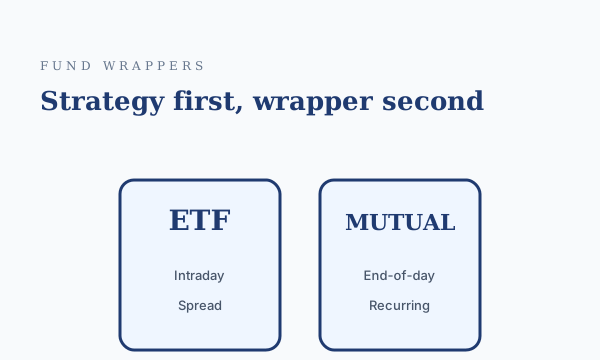
ETF vs Mutual Fund: What Actually Matters for Long-Term Investors
ETFs and mutual funds can hold identical portfolios. The differences that matter for long-term investors come down to how each is bought, taxed, and automated.