Investing
How a 401(k) Actually Works (And How to Get the Most Out of It)
A 401(k) is the most common retirement account in the US, and its employer match is often the single best investment return available to any employee.
Last updated September 3, 2026
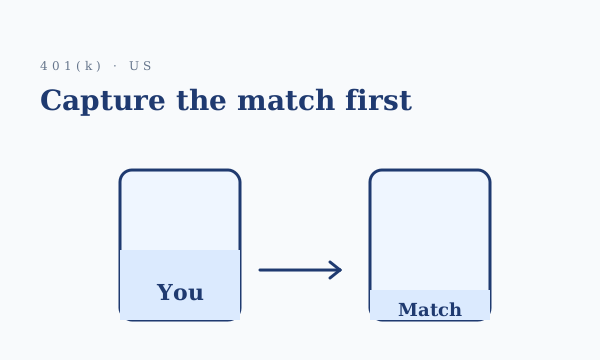
A 401(k) is a workplace retirement account offered by many US employers. It lets employees contribute part of their pay directly from their paycheque, often with a matching contribution from the employer, and offers significant tax advantages designed to encourage long-term saving.
For workers with access to one, understanding how a 401(k) works — and specifically how to capture the employer match — is one of the single most valuable financial skills available. Verify current-year limits and rules at irs.gov before making decisions.
How contributions work
You choose a percentage of your salary to contribute each pay period. If you choose Traditional 401(k), the money is deducted before income tax, reducing your taxable income now; withdrawals in retirement are taxed as ordinary income. If your plan offers a Roth 401(k), you contribute after tax and qualified withdrawals in retirement are tax-free. Many plans allow you to split contributions between the two.
The IRS sets an annual contribution limit that typically rises with inflation — in recent years it has been in the $23,000 range for workers under 50, with an additional catch-up contribution for workers age 50 and older. Check the current-year limit at irs.gov before setting your contribution rate.
The employer match — usually the best return you will ever see
Many employers match a portion of your contributions. A common structure is "100% of the first 3% of pay, plus 50% of the next 2%," which produces a maximum match of 4% of salary. If you earn $60,000 and contribute at least 5% ($3,000), the employer adds $2,400 — an immediate 80% return on your contribution before markets do anything.
If you do nothing else, contribute at least enough to capture the full employer match. Passing on a match is one of the most common — and expensive — financial mistakes.
Vesting
Your own contributions are always 100% yours. The employer's match may be subject to a vesting schedule, meaning it becomes fully yours only after a set number of years of employment. Common schedules include immediate vesting, three-year cliff vesting, and graded vesting over five or six years. Check your plan's summary description to see what applies to you.
Choosing your investments
Inside the 401(k), you choose from a menu of investment options selected by the plan administrator. Most plans include several index funds, actively managed funds, and target-date funds. For most workers, a low-cost target-date fund matched to your expected retirement year is a reasonable default — it automatically holds a diversified mix of stocks and bonds and gradually shifts toward more bonds as retirement approaches. If you prefer to build your own allocation, look for the lowest-cost total-market or S&P 500 index option available.
What happens when you change jobs
When you leave an employer, your 401(k) balance stays yours. You typically have four options: leave it in the old plan (if allowed), roll it over into your new employer's plan, roll it over into an IRA, or cash it out. Cashing out is almost always a bad idea for anyone under 59½ — the money is taxed as ordinary income and hit with a 10% early-withdrawal penalty. Rolling into an IRA usually offers the broadest investment choice and lowest fees.
Translate the employer match into a contribution target
Read the Summary Plan Description and write the formula in plain numbers. A match may apply per pay period, cap eligible pay, exclude some compensation, or include a year-end true-up. Contributing too little misses compensation; front-loading too early can also miss later per-pay-period matches when there is no true-up. Verify vesting separately because contributed salary and employer money may follow different ownership rules.
Set a contribution rate that captures the understood match without breaking essential cash flow, then evaluate high-cost debt and emergency reserves before automatically chasing the annual maximum. The IRS employee limit is not a recommendation and changes by year. It also interacts with age-based provisions and contributions to multiple employers’ plans.
Audit the menu and the plan layer
For each viable fund, record asset class, benchmark, expense ratio, and overlap. A target-date fund can be a complete diversified choice; adding several stock funds may accidentally undo its allocation. Also inspect administrative, advice, loan, and transaction fees because a low-cost fund can sit inside an expensive plan.
When leaving a job, compare staying in the plan, moving to a new employer plan, or rolling to an IRA using fees, investment access, creditor protection, service, and tax consequences. Avoid having a retirement cheque paid to you without understanding withholding and rollover deadlines. Verify current rules with the plan administrator and IRS.
Traditional versus Roth 401(k): choosing which bucket to fund
Most modern plans let each dollar of your contribution go into a Traditional 401(k), a Roth 401(k), or both. The choice looks small but compounds over decades. A Traditional contribution reduces your taxable income today, and the account grows tax-deferred; you pay ordinary income tax on withdrawals in retirement. A Roth contribution is made with after-tax dollars, and qualified withdrawals in retirement — including growth — are tax-free. The decision hinges on your current marginal tax rate versus your expected marginal rate later, plus the value of tax diversification.
Rules of thumb are useful only as starting points. If you are near a bracket edge and the deduction would drop you into a lower bracket, the Traditional often wins in year one. If you are early-career, earning less than you likely will later, the Roth often wins because you are effectively paying tax at your lowest rate. High earners near contribution limits often prefer Traditional because the deduction is larger in absolute terms; some also split contributions to give themselves two future tax profiles to draw from.
Employer matches are almost always deposited on a pre-tax basis regardless of whether your own contribution is Roth or Traditional. That means every Roth-heavy contributor still ends up with a Traditional side-account from the match. Track both balances separately in retirement planning tools; they behave differently in withdrawals, in Roth-conversion planning, and in required-distribution calculations.
How to read your plan documents like a benefits analyst
The Summary Plan Description (SPD) is the plain-language contract that governs your 401(k). Every claim on a marketing brochure or benefits portal is only meaningful if it also appears in the SPD. Read the sections on eligibility, contributions, matching, vesting, distributions, loans, hardships, and beneficiary designations. Note the exact match formula, the pay definition it uses, whether there is a true-up, and how the vesting schedule handles employer contributions.
The Fee Disclosure (often called the 404(a)(5) notice in the US) tells you what the plan actually costs. It typically lists an administrative fee, individual services fees such as loan origination, and investment-level fees for every fund. Add these together to get your total annual cost as a percentage of assets. A low-fee investment inside a high-fee plan may still be more expensive than a slightly pricier investment in a low-fee plan; the total is what matters, not any single line.
The Investment Menu is the third document. It lists every available fund, its benchmark, expense ratio, and often historical returns net of fees. Group the menu into categories: broad-market equity funds, international equity, bonds by duration and credit quality, cash-like options, and any specialty funds. If the menu includes target-date funds, note their glide path philosophy and underlying holdings; two funds with the same target year can behave very differently.
Vesting schedules and the true cost of leaving early
Your own contributions vest immediately — they are your money the moment they land in the account. Employer contributions may follow a graded schedule (for example, 20% per year over five years) or a cliff schedule (0% until you complete a set period, then 100%). Leaving before you fully vest forfeits the unvested portion. That forfeited amount is a real, ignored cost of switching jobs and should influence timing when you have flexibility on start dates.
Calculate the unvested balance before accepting an outside offer if you are close to a vesting milestone. If leaving three months earlier forfeits 40% of two years of matches on a $150,000 salary contributing 5%, that is roughly $6,000 in lost employer money — before considering compounding for 30 years. Some employers accelerate vesting on specific triggers (acquisition, disability, retirement age); read the SPD before you assume the schedule always applies.
Contribution mechanics: front-loading, true-ups, and catch-ups
Most plans match on a per-pay-period basis: they add a percentage of your contribution to each paycheque, up to the annual match cap. If you hit the IRS contribution limit early in the year — for example by maxing out in July — some employers stop matching entirely for the rest of the year. Others perform a "true-up" at year end, restoring the missed match. Do not assume a true-up exists; verify it in the SPD or by asking HR in writing.
Workers aged 50 and older can generally make catch-up contributions above the standard limit. The catch-up is a separate election in the payroll system and does not happen automatically at the moment you turn 50. Set a calendar reminder for the pay period you become eligible and update the election so you do not lose months of extra contribution room.
If you change jobs mid-year, the annual employee contribution limit is aggregated across all 401(k) plans you participate in. Your new employer’s payroll system does not know what you contributed to your previous plan; you must monitor this yourself. Excess contributions must be withdrawn by the tax deadline to avoid double taxation.
Investment selection: an unglamorous checklist that wins
For most workers, a low-cost, broadly diversified equity fund plus an age-appropriate allocation to bonds and cash covers 90% of the value a plan can deliver. Complexity does not usually improve returns net of fees and behaviour. If a target-date fund matches your intended retirement year and its glide path fits your risk capacity, using it as the sole investment is a defensible choice — and often outperforms self-built portfolios because it prevents rebalancing paralysis.
If the plan menu lacks a strong target-date option, build a simple three- or four-fund portfolio: a total-market equity fund, an international equity fund, a total-market bond fund, and optionally an inflation-protected bond fund. Rebalance annually or when any allocation drifts more than five percentage points from target. Avoid actively managed funds that charge over 0.75% unless the SPD documents a compelling reason; most fail to justify their fees over long periods.
Never chase last year’s best-performing fund. Fund flows into recent winners consistently underperform simple diversified portfolios. Set the allocation, automate the contribution, and only revisit the plan when the SPD changes, when your risk capacity changes, or when a life event alters the retirement horizon.
Rollovers, loans, and hardship withdrawals: knowing before you need them
When you leave a job, you generally have four options for the 401(k) balance: leave it in the plan, roll it into the new employer’s plan, roll it into an IRA, or take a distribution. Each has trade-offs. Leaving it in place preserves creditor protection and access to institutional-share-class funds. Rolling to an IRA usually widens investment choices and simplifies consolidation but may reduce creditor protection depending on state law. Taking a distribution before age 59½ typically triggers ordinary tax plus a 10% penalty and permanently removes decades of compounding.
401(k) loans allow you to borrow from your own balance and repay through payroll deductions with interest. The interest returns to your account rather than to a lender, which sounds attractive but is not free money: the borrowed amount stops growing while it is out, and unpaid balances at separation may become taxable distributions on a short deadline. Use plan loans only for genuine short-term needs when the alternative is worse.
Hardship withdrawals are limited to specific IRS-defined categories: medical expenses, purchase of a primary residence, tuition, prevention of eviction, funeral expenses, and certain repair costs. Some plans also allow hardship withdrawals for disaster relief. All are taxable and often penalised, and they typically cannot be repaid. Treat hardship as a last resort after exhausting emergency savings, unsecured credit, and family help.
Common mistakes and how to design around them
The most common mistake is not contributing enough to capture the full employer match. It is the highest-guaranteed return available to most workers. The fix is a written contribution rate that automatically escalates each year, so the number rises with pay raises rather than staying frozen at the level you set as a new hire.
The second common mistake is holding company stock as a large share of the balance. Concentration risk in your employer means your job and your retirement lean on the same company. Cap company stock at a small percentage — many advisers suggest under 10% of total investable assets — and diversify the rest broadly.
The third mistake is checking balances during market downturns and stopping contributions. Historical evidence is clear: contributing during declines buys shares at discount prices and is one of the most reliable ways to accumulate wealth. If watching balances triggers the impulse to sell, hide the account from daily view and rely on the annual review.
Sources and methodology
We use primary and authoritative sources for rules, definitions, and data. Sources and factual claims were last checked September 3, 2026.
- 401(k) plans — Internal Revenue Service (United States)
- A look at 401(k) plan fees — U.S. Department of Labor (United States)
- Asset allocation and diversification — Investor.gov, U.S. Securities and Exchange Commission (United States; concepts broadly applicable)
Frequently asked questions
- Should I contribute to a 401(k) or an IRA first?
- A common priority order is: first contribute enough to the 401(k) to capture the full employer match, then max out an IRA (Roth if eligible), then return to the 401(k) for additional contributions up to the annual limit.
- What is a target-date fund?
- A single fund that holds a diversified mix of stocks and bonds appropriate for a given retirement year (for example, "Target Date 2055"). It rebalances automatically over time.
- Can I take money out of my 401(k) early?
- Usually not without cost. Withdrawals before age 59½ are typically taxed as ordinary income plus a 10% penalty, with limited exceptions (hardship, first-home purchase from certain plans, etc.).
- What happens to my 401(k) in a market crash?
- Its value will fall along with the market. Historically, broad markets have recovered from every previous downturn over long enough horizons. The worst move is usually to stop contributing during a decline — the same downturn buys you more shares at lower prices.
Related articles
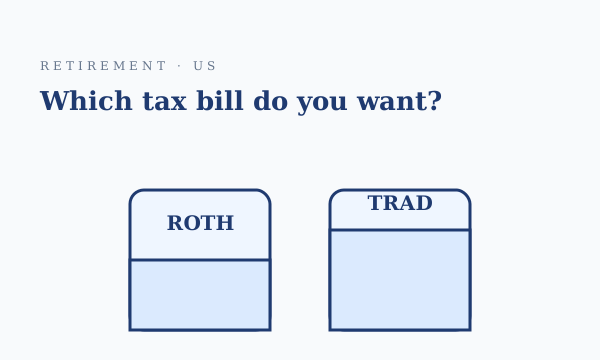
Roth IRA vs Traditional IRA: How to Choose
Both accounts offer powerful tax advantages, but they work in opposite directions. Choosing the right one depends mostly on where your tax rate will be in retirement.
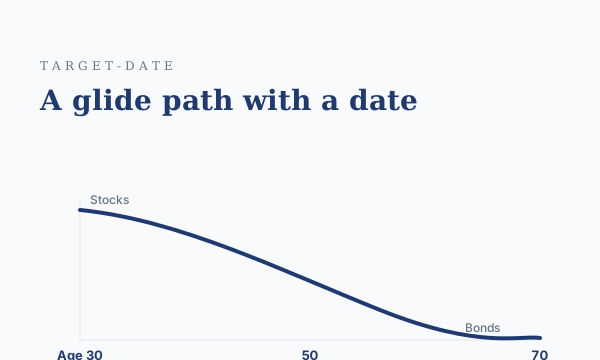
Target-Date Funds: One-Fund Retirement Portfolios, Explained
A target-date fund is a single fund that holds an entire retirement portfolio and adjusts it automatically over time. For many workers it is the simplest correct choice available.
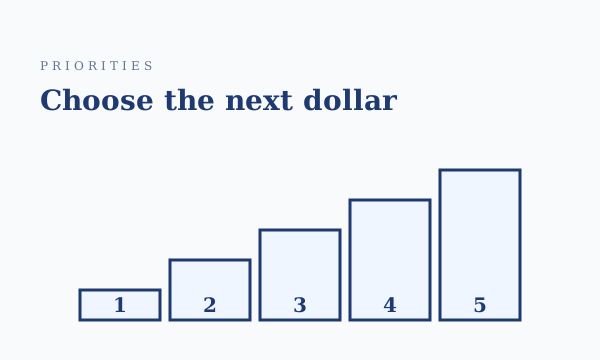
The Right Order of Financial Priorities (Most People Get This Backwards)
A practical order of operations for money — from a starter emergency fund to long-term investing — that avoids the common mistake of skipping cheap wins for flashier ones.