Investing
Roth IRA vs Traditional IRA: How to Choose
Both accounts offer powerful tax advantages, but they work in opposite directions. Choosing the right one depends mostly on where your tax rate will be in retirement.
Last updated September 3, 2026
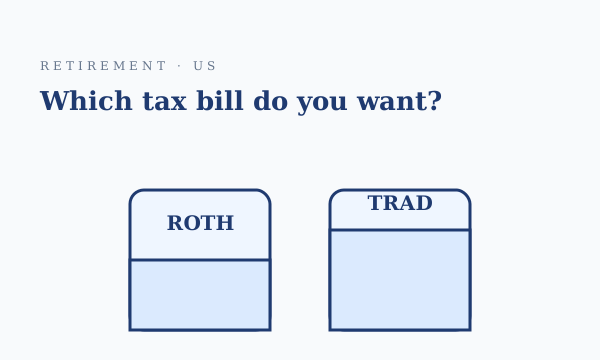
A Roth IRA and a Traditional IRA are both individual retirement accounts that offer meaningful tax advantages, but they work in opposite directions. Understanding the difference is one of the highest-value pieces of financial knowledge a US worker can acquire.
This guide covers how each account works, the current contribution and income limits (per the IRS), and a decision framework for choosing between them. Verify current-year figures at irs.gov before contributing.
How a Traditional IRA works
You contribute pre-tax dollars (subject to income and workplace-plan rules for the deduction), the money grows tax-deferred, and you pay ordinary income tax on withdrawals in retirement. You must start required minimum distributions (RMDs) at age 73 under current law. Early withdrawals before age 59½ typically trigger a 10% penalty on top of ordinary income tax, with some exceptions.
How a Roth IRA works
You contribute after-tax dollars, the money grows tax-free, and qualified withdrawals in retirement are tax-free. Roth IRAs have no required minimum distributions during the account owner's lifetime. Contributions (but not earnings) can be withdrawn at any time, tax- and penalty-free, which gives the Roth an unusual amount of flexibility for a retirement account.
Contribution and income limits
The annual contribution limit is set by the IRS and updated periodically. In recent years the limit has been $7,000 (with an additional $1,000 catch-up contribution for savers age 50 and older). Roth IRAs also phase out at higher incomes — a common phase-out range for single filers has been around $150,000 and for married-filing-jointly around $236,000. Traditional IRA contributions are always allowed, but the tax deduction phases out at similar thresholds if you or a spouse have a workplace retirement plan. Confirm current-year limits at irs.gov before contributing.
The core decision: current vs future tax rate
The single most important question is whether your marginal tax rate will be higher or lower in retirement than it is today. If you expect a higher rate later, Roth wins — you pay tax at today's lower rate and skip it at tomorrow's higher rate. If you expect a lower rate later, Traditional wins — you skip tax at today's higher rate and pay at tomorrow's lower rate.
Because no one knows their future tax rate with certainty, many people split contributions between both accounts (called "tax diversification"). This hedges against a future that turns out differently than expected.
Rules of thumb by career stage
Early-career workers in low tax brackets often benefit most from Roth contributions, because paying tax at a low rate now is likely a better deal than paying at an unknown (probably higher) rate decades later. Mid-career high earners often benefit more from Traditional contributions, because the current deduction is worth more when marginal rates are high. Late-career workers whose retirement plans are largely finalized should look at their projected retirement bracket to decide.
When neither is a fit
If your income exceeds the Roth phase-out and you are already covered by a workplace retirement plan, the Traditional deduction may not apply either. In that case, the "backdoor Roth" strategy — contributing to a nondeductible Traditional IRA and immediately converting to Roth — remains available under current law, subject to the pro-rata rule. Consult a tax professional before executing a backdoor Roth to avoid unexpected tax bills.
Compare marginal tax rates, not labels
A deductible Traditional contribution may reduce income taxed at today’s marginal rate; a qualified Roth withdrawal may avoid tax at the future marginal rate. Model several future rates rather than assuming retirement automatically means a lower bracket. Include state or local tax, other retirement income, required distributions under then-current law, and the value of any deduction actually available.
Make the comparison with equal economic cost. If a Traditional contribution creates a tax saving, the fair scenario invests that saving rather than spending it. If contribution limits constrain how much can enter the account, the Roth can shelter a larger after-tax amount, but only when the saver can afford the tax outside the account.
Eligibility and access can decide before optimisation
Verify compensation requirements, income phase-outs, workplace-plan effects on deductibility, spouse rules, contribution deadline, and aggregation across all IRAs. Do not copy an annual limit from an evergreen article. Check the IRS page for the tax year and preserve evidence of contributions, conversions, distributions, and basis.
Roth contribution access, conversion ordering, Traditional deductions, and exceptions to additional tax are distinct rules. Treat retirement accounts as long-term even where some withdrawals are permitted: tax paperwork, penalties, and lost compounding can make “accessible” money expensive. Complex existing IRA basis or cross-border tax residency warrants qualified tax advice.
The mathematical case for each account
The decision between Roth and Traditional IRAs reduces to one question: is your marginal tax rate today higher or lower than the rate you expect to face when you withdraw the money? If today’s rate is higher, the Traditional wins because you get the tax break at your higher rate now. If today’s rate is lower, the Roth wins because you pay tax at the current low rate and avoid tax at the higher future rate. If they are the same, the two are mathematically equivalent — a fact many articles obscure with breathless comparisons.
Two subtleties complicate the pure math. First, the Traditional IRA tax break has to be reinvested to make the comparison fair; spending the tax refund turns the comparison into a Roth advantage by default. Second, tax rates apply to gross withdrawals in retirement, not to net contributions today, so the effective "size" of a Roth contribution is larger — you have already paid the tax, so every dollar in the account is spendable. This is why maxing out a Roth contribution can shelter more real wealth than maxing out a Traditional contribution, even at the same nominal limit.
Income limits and eligibility
Direct Roth IRA contributions phase out at income levels the IRS updates annually. Above the full phase-out, you cannot contribute directly. Traditional IRA contributions are always allowed but the deductibility of those contributions phases out at income levels that depend on whether you or your spouse is covered by a workplace retirement plan. High earners covered by a workplace plan may find they can only make nondeductible Traditional contributions — which is why the backdoor Roth strategy exists.
Verify current-year income limits at IRS.gov before contributing. Both the phase-out ranges and the contribution limits themselves change with inflation, and the specific thresholds vary by filing status. A married couple filing jointly has different limits from two single filers with the same combined income. Never rely on last year’s numbers or an evergreen article — the IRS Publication 590-A is the authoritative source and is updated annually.
When Traditional is clearly better
Traditional wins clearly in three situations. First, when you are in your peak earning years and expect retirement income to be materially lower — for example, a professional in their late 40s or early 50s planning to retire at 60 with a paid-off house and modest lifestyle. Second, when you are contributing at a high marginal rate and would invest the tax savings, effectively "supersizing" the contribution. Third, when you plan to make charitable contributions in retirement using Qualified Charitable Distributions, which can satisfy required minimum distributions tax-free from Traditional IRAs.
Traditional also has an operational advantage: the deduction is immediate and visible. You see the tax refund or reduced tax liability in the current filing year, which some people find motivating. Roth benefits are invisible until decades later, which can weaken commitment for savers who need short-term feedback.
When Roth is clearly better
Roth wins clearly in five situations. First, early-career workers in low brackets who expect income growth. Second, workers who have already maxed a Traditional 401(k) and want additional tax-diversified retirement money. Third, high-net-worth families expecting large taxable retirement income from pensions, rental properties, or Traditional 401(k) balances that will trigger high tax brackets and Medicare premium surcharges. Fourth, savers under 59½ who want optional access to contributions without penalty (Roth contributions — not earnings — can be withdrawn any time tax-free and penalty-free). Fifth, anyone leaving substantial assets to heirs who will pay high tax rates on inherited Traditional balances.
Roth also protects against future tax rate increases. Current US federal tax rates are historically low. If rates rise materially over the next 30 years, Roth balances become disproportionately valuable. This is not a prediction; it is a hedge. Portfolio construction benefits from including hedges against tail risks even when the expected outcome is uncertain.
The Roth conversion ladder: converting Traditional to Roth deliberately
Roth conversions let you move money from Traditional to Roth by paying tax on the converted amount at your current marginal rate. Done strategically in low-income years — for example, early retirement before Social Security or pension income begins, or a sabbatical year — conversions can dramatically reduce lifetime taxes. The tactic works best when you have taxable savings to pay the conversion tax without touching the converted amount, preserving the full balance for tax-free growth.
Beware of common conversion mistakes. The pro-rata rule aggregates all Traditional, SEP, and SIMPLE IRAs when calculating the taxable portion of a conversion, so nondeductible basis is spread proportionally across all accounts. Converting without understanding this rule can create unexpected tax bills. Also, converted amounts have a separate five-year clock for penalty-free withdrawal — each conversion starts its own countdown.
Required minimum distributions and their impact on the decision
Traditional IRAs require the account holder to begin withdrawing a minimum amount each year starting at age 73 (or 75 for those born after 1960, under current law). These required minimum distributions (RMDs) are calculated based on account balance and life expectancy and are taxed as ordinary income. Failing to take an RMD triggers a penalty. Large Traditional balances can produce RMDs that push retirees into higher tax brackets, trigger IRMAA (Medicare premium surcharges), and increase taxation of Social Security benefits.
Roth IRAs have no RMD requirement for the original owner. This lets Roth balances continue growing tax-free indefinitely and provides estate-planning flexibility. Inherited Roth IRAs do have distribution requirements for most non-spouse beneficiaries under current law, but the distributions remain tax-free. The absence of RMDs is a major structural advantage of the Roth in retirement planning, especially for people who do not need the income for living expenses.
A mixed strategy: why "both" often beats picking one
Tax diversification — holding balances in both Traditional and Roth accounts — provides flexibility in retirement to manage annual taxable income deliberately. In a year with high taxable income (unexpected capital gains, an inheritance, a large medical deduction offsetting income), you can withdraw from Roth to avoid pushing into a higher bracket. In a low-income year, you can withdraw from Traditional to fill low brackets. This tactical control can save meaningful money over a 30-year retirement.
A practical mixed strategy: contribute to the 401(k) up to the full employer match, then max a Roth IRA if eligible, then return to the 401(k) for additional contributions. If you can afford more than these amounts, consider a mix within the 401(k) itself if the plan offers a Roth option. Recheck the mix every few years as your income, expected retirement date, and tax rates evolve.
Contribution timing: annual, monthly, or lump-sum
IRA contributions for a given tax year can be made from January 1 of that year through the tax filing deadline of the following year — typically April 15. Making the full annual contribution in January of the tax year maximises tax-advantaged growth time; waiting until April of the following year sacrifices roughly 15 months of tax-free compounding. Over a 30-year investing horizon, this timing difference can add up to meaningful dollars.
For workers who cannot afford a lump-sum January contribution, automating monthly contributions of 1/12th the annual limit is the next-best approach. It captures dollar-cost averaging benefits and eliminates the need to remember to contribute each year. Set the automation once and let it run; only revisit if the annual limit changes or your cash flow shifts significantly.
Common mistakes with IRAs
The most common mistake is contributing to an IRA and forgetting to invest the money. Cash sitting in an IRA earns money-market rates and misses the market. After every contribution, verify that the money has been invested according to your target allocation. Some providers default new contributions to a settlement account rather than automatically investing them.
The second common mistake is exceeding the annual contribution limit, often by contributing to both a Roth and Traditional IRA without realising the limit applies to the total. Excess contributions incur a 6% annual penalty until withdrawn. If you discover an excess before the tax deadline, withdraw it (and any earnings) to avoid the penalty. After the deadline, correction becomes more complex and usually requires professional tax help.
The third mistake is treating the IRA like a taxable account and trading frequently. Trading commissions are usually zero at major providers, but the temptation to time markets, chase performance, or make emotional decisions is amplified when the account balance is visible. Set a simple long-term allocation and interact with the account only for contributions, rebalancing, and required distributions.
Sources and methodology
We use primary and authoritative sources for rules, definitions, and data. Sources and factual claims were last checked September 3, 2026.
- Individual retirement arrangements (IRAs) — Internal Revenue Service (United States)
- Publication 590-A: Contributions to IRAs — Internal Revenue Service (United States)
- Introduction to investing — Investor.gov, U.S. Securities and Exchange Commission (United States; concepts broadly applicable)
Frequently asked questions
- Can I contribute to both a Roth and a Traditional IRA in the same year?
- Yes, but the combined annual contribution cannot exceed the total IRS limit for that year.
- Can I withdraw Roth contributions early?
- Yes. Your Roth IRA contributions (the money you put in) can be withdrawn at any time, tax- and penalty-free. Earnings withdrawn before age 59½ or before the account is five years old may be taxed and penalised.
- Does everyone qualify for a Roth IRA?
- No. Direct Roth contributions phase out above certain income thresholds. High earners often use the "backdoor Roth" strategy to contribute indirectly.
- What if I do not have earned income?
- You cannot contribute to an IRA without earned income (with a spousal-IRA exception for married couples where one spouse works).
Related articles

How a 401(k) Actually Works (And How to Get the Most Out of It)
A 401(k) is the most common retirement account in the US, and its employer match is often the single best investment return available to any employee.
Backdoor Roth IRA: What It Is and How It Works
High earners are phased out of direct Roth IRA contributions. The backdoor Roth uses a legal two-step to preserve access to the Roth account regardless of income.
Health Savings Accounts (HSAs): The Most Tax-Advantaged Account Most People Ignore
A properly used HSA offers a triple tax advantage no other account can match. For eligible savers, it can quietly become one of the best retirement accounts available.