Investing
Backdoor Roth IRA: What It Is and How It Works
High earners are phased out of direct Roth IRA contributions. The backdoor Roth uses a legal two-step to preserve access to the Roth account regardless of income.
Last updated September 3, 2026
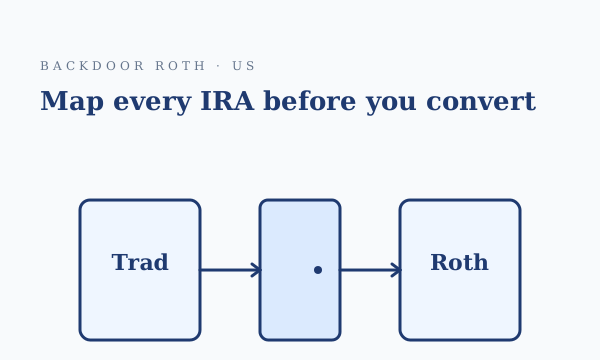
A Roth IRA offers tax-free growth and tax-free qualified withdrawals in retirement - an unusually attractive combination. But the IRS phases out direct Roth contributions above certain income levels. For workers above the phase-out, the "backdoor Roth" strategy uses a legal two-step (contribute to a nondeductible Traditional IRA, then convert to Roth) to reach the same outcome.
The strategy is straightforward but has one important complication - the pro-rata rule - that trips up many first-time users.
Why the backdoor exists
The IRS caps direct Roth IRA contributions above certain income thresholds. However, there is no income limit on either nondeductible Traditional IRA contributions or on Roth conversions. Combining the two lets you effectively contribute to a Roth without going through the front door.
Congress removed the income limit on Roth conversions in 2010 without adding one back. Backdoor Roth contributions have since become standard tax planning for high-income workers who want Roth exposure.
The mechanics
Step one: contribute after-tax dollars to a Traditional IRA (up to the annual IRA limit). Because your income is too high to deduct the contribution, it is a nondeductible contribution. Step two: convert the Traditional IRA balance to a Roth IRA. Because you have already paid tax on the contribution, only any earnings between contribution and conversion are taxable. If you convert soon after contributing, the tax owed is usually zero or trivial.
Report both steps on IRS Form 8606 when you file your taxes. Skipping this form is the most common backdoor Roth mistake and can lead to double taxation if not caught.
The pro-rata rule
The IRS treats all your Traditional IRA balances as one pool for conversion purposes. If you already have pre-tax money in any Traditional IRA (from prior deductible contributions or a 401(k) rollover), the pro-rata rule taxes the conversion based on the ratio of pre-tax to after-tax money across all your Traditional IRAs, not just the account you converted from.
Example: you have $95,000 in a rollover IRA from an old 401(k) (all pre-tax) and make a $5,000 nondeductible contribution. Your total IRA balance is $100,000, of which 95 percent is pre-tax. If you convert $5,000, the IRS considers 95 percent of the conversion ($4,750) taxable, even though the $5,000 you converted was after-tax. This is often a surprise.
Working around the pro-rata rule
The cleanest solution is to have no pre-tax Traditional IRA balance on December 31 of the year you do the conversion. Options include rolling any existing pre-tax Traditional IRA into your current employer 401(k) (if the plan accepts rollovers) or converting the entire pre-tax balance to Roth in one large event (and paying the tax bill). Either eliminates the pro-rata complication for future backdoor Roth contributions.
Is it worth the effort?
For a high-earning worker, a backdoor Roth adds $7,000 to $8,000 of tax-free retirement savings per year. Over a career, that compounds into significant tax-free wealth. Setting up the process cleanly the first year makes subsequent years a 10-minute annual routine.
Map every IRA balance before moving money
List year-end balances and basis across Traditional, SEP, and SIMPLE IRAs, not just the new account. The pro-rata calculation generally aggregates relevant IRAs, so opening a separate empty account does not isolate a nondeductible contribution from existing pre-tax money. Employer plans are treated differently, but any rollover strategy must be allowed by the plan and evaluated on its own fees and rules.
Confirm direct Roth eligibility, compensation, annual contribution room, and contributions already made for the tax year. A backdoor process does not create extra IRA contribution space. Keep contribution and conversion transactions distinct, preserve statements, and understand that investment gains before conversion can create taxable income even when the original contribution was nondeductible.
Treat reporting as part of the strategy
Form 8606 tracks nondeductible basis and helps calculate the taxable conversion. Filing history matters across years; missing basis records can lead to double taxation or correction work. The conversion document from the custodian does not by itself prove the correct tax treatment. Reconcile tax forms with account statements before filing.
There is no one-click guarantee that the procedure suits every taxpayer. State tax, inherited IRAs, spouse accounts, rollovers in the same year, prior basis, and future legislative changes add complexity. Verify current IRS instructions and use a qualified tax professional when the pro-rata worksheet or records are unclear.
Why the backdoor Roth exists
The backdoor Roth IRA is a two-step tax strategy that lets high-income earners contribute to a Roth IRA despite exceeding the direct Roth contribution income limits. It exploits a technical distinction in the tax code: Roth IRA contributions have income limits, but Roth conversions (from Traditional IRA to Roth IRA) do not. By contributing to a Traditional IRA (which has no income limit for non-deductible contributions) and immediately converting to Roth, high earners access the Roth structure indirectly.
For 2024, direct Roth IRA contributions phase out between $146,000-$161,000 modified AGI for single filers and $230,000-$240,000 for married filing jointly. Above these ranges, direct contributions are prohibited. The backdoor strategy provides Roth access above these thresholds, effectively continuing to allow $7,000 ($8,000 age 50+) of Roth contributions regardless of income.
The backdoor Roth has been in use since 2010 (when income limits on Roth conversions were removed). It is legally permitted and widely used by high earners; various proposed legislation to eliminate it has not passed as of 2024. Use it while it exists, but track legislative developments — a future law change could close this path.
The mechanics: two steps in one calendar year
Step 1: Contribute after-tax dollars to a Traditional IRA. Because your income exceeds thresholds for Traditional IRA deductibility (if covered by a workplace retirement plan) or Roth eligibility, the contribution is non-deductible. Maximum: $7,000 in 2024 ($8,000 age 50+).
Step 2: Convert the Traditional IRA balance to a Roth IRA. This is typically done shortly after Step 1 — ideally within the same tax year and before earnings accumulate. Because the contribution was already after-tax, only earnings during the brief holding period are taxable on conversion (usually a few dollars at most if converted quickly).
Both steps must be reported on tax returns. Step 1 is reported on Form 8606 (Nondeductible IRAs). Step 2 is reported on Form 8606 and Form 1040 (as a distribution and rollover). Get Form 8606 filed correctly for the contribution year — missing filings create documentation problems that make future conversions and distributions unnecessarily complex.
The pro-rata rule: the critical complication
The IRS applies the "pro-rata rule" when converting Traditional IRA balances. If you have any pre-tax money in ANY Traditional IRA (not just the one you contributed to), the conversion is taxed proportionally to the ratio of pre-tax to total balance across ALL your Traditional IRAs.
Example: you contribute $7,000 after-tax to a new empty Traditional IRA. You also have $63,000 pre-tax in an existing Traditional IRA from a previous 401(k) rollover. Total across all Traditional IRAs: $70,000, of which 90% is pre-tax. When you convert $7,000, the IRS treats 90% ($6,300) as taxable pre-tax money and only 10% ($700) as non-taxable after-tax basis. You owe income tax on $6,300 — often $2,000+ in additional taxes.
This makes the backdoor Roth expensive or ineffective for anyone with existing pre-tax IRA balances. Solutions: (1) roll pre-tax IRA money into a 401(k) plan that accepts rollovers (removes it from the pro-rata calculation); (2) accept the tax cost of pro-rata conversions; (3) avoid the backdoor Roth entirely if the pro-rata cost exceeds benefits.
Who should and should not use the backdoor Roth
Ideal candidates: high-income earners with no existing pre-tax Traditional IRA balances (from prior rollovers), covered by a workplace retirement plan (which eliminates their direct Traditional IRA deductibility), and expecting to remain in high tax brackets. The strategy adds $7,000-$14,000 (couple) of tax-free Roth growth annually to accounts that would otherwise not exist.
Poor candidates: anyone with large existing pre-tax Traditional IRA balances that cannot be rolled into a 401(k). The pro-rata rule makes the strategy expensive or ineffective for these people. Instead, focus on maximizing 401(k) contributions and possibly Mega Backdoor Roth (a separate strategy inside 401(k) plans that support it).
Younger high earners benefit most from decades of tax-free compounding. A 30-year-old contributing $7,000 annually to backdoor Roth for 35 years accumulates roughly $1M by age 65 at 7% real returns — all tax-free in retirement. Older high earners have less time for compounding but still benefit meaningfully from adding Roth diversification to portfolios likely to be Traditional-heavy.
Timing and process best practices
Perform the contribution and conversion promptly — ideally within a few days of each other. Delays let earnings accumulate in the Traditional IRA, and those earnings are taxable on conversion. A $7,000 contribution that earns $50 in interest before conversion creates a taxable event on that $50; a $7,000 contribution that grows to $8,500 before conversion creates a taxable event on $1,500.
Do the strategy annually. Contributions and conversions can be made January 1 through April 15 of the following year for the previous tax year. Some practitioners recommend contributing early in the year (January) to maximize time for tax-free growth; others prefer waiting to confirm income eligibility. Both approaches work.
Keep meticulous records: contribution amounts, dates, conversion amounts, dates, Form 8606 filings, and account statements showing after-tax basis. These records may matter decades later when withdrawing from Roth (to confirm the account has been open 5 years and you are eligible for tax-free withdrawals) and cannot be recreated if lost.
The Mega Backdoor Roth strategy
The Mega Backdoor Roth is a separate strategy that uses after-tax contributions inside a 401(k) plan (if the plan allows them) and either in-plan Roth conversions or in-service withdrawals to Roth IRA. Contribution limits are dramatically higher: up to $46,000 in 2024 after subtracting employee contributions and employer match (total 401(k) plan limit is $69,000).
Requirements: (1) your 401(k) plan must allow after-tax (not Roth) contributions above the standard employee limit, (2) the plan must allow either in-plan conversions to Roth 401(k) or in-service withdrawals of after-tax money to Roth IRA. Not all plans allow both — check your Summary Plan Description or ask HR.
For high earners at companies with generous plans (many tech companies, some finance firms), the Mega Backdoor Roth can add $20,000-$40,000+ of annual Roth contributions on top of standard 401(k) and IRA contributions. This is potentially the single most powerful long-term wealth building strategy available to workers who have access to it.
Common backdoor Roth mistakes
The most common mistake is executing the strategy while holding pre-tax Traditional IRA balances, triggering unexpected tax bills through the pro-rata rule. Before starting, verify all your Traditional IRA balances (including SEP-IRA, SIMPLE IRA from previous employment) — the pro-rata rule aggregates across all of them.
The second common mistake is missing Form 8606 filings. Form 8606 tracks after-tax basis in Traditional IRAs. Without proper filings, the IRS assumes all IRA money is pre-tax, potentially double-taxing your contributions when you eventually withdraw. If you missed 8606 filings in previous years, work with a tax professional to file corrected returns.
The third mistake is letting the contribution sit in Traditional IRA for months or years before converting. Every day the contribution earns interest or gains creates taxable conversion events. Convert promptly — many investors do it the same week as contribution, or within 30 days.
Sources and methodology
We use primary and authoritative sources for rules, definitions, and data. Sources and factual claims were last checked September 3, 2026.
- Form 8606: Nondeductible IRAs — Internal Revenue Service (United States)
- Publication 590-A: Contributions to IRAs — Internal Revenue Service (United States)
- Individual retirement arrangements (IRAs) — Internal Revenue Service (United States)
Frequently asked questions
- Is the backdoor Roth legal?
- Yes. It follows existing IRS rules for nondeductible contributions and conversions. Congress could change this, so watch for legislative updates, but it remains a standard strategy.
- Can I do a backdoor Roth if I have a 401(k)?
- Yes, as long as your Traditional IRA balances allow you to avoid the pro-rata rule. 401(k) balances do not count against the pro-rata calculation - only Traditional IRA, SEP-IRA, and SIMPLE IRA balances do.
- Should I use a backdoor Roth or a mega backdoor Roth?
- They are different. The regular backdoor is available to anyone with earned income above the Roth phase-out. The mega backdoor uses after-tax 401(k) contributions and only works if your employer plan explicitly supports it.
Related articles
Roth IRA vs Traditional IRA: How to Choose
Both accounts offer powerful tax advantages, but they work in opposite directions. Choosing the right one depends mostly on where your tax rate will be in retirement.
How a 401(k) Actually Works (And How to Get the Most Out of It)
A 401(k) is the most common retirement account in the US, and its employer match is often the single best investment return available to any employee.
Health Savings Accounts (HSAs): The Most Tax-Advantaged Account Most People Ignore
A properly used HSA offers a triple tax advantage no other account can match. For eligible savers, it can quietly become one of the best retirement accounts available.