Investing
ETF vs Mutual Fund: What Actually Matters for Long-Term Investors
ETFs and mutual funds can hold identical portfolios. The differences that matter for long-term investors come down to how each is bought, taxed, and automated.
Last updated September 3, 2026
Exchange-Traded Funds (ETFs) and mutual funds are both pooled investment vehicles that let you own a slice of many stocks or bonds through a single fund. The same underlying index (say, the S&P 500) is often available in both formats from the same provider. For a long-term index investor, the practical differences are small but real.
How each is traded
An ETF trades like a stock. During market hours, you can buy or sell at whatever price the market is quoting. That means the price can drift slightly above or below the actual net asset value (NAV) of the underlying holdings, though for large, liquid ETFs the gap is usually tiny.
A mutual fund trades once per day. Orders placed during the day execute at the closing NAV. For long-term investors this is rarely a problem; it can matter if you specifically want to buy or sell at a mid-day price.
Taxes in a taxable account
Inside an IRA, 401(k), or HSA, the ETF vs mutual fund tax difference disappears. Inside a taxable brokerage account, ETFs have a structural advantage: their in-kind creation and redemption process usually avoids the capital-gains distributions that some mutual funds pass through to shareholders each year. That means fewer surprise tax bills.
Minimums and automation
Many mutual funds allow exact-dollar contributions ($100 buys $100 worth, even if it is a fractional share) and easy automated recurring investments. ETFs traditionally required whole-share purchases, but most brokers now support fractional shares, closing much of that gap. If your brokerage does not, mutual funds may still be more convenient for automated monthly investing.
Fees
Expense ratios on broad index ETFs and mutual funds from the same provider are typically identical or nearly so. Neither format is inherently cheaper. Trading commissions used to favor mutual funds; most large brokers now offer commission-free stock and ETF trades, so this is no longer a meaningful factor.
When to prefer each
Prefer an ETF in a taxable brokerage account for tax efficiency, or when you want the flexibility to trade at market prices. Prefer a mutual fund inside a retirement account when you want simple recurring automation and exact-dollar contributions, or when your plan offers a specific low-cost fund you like. In practice, either choice compounds identically over decades if you invest consistently in a broad, low-cost fund.
Compare strategy first and wrapper second
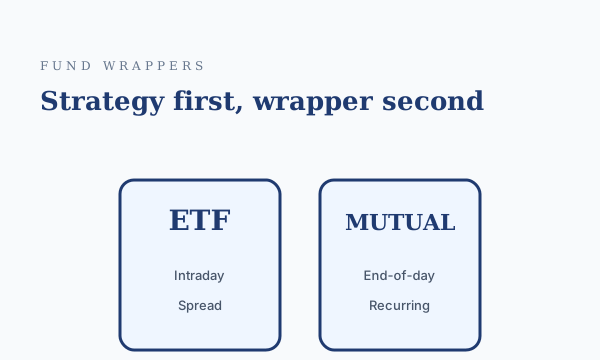
An ETF can be active and a mutual fund can track an index. First compare objective, benchmark, holdings, risk, and total cost. Only then compare wrapper mechanics: intraday trading versus end-of-day pricing, bid-ask spread, premiums or discounts, automatic investing, minimums, fractional availability, and settlement. The label alone says little about expected return.
Estimate implementation cost for your contribution size. An ETF with a narrow spread can be inexpensive, but commissions, currency conversion, and repeated small trades may dominate. A mutual fund may support exact recurring amounts but impose minimums, purchase fees, redemption fees, or a higher-cost share class. Provider-specific facts belong in current disclosures, not evergreen assumptions. For cross-border holdings, also confirm the custody chain and investor-compensation scheme.
Tax efficiency is jurisdiction- and account-dependent
U.S. discussions often emphasise the ETF creation and redemption mechanism, but actual tax outcomes depend on distributions, turnover, investor behaviour, account type, and local law. Other jurisdictions may tax accumulating and distributing funds differently or impose special rules on foreign-domiciled holdings. Verify domicile and reporting obligations before optimising a small expense-ratio gap.
Liquidity is not simply trading volume. The underlying assets, market makers, spread, and time of day affect execution. Long-term investors can use limit orders where appropriate and avoid trading around disorderly market openings, but the larger decision remains whether the fund owns the right assets at a defensible cost.
The structural differences that matter
ETFs (exchange-traded funds) and mutual funds are both pooled investment vehicles — you buy shares of a fund that holds many underlying securities. The differences are structural rather than fundamental. ETFs trade on stock exchanges throughout the trading day at market-determined prices. Mutual funds are priced once daily after market close at net asset value (NAV) and all trades that day execute at that single price.
This trading mechanism creates several downstream differences. ETFs can be bought and sold instantly during market hours at known prices (limit orders let you specify exact acceptable prices). Mutual funds require waiting until market close to know your execution price. For long-term investors, this distinction is usually irrelevant; for active traders, it is central.
The tax structure differs meaningfully. ETFs use an "in-kind creation and redemption" process that minimizes capital gains distributions to shareholders. When institutional investors redeem ETF shares, they receive underlying securities rather than cash, allowing the fund to remove low-basis shares from its holdings without triggering taxable events. Mutual funds must sell securities to raise cash for redemptions, potentially generating capital gains distributions that all shareholders owe taxes on.
When ETFs are better than mutual funds
Taxable accounts strongly favor ETFs due to their tax efficiency advantage. In a typical year, index ETFs may distribute little or no capital gains, while comparable index mutual funds may distribute 1-3% of NAV in capital gains that create tax bills for shareholders. Over 20+ years, this tax drag adds up meaningfully.
For frequent trading or intraday strategies, ETFs are the only choice. Mutual funds cannot be traded during market hours; you must wait for end-of-day pricing. Investors who want to buy or sell based on intraday movements need ETFs regardless of underlying strategy.
For access to specific asset classes not available in mutual fund form, ETFs often lead. Innovative strategies (thematic ETFs, leveraged funds, inverse funds, cryptocurrency-adjacent products) typically launch as ETFs first. Whether these products should be in your portfolio is a separate question, but if you decide you want them, ETFs are usually the primary vehicle.
When mutual funds are better than ETFs
For automatic monthly contributions of specific dollar amounts, mutual funds typically work more smoothly. You can invest exactly $100 in a mutual fund and receive fractional shares automatically. ETFs require either fractional share support from your broker (increasingly common but not universal) or accepting that leftover cash sits uninvested each month.
For 401(k) plans and other employer retirement accounts, mutual funds dominate the menu. Most 401(k)s do not offer ETFs directly — they offer institutional-share-class mutual funds instead. In these accounts, the ETF vs mutual fund choice is not available; you invest in whatever the plan offers.
For some specialized share classes (institutional shares available through employer plans, Vanguard Admiral shares for large balances), mutual funds may offer lower expense ratios than comparable ETFs. This varies by provider and fund; check specific expense ratios for the exact share classes you can access.
The cost comparison that actually matters
For core index investing, ETF and mutual fund expense ratios are typically very similar. Vanguard Total Stock Market ETF (VTI) charges 0.03%; Vanguard Total Stock Market Admiral mutual fund (VTSAX) also charges 0.04%. Fidelity ZERO Total Market Index mutual fund (FZROX) charges 0.00%; Fidelity Total Market ETF (ITOT is BlackRock’s equivalent) charges 0.03%.
Beyond expense ratio, consider transaction costs. Most major brokerages have eliminated commissions for both stocks (including ETFs) and their own mutual funds. Third-party mutual funds may still carry transaction fees ($20-50 per trade at some brokerages). Bid-ask spreads on ETFs add small costs to buys and sells — typically 0.01-0.05% for highly liquid ETFs like VTI, more for less-traded specialty ETFs.
For long-term buy-and-hold investors, the total cost difference between comparable ETF and mutual fund options is typically negligible. Do not obsess over 0.01-0.05% differences; do not switch existing holdings that would generate tax consequences to save trivially small ongoing costs. Choose the vehicle that fits your operational preferences (automatic dollar-amount contributions favor mutual funds; taxable accounts favor ETFs) and move on.
ETF liquidity and premium/discount to NAV
ETF prices during market hours reflect market demand plus authorized participants’ arbitrage activity that keeps prices close to underlying NAV. For highly liquid ETFs (SPY, VTI, VOO, top-10 holdings by AUM), prices typically stay within 0.05-0.10% of NAV throughout the trading day.
For less-liquid ETFs (specialty sectors, international niche markets, small-cap ETFs), premium/discount to NAV can widen significantly, particularly during market stress or unusual trading hours. Buying an ETF at a 2% premium to NAV means immediately overpaying by 2% — a cost that dwarfs any expense ratio advantage.
To minimize premium/discount risk: (1) trade during regular market hours (9:30 AM - 4:00 PM ET for US-listed ETFs), avoiding the first and last 30 minutes; (2) use limit orders rather than market orders; (3) check the ETF’s current premium/discount before large trades; (4) for less-liquid ETFs, spread large trades across multiple days.
Mutual fund minimums and share classes
Mutual funds often have minimum initial investment requirements, ranging from $0 (Fidelity ZERO funds, some Schwab funds) to $3,000 (many Vanguard Investor Shares) to $10,000+ (Vanguard Admiral Shares, institutional classes). ETFs typically require only the price of one share ($40-500 for common index ETFs) plus any broker minimums.
Vanguard uses a three-tier share class system for many funds: Investor Shares (typically $3,000 minimum, higher expense ratio), Admiral Shares (typically $3,000-$10,000 minimum, lower expense ratio), and ETF Shares (single-share minimum, expense ratio typically matching Admiral). For balances that meet Admiral minimums, either Admiral mutual funds or ETFs work equivalently.
Institutional share classes (typically requiring $500,000+ minimums but sometimes available through employer plans at any balance) often carry the lowest expense ratios of all. If your 401(k) or employer HSA offers institutional share classes of otherwise expensive funds, that is often the best available investment in the plan.
The vehicle vs strategy distinction
Both ETFs and mutual funds can hold identical underlying securities and follow identical strategies. The vehicle is largely irrelevant to investment strategy — a total market ETF and total market mutual fund tracking the same index will produce very similar returns over long periods.
What matters much more than vehicle choice: (1) asset allocation (stocks vs bonds, US vs international, small vs large), (2) expense ratio, (3) diversification within each asset class, (4) contribution rate, (5) time in market. Optimizing across these dimensions produces far greater impact than optimizing between similar ETF and mutual fund vehicles.
Investors who spend significant time analyzing ETF vs mutual fund choices are often engaged in what behavioral economists call "activity bias" — feeling productive by making decisions that do not meaningfully affect outcomes. If both vehicles work for your situation, pick one and move on to more consequential decisions.
Common ETF vs mutual fund mistakes
The most common mistake is switching from an existing mutual fund to an equivalent ETF in a taxable account, incurring capital gains taxes for a trivial or nonexistent long-term benefit. Once holding a fund with significant unrealized gains, staying put is usually better than switching to save 0.01-0.03% in annual expenses.
The second common mistake is treating ETFs as inherently better than mutual funds. In tax-advantaged accounts, the tax efficiency advantage of ETFs disappears. Mutual funds may work more smoothly for automatic contributions and offer better share classes in employer plans. Match the vehicle to the situation, not to internet consensus.
The third mistake is trading ETFs frequently just because you can. The ability to trade intraday does not mean you should. Most retail investors who trade frequently underperform their own funds due to poor timing decisions. Even for buy-and-hold strategies, use ETFs the same way you would use mutual funds — buy at your chosen contribution schedule and hold for decades.
Sources and methodology
We use primary and authoritative sources for rules, definitions, and data. Sources and factual claims were last checked September 3, 2026.
- Mutual funds and exchange-traded funds — Investor.gov, U.S. Securities and Exchange Commission (United States; concepts broadly applicable)
- Asset allocation and diversification — Investor.gov, U.S. Securities and Exchange Commission (United States; concepts broadly applicable)
- Investor education gateway — IOSCO (Global)
Frequently asked questions
- Are ETFs riskier than mutual funds?
- No. Risk comes from what the fund holds, not the wrapper. An S&P 500 ETF and an S&P 500 mutual fund have essentially the same risk.
- Can I convert a mutual fund to an ETF?
- Some providers (notably Vanguard) allow tax-free conversions of certain mutual fund share classes to their ETF equivalents. Rules vary by provider.
- Do ETFs pay dividends?
- Yes. Dividends from underlying holdings pass through to ETF shareholders, typically quarterly.
Related articles
Index Funds Explained: The Simplest Way to Invest
Index funds now hold more money than all actively managed US mutual funds combined. Here is why they became the default recommendation for long-term investors.
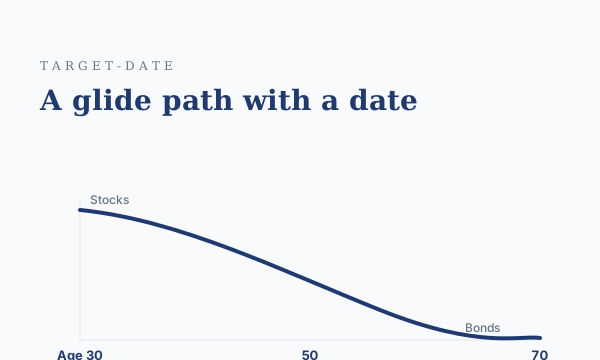
Target-Date Funds: One-Fund Retirement Portfolios, Explained
A target-date fund is a single fund that holds an entire retirement portfolio and adjusts it automatically over time. For many workers it is the simplest correct choice available.
How to Start Investing With $100
You do not need thousands to begin. Here is a beginner-friendly path to putting your first $100 to work — and why starting small still matters.