Investing
Traditional IRA vs 401(k): Which Should You Fund First?
You have limited retirement dollars. Where should they go first — Traditional IRA or 401(k)? The answer depends on employer match, plan fees, and investment access. Here is the exact decision framework.
Last updated September 4, 2026

One of the most common personal finance questions: with limited retirement savings capacity, should you fund your Traditional IRA or your 401(k) first? The answer depends on four specific factors — employer match, plan fees, investment quality, and your income level. Getting the sequence right can add tens of thousands of dollars to your retirement over decades; getting it wrong wastes free money and locks you into expensive plans.
This guide provides a decision framework for choosing between Traditional IRA and 401(k) contributions, plus rules for the sequence when you can afford to fund both. All figures use 2024 IRS limits — verify current amounts before making contribution decisions. Contribution limits, phase-out thresholds, and rules change with inflation adjustments and legislation.
Traditional IRA and 401(k): the structural differences
A Traditional IRA is an individual retirement account you open at any brokerage (Fidelity, Vanguard, Schwab, etc.). Contributions may be tax-deductible depending on your income. Growth is tax-deferred; withdrawals in retirement are taxed as ordinary income. You control everything: which brokerage, which investments, what fees you pay.
A 401(k) is an employer-sponsored retirement plan governed by ERISA. Your employer chooses the plan administrator, selects the investment menu, and pays some or all administrative fees. You choose from the available investment options. Contributions are pre-tax (Traditional) or after-tax (Roth) via payroll deduction. Growth is tax-deferred; Traditional withdrawals are taxed as ordinary income.
Key differences: 401(k)s often have employer matching contributions (free money); Traditional IRAs never do. 401(k)s have higher contribution limits ($23,000 vs $7,000 in 2024). Traditional IRAs offer unlimited investment choice; 401(k)s are limited to the plan menu. 401(k)s have stronger creditor protection under federal law; Traditional IRA protection varies by state.
Priority 1: Capture the full employer 401(k) match
Before doing anything else, contribute to your 401(k) up to the employer match limit. This is the highest-guaranteed return available to most workers. A common formula: employer matches 100% of first 3% of salary, then 50% of next 2%. A worker earning $60,000 contributing 5% ($3,000) receives $2,400 in employer contributions — an instant 80% return on their contribution.
This priority overrides essentially every other consideration. Even if the 401(k) has terrible fees, awful investments, and delayed vesting, capturing the match usually beats any alternative use of that money. A 100% match on 3% of salary is a 100% return; even a 1.5% expense ratio over 40 years cannot destroy that value.
Verify the specifics of your match at your employer. Read the Summary Plan Description (SPD). Match structures vary widely: some employers match dollar-for-dollar up to a percentage, others match 50 cents on the dollar, some have tiered matches, some require full-year employment. Some match true-up at year end (recovers any missed matches from early payroll periods); many do not.
Priority 2: Decide between additional 401(k) or Traditional IRA
After capturing the full 401(k) match, the choice between additional 401(k) contributions and Traditional IRA contributions depends on three factors: plan fee level, investment quality, and your income (which affects IRA deductibility).
Factor 1 — Plan fees: If your 401(k) plan total cost (administrative fees + weighted average expense ratio of your holdings) exceeds 1% annually, additional contributions face significant fee drag. A 1% fee over 40 years reduces final balance by roughly 25-30%. In this case, Traditional IRA contributions at a low-cost brokerage (0.02-0.10% expense ratios) often produce better long-term outcomes despite lower contribution limits.
Factor 2 — Investment quality: Some 401(k) plans have excellent institutional-share-class funds unavailable to retail investors elsewhere. Others have expensive proprietary funds with limited diversification options. Compare your plan's best options against what you could hold in an IRA. If plan options include broadly diversified funds under 0.15% expense ratio, the plan is investment-competitive with retail IRA options.
Factor 3 — IRA deductibility: Traditional IRA deductions phase out at higher incomes if you or your spouse is covered by a workplace retirement plan. 2024 phase-out ranges: single filer with workplace plan $77,000-$87,000; married filing jointly with contributing spouse having workplace plan $123,000-$143,000. Above the phase-out, Traditional IRA contributions become non-deductible — which reduces their advantage relative to a Roth IRA (via backdoor if needed).
The decision matrix
Situation A: Low 401(k) fees (< 0.5%), strong investment options, income within IRA deduction limits. Priority: max 401(k) after match (higher contribution limit), then add Traditional IRA if you can save more.
Situation B: High 401(k) fees (> 1%), limited investment options, income within IRA deduction limits. Priority: capture match, then Traditional IRA to $7,000 annual limit at a low-cost brokerage, then decide about additional 401(k) vs taxable investing based on the fee drag.
Situation C: Any 401(k) fee level, income above IRA deduction phase-out. Traditional IRA contributions are non-deductible, reducing their advantage. Priority: max 401(k) after match (still tax-deferred), then Backdoor Roth IRA (contribute nondeductible Traditional then immediately convert to Roth), then Mega Backdoor Roth if plan allows.
Situation D: Self-employed with no workplace plan. Solo 401(k) or SEP-IRA typically provides higher contribution limits than Traditional IRA. A Solo 401(k) allows up to $69,000 total contributions in 2024 (employee + employer combined). This dominates Traditional IRA for high-income self-employed workers.
Contribution limit coordination
2024 contribution limits: 401(k) employee contribution $23,000 ($30,500 age 50+); Traditional IRA $7,000 ($8,000 age 50+); combined limits are separate — you can max both. Total maximum retirement contributions for a worker under 50 with generous employer plan: $23,000 (own 401(k)) + $7,000 (IRA) + employer match = potentially $35,000-45,000+ annually.
Combined household limits for married couples: each spouse can max their own 401(k) and IRA independently. A dual-income household can potentially contribute $60,000+ annually to retirement accounts (2 x $23,000 401(k) + 2 x $7,000 IRA + employer matches). This is why maxing tax-advantaged accounts is the fastest path to wealth accumulation for high-income households.
Contribution deadlines: 401(k) contributions must be made by December 31 of the tax year (via payroll deductions throughout the year). Traditional IRA contributions can be made through April 15 of the following year for the previous tax year. This April deadline provides flexibility — you can calculate exact income for the year and decide contribution amount at tax filing time.
Rollover considerations at job change
When you leave an employer, your 401(k) has four options: leave it in the plan (if permitted), roll to new employer's 401(k), roll to a Traditional IRA, or withdraw (heavily penalized before 59.5). For most workers with mediocre or expensive old 401(k) plans, rolling to a Traditional IRA is the highest-value move — you gain access to unlimited investment choice at lowest available fees.
Exceptions: (1) if your old 401(k) has excellent institutional-share-class funds and low fees, leaving it there or rolling to new employer's plan may be superior; (2) if you have significant pre-tax IRA balance and plan to use the Backdoor Roth strategy, rolling 401(k) to IRA triggers pro-rata rule complications — better to leave 401(k) or roll to new employer's plan to keep pre-tax and after-tax money separate; (3) 401(k)s have stronger creditor protection under federal law than IRAs in most states.
Direct rollovers (custodian-to-custodian transfer) avoid tax withholding complications. Indirect rollovers (check paid to you, then you deposit) trigger 20% mandatory federal withholding that you must recover at tax filing — and if you miss the 60-day redeposit deadline, the entire amount becomes taxable distribution with potential early withdrawal penalty.
Roth alternatives at each level
Every decision above assumes Traditional (pre-tax) contributions. Roth alternatives (Roth 401(k), Roth IRA) provide different tax treatment: after-tax contributions grow tax-free, qualified withdrawals in retirement are tax-free. The Roth vs Traditional decision depends on expected tax rates in retirement vs now.
For most young high-earners, Roth 401(k) contributions may make sense despite paying tax at high current rates — the tax-free growth over 30-40 years typically exceeds the value of current deduction, especially given the historical trend of rising tax rates. For older savers or those in peak earning years planning to retire in lower brackets, Traditional contributions typically win.
Employer matches always go into a pre-tax Traditional 401(k) sub-account, regardless of whether your own contributions are Traditional or Roth. This means every Roth 401(k) contributor still has a Traditional side-account for the match.
Common Traditional IRA vs 401(k) mistakes
The most common mistake is failing to capture the employer match. Some workers assume they cannot afford to contribute even to the match level — but the match is guaranteed instant return that beats essentially any alternative use of that money. If cash flow is tight, cut discretionary spending to fund at least the match contribution.
The second common mistake is maxing 401(k) contributions before evaluating plan fees and investment quality. A worker maxing a $23,000 contribution to a 1.5% fee plan is losing $345/year in fees just on that year's contribution — compounding to significant multi-decade drag. If plan quality is poor, contribute only to match level and direct additional savings to Traditional IRA at a low-cost brokerage.
The third mistake is holding money in Traditional IRA without investing it. IRA contributions default to a cash settlement fund at many brokerages — earning money-market rates while the intended investment goes unfunded. After every IRA contribution, verify money has been invested according to your target allocation.
Sources and methodology
We use primary and authoritative sources for rules, definitions, and data. Sources and factual claims were last checked September 4, 2026.
- 401(k) plans — Internal Revenue Service (United States)
- Individual retirement arrangements (IRAs) — Internal Revenue Service (United States)
- Publication 590-A: Contributions to IRAs — Internal Revenue Service (United States)
- A look at 401(k) plan fees — U.S. Department of Labor (United States)
Frequently asked questions
- Should I fund 401(k) or IRA first?
- The universal first priority is contributing enough to your 401(k) to capture the full employer match — this is typically a 50-100% guaranteed return that beats any other investment option. After capturing the match, whether to prioritise additional 401(k) contributions or Traditional IRA contributions depends on plan fees, investment quality, and your income (which affects IRA deductibility).
- Can I contribute to both a Traditional IRA and a 401(k)?
- Yes. Contribution limits are separate — up to $23,000 employee to 401(k) plus $7,000 to Traditional IRA in 2024 ($30,500 and $8,000 respectively at age 50+). However, if you or your spouse is covered by a workplace retirement plan, Traditional IRA deductibility phases out at higher incomes (2024 phase-out $77,000-$87,000 single filer with workplace plan).
- What if my 401(k) has high fees?
- If plan fees exceed 1% annually and better investment options exist elsewhere, consider: (1) still contribute enough to capture the full employer match — the match value usually exceeds fee cost; (2) direct additional retirement savings to a Traditional IRA where you control fees and investment selection; (3) plan to roll over the 401(k) to an IRA when you change jobs to escape plan fees permanently.
Related articles
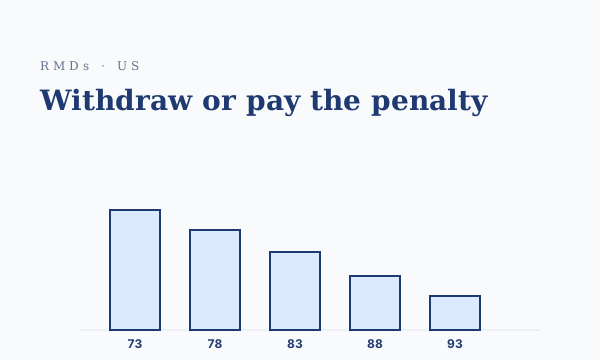
Required Minimum Distributions (RMDs) Explained
The IRS requires most retirement account holders to withdraw a calculated minimum starting at age 73. Miss it and you owe a 25% penalty. Here is how the math works.
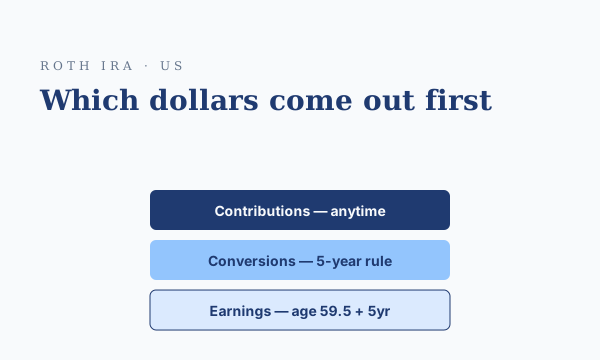
Roth IRA Withdrawal Rules: The Complete Guide
Roth IRA withdrawal rules confuse most savers. Contributions come out anytime tax-free; earnings have strict rules. Here is what actually applies to each dollar.
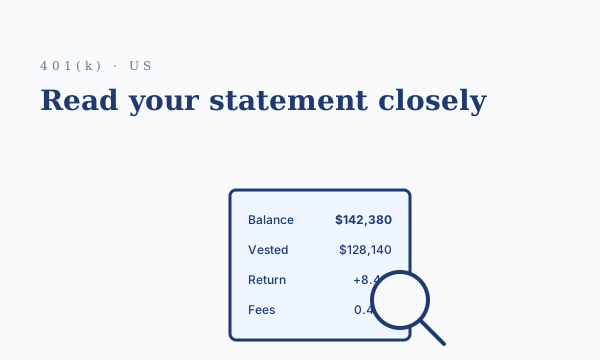
How to Read Your 401(k) Statement Like an Analyst
Your 401(k) statement contains everything you need to know about your retirement — if you can read it. Here is what every section actually means.