Budgeting
The 50/30/20 Budget Rule, Explained With a Real Example
A simple budgeting framework that splits take-home pay into needs, wants, and savings — with a worked example and adjustments for high cost of living.
Last updated September 3, 2026
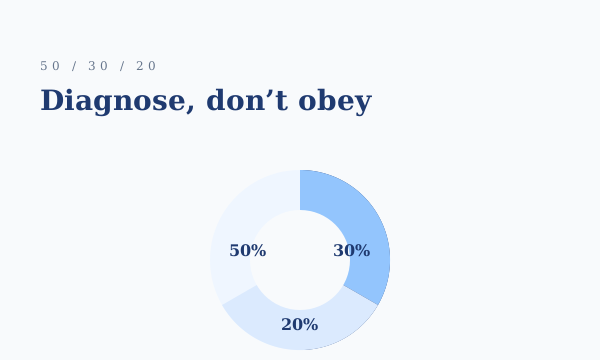
If budgeting feels complicated, the 50/30/20 rule is a good place to start. It replaces dozens of spending categories with three simple buckets, which makes it easy to remember and hard to abandon. Popularised by Senator Elizabeth Warren in her book "All Your Worth," the rule splits your after-tax income into 50% needs, 30% wants, and 20% savings and debt repayment.
This guide explains how each bucket works, provides a worked example, and shows how to adjust the ratios when your reality does not fit the textbook version.
What each bucket means
50% — Needs
Needs are the essentials you genuinely cannot go without: housing, utilities, groceries, transportation to work, insurance, and minimum debt payments. A useful test is to ask what would happen if you skipped the expense. If the answer involves eviction, a missed job, a penalty, or a shut-off notice, it belongs in needs. If the answer is "I would be a bit less comfortable," it belongs in wants.
30% — Wants
Wants are the things that make life enjoyable but are not strictly essential: dining out, streaming subscriptions, hobbies, travel, a nicer phone, gym memberships you could go without. Spending here is not the enemy — the rule simply keeps it bounded so it does not crowd out saving.
20% — Savings and debt
This bucket builds your future: emergency-fund contributions, retirement and other investing, and any debt payments beyond the minimums. Paying down high-interest debt belongs here because every dollar of interest avoided is effectively a guaranteed, risk-free return equal to the interest rate on the debt.
A worked example
Assume take-home pay is $3,500 per month. The rule allocates $1,750 to needs, $1,050 to wants, and $700 to savings and debt. In practice that might look like $1,300 rent and utilities plus $450 groceries and transport for needs; $1,050 for dining, subscriptions, and hobbies; and $700 split between an emergency fund, a Roth IRA contribution, and extra credit-card payments.
Real budgets rarely land perfectly on the target percentages, and that is fine. The value of the rule is the quick gut-check: if your needs are eating 65% of income, you know exactly where the pressure is coming from without needing a spreadsheet with fifty rows.
How to adjust for a high cost of living
In expensive cities, rent alone can push needs past 50%. Rather than abandon the framework, shift the ratios — for example 60/20/20 or 60/25/15 — and treat the original 50/30/20 as the direction to move toward as income grows or costs fall. The important discipline is protecting the savings bucket even when it shrinks: a consistent 15% you actually hit beats an aspirational 20% you never do.
How to start this week
Find your take-home pay on a recent pay-slip, list last month's spending from bank and credit-card statements, and sort each item into needs, wants, or savings. Compare the real percentages to the targets, then pick one bucket to adjust next month. An app is not required — a single spreadsheet or even a notes page works.
Define the buckets before judging the percentages
Start with income actually available to allocate and document whether payroll retirement deductions, health insurance, or taxes have already been removed. Classify obligations by consequence rather than emotion: basic housing, utilities, food, transport, insurance, and minimum debt payments are needs; optional upgrades and convenience are wants; extra debt reduction and goal contributions are future-focused. Apply one rule consistently to mixed expenses.
Now calculate the current ratio without forcing it to fit. In a high-cost area, needs may exceed half even with restrained choices. That is information, not failure. Use a temporary custom ratio, identify which costs can change only at renewal or relocation, and protect at least a small future contribution. A rigid 50/30/20 split that requires new debt is not a working budget.
Turn the framework into a monthly control loop
Set planned amounts, track actual spending, and explain only material variances. If an annual bill is predictable, convert it to a monthly sinking-fund contribution instead of allowing the bill month to distort the ratio. When income changes, recalculate from the new take-home amount; do not preserve dollar allowances that belonged to a different salary.
Use the framework to choose one structural improvement at a time: renegotiate housing at the next decision point, reduce a transport commitment, redirect a cancelled subscription, or automate a future contribution. Global readers should replace U.S. account examples with locally regulated savings, pension, and tax vehicles after verifying access rules.
The origin and honest assessment of the 50/30/20 rule
The 50/30/20 rule was popularised by Senator Elizabeth Warren in her 2005 book "All Your Worth," co-written with her daughter Amelia Warren Tyagi. It was designed as a simple diagnostic to reveal whether a household was under-saving or over-committed to fixed costs, not as a rigid prescription. The percentages were chosen partly for memorability and partly because Warren’s bankruptcy research suggested that households with fixed costs above 50% of after-tax income were structurally vulnerable to shocks.
Twenty years later, the rule remains useful as a starting point but has clear limitations. It was calibrated to a specific era, geography, and income distribution. In high-cost cities, keeping housing plus utilities under 50% of after-tax income can be nearly impossible for entry-level workers. In low-cost regions, the 50% target may be trivially achievable and hide opportunities to save more aggressively. Use the rule as a diagnostic, then customise the percentages to your actual situation with a written justification for each deviation.
Defining the three categories with precision
The "needs" bucket (50%) contains essential expenses that would continue if your income dropped tomorrow: housing, utilities, food (basic groceries, not restaurants), transportation to work, health insurance, minimum debt payments, and childcare if it enables work. Netflix, gym memberships, phone plans beyond the cheapest tier, and Amazon Prime are typically wants, though households draw the line differently. The test: could you cancel it within 30 days without significant consequences? If yes, it is probably a want.
The "wants" bucket (30%) covers everything discretionary: dining out, subscriptions, hobbies, vacations, new furniture, gifts, and lifestyle upgrades. This category is where most people find flexibility for adjustment. It is not a moral category — "wants" are not bad — but honesty about which expenses actually fall here is essential. Many households mislabel wants as needs to avoid confronting spending patterns, which defeats the diagnostic purpose of the framework.
The "savings and debt reduction" bucket (20%) includes retirement contributions, additional debt payments beyond minimums, emergency fund deposits, and investment contributions. This category is where the rule most often fails in practice: households who lack cushion in this bucket are one job loss or medical event away from serious trouble, regardless of how "affordable" their needs and wants appear on paper.
The gross versus net income question
The original rule applies to after-tax income. Using gross income makes the percentages easier to hit but hides real trade-offs. A household earning $100,000 gross with $30,000 in taxes and payroll deductions has $70,000 to allocate. A 20% savings target on gross ($20,000) versus net ($14,000) is a 40% difference in monthly savings — and one number is real while the other is fiction.
Complications arise when retirement contributions come out of gross pay before you see the money. A worker maxing a 401(k) has already saved a significant portion of gross income invisibly. Add that pre-tax retirement contribution back to the savings category when calculating your ratios, or you will systematically underestimate your true savings rate. Some households discover they are already at 25-30% savings once they include employer-side contributions and pre-tax 401(k) deferrals — a much healthier picture than the after-tax paycheque alone suggests.
When the 50/30/20 numbers do not fit your reality
In expensive metropolitan areas — San Francisco, New York, London, Sydney, Vancouver — housing alone can consume 40% of after-tax income for median earners. The 50/30/20 rule is not "wrong" in these places; it is a signal that structural pressure exists. The response is not to give up on saving but to rebalance the other buckets deliberately: perhaps 60% needs, 20% wants, 20% savings, with a written plan to move toward better ratios through career growth, geographic arbitrage, or shared housing arrangements.
For high earners, the opposite problem appears. A household earning $300,000 with basic tastes might spend 30% on needs, 20% on wants, and 50% on savings — dramatically better than the target. Rigid adherence to "spend 30% on wants" would waste money on lifestyle inflation the household does not actually want. The rule should shift up, not force spending to fit the label.
Implementation: from percentage targets to monthly execution
Percentages do not pay bills; specific accounts and automations do. Once you have chosen your target percentages, translate them into monthly dollar amounts and route income accordingly on payday. A common structure: paycheque deposited into a checking account, immediate automatic transfer of savings/debt-reduction amount to the appropriate accounts, and the rest available for needs and wants throughout the month. This "pay yourself first" mechanic makes the savings target hit reliably regardless of monthly variability in wants.
Track adherence monthly for the first three months, then quarterly. The first month usually reveals miscategorised expenses and unrealistic targets. Adjust based on actual behaviour rather than aspiration — a budget you can hit is worth more than a budget you cannot. If you consistently overspend the wants category by 30%, either your wants target is too low for your actual lifestyle or you have a spending problem to address, but pretending the original target will spontaneously start working next month is not a plan.
Building the savings bucket with the right priority order
Twenty percent of after-tax income to savings is meaningless without knowing where the money goes. A defensible priority order for the savings bucket: first, employer 401(k) match capture (do not leave free money on the table); second, high-interest debt reduction (credit cards above roughly 8% real interest); third, emergency fund to 3-6 months of essential expenses; fourth, Roth or Traditional IRA contribution up to the annual limit; fifth, additional retirement or taxable investing.
Skipping steps in this order usually costs money. Contributing extra to retirement while carrying 22% credit card debt is mathematically backwards — the guaranteed 22% return from debt payoff exceeds any reasonable expected investment return. Building a large emergency fund before capturing an employer match wastes free money. Personal finance frameworks work when the sequence matches the underlying mathematics of returns and risks.
When the rule signals real financial distress
If your needs exceed 70% of after-tax income for more than a temporary transition period, the underlying structure of your finances needs attention that no budget can fix. Options: increase income (career growth, second job, side income, geographic relocation), decrease housing cost (roommates, smaller unit, move), or reduce transportation cost (used car, public transit, employer flexibility on remote work). Small adjustments to the wants bucket cannot compensate for structural imbalance in needs.
If your savings bucket is consistently below 10%, you are one shock away from serious problems. This is not moralism; it is arithmetic. The first response should be forensic: review three months of actual spending line by line to find leaks. Most households discover 5-10% of income going to categories they did not know they were funding — forgotten subscriptions, delivery fee upcharges, impulse purchases at the checkout. The second response, if the audit does not solve it, is the same as above: increase income or reduce fixed costs structurally.
Common 50/30/20 mistakes
The first mistake is treating the rule as a moral judgement rather than a diagnostic. Spending 35% on wants is not a character flaw if your needs and savings are handled; it may reflect genuine preferences worth funding. The rule’s value is in surfacing patterns, not in enforcing a specific lifestyle.
The second mistake is calculating percentages against gross income to make the ratios look better. This is self-deception. Use after-tax income (plus pre-tax retirement contributions added back to savings) to see reality.
The third mistake is applying the rule to volatile income without buffering. On variable income, calculating percentages against monthly amounts produces wildly different targets. Instead, calculate targets against a conservative estimate of annual after-tax income divided by 12, and route surplus in strong months to a reserve that supplements weak months.
Sources and methodology
We use primary and authoritative sources for rules, definitions, and data. Sources and factual claims were last checked September 3, 2026.
- Budgeting resources — Consumer Financial Protection Bureau (United States)
- Financial education — OECD (Global)
Frequently asked questions
- Should 50/30/20 use gross or net income?
- Use net (take-home) pay — what actually lands in your account after taxes and payroll deductions. Budgeting off gross income overstates what you have to work with.
- What if my needs are more than 50%?
- That is common in high-cost areas. Adjust the ratios (for example 60/20/20) and aim to move toward 50/30/20 over time. Protect the savings bucket even if you have to shrink it.
- Do minimum debt payments count as a need or as savings?
- Minimum required payments are a need (missing them has serious consequences). Any extra payments above the minimum belong in the 20% savings-and-debt bucket.
- Is 50/30/20 better than a zero-based budget?
- They serve different people. 50/30/20 is simpler and easier to maintain. Zero-based budgeting is more precise but requires more effort. Start with 50/30/20 and switch only if you want tighter control.
Related articles
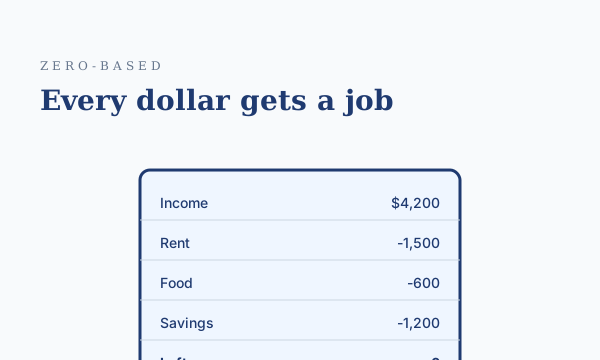
Zero-Based Budgeting: How It Works and Who It Is For
Every dollar gets a job before the month begins. Zero-based budgeting is the most precise method available — here is how to actually run one without burning out.

The Cash Envelope System: An Old Method That Still Works
The envelope system is a decades-old budgeting method that keeps working for one reason: the physical friction of handling cash slows down spending in ways an app cannot.
How to Cut Your Monthly Bills Without Feeling Deprived
Most household budgets contain a few large recurring costs and dozens of small subscriptions. Focusing on the right ones creates real savings without changing how you live.