Budgeting
Zero-Based Budgeting: How It Works and Who It Is For
Every dollar gets a job before the month begins. Zero-based budgeting is the most precise method available — here is how to actually run one without burning out.
Last updated September 3, 2026
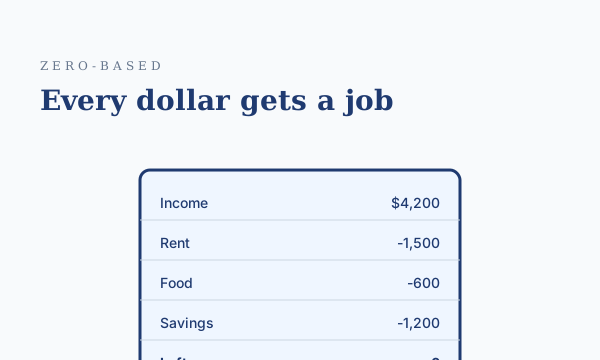
Zero-based budgeting is the most precise personal-budgeting method in common use. The rule is simple: at the start of every month, you assign every dollar of expected income a specific job until you have zero dollars left unassigned. Nothing is left "floating" — every dollar is either a bill, a category, a savings goal, or a debt payment.
The method was popularised by Dave Ramsey and the app YNAB (You Need A Budget), but the underlying idea has been used by businesses for decades. Applied honestly, zero-based budgeting eliminates the mystery of where your money went last month.
How to build a zero-based budget
Step 1: List expected income
Start with the after-tax income you actually expect to hit your account this month. If your income is variable, use last month's income as the base and treat any extra as a bonus to allocate later, rather than budgeting a hopeful number.
Step 2: List every category
Fixed bills (rent, utilities, subscriptions), essentials (groceries, transport), sinking funds (car, home, holidays), debt payments, savings, investing, and everyday spending each get a line. If a category is missing, add it — the whole point is that nothing is invisible.
Step 3: Assign until you reach zero
Distribute your income across the categories. When the total assigned matches income, the budget is balanced. If you run out of income before every category is funded, you must either reduce a category, remove a category, or find more income. That forced trade-off is the method's core discipline.
Step 4: Track spending against the budget
During the month, log spending to each category (most modern budget apps do this by importing transactions). When a category runs out, either stop spending in it or explicitly move money from another category to cover it. That second step — the transfer — is what makes zero-based budgeting work; ignoring overspending is what makes any budget fail.
Zero-based versus 50/30/20
The 50/30/20 rule is directional: it tells you roughly how spending should be distributed. Zero-based budgeting is prescriptive: every dollar is assigned before the month starts. Zero-based gives more control and clearer feedback, but requires more effort. For someone who has never budgeted, 50/30/20 is easier to start with; for someone who wants to accelerate savings or pay off debt aggressively, zero-based tends to work better.
Common pitfalls
The two most common ways zero-based budgeting fails are perfectionism and infrequency. Perfectionism shows up as forty tiny categories that make the budget feel like a chore; combine similar items until each category earns its place. Infrequency shows up as building the budget once and never opening it again; a fifteen-minute weekly check-in is enough to keep it useful.
Is it worth the effort?
For people who want maximum awareness of where every dollar goes, zero-based budgeting is unbeatable. For people whose main goal is simply to stop overspending, a simpler rule-based approach often works just as well with less effort. Try zero-based for three months, and if you dread opening the app by month two, switch to 50/30/20 without guilt.
Budget only money that exists
Begin with the opening cash available and income expected before the next planning date. Subtract obligations, true expenses, minimum debt payments, and savings goals until unassigned money reaches zero. “Zero” does not mean spending everything; emergency savings, sinking funds, investing, and debt reduction are jobs. Avoid budgeting uncertain income before it arrives, especially when pay is variable.
Create a small “things I forgot” category during the first months. Underestimating an irregular cost is not permission to hide it: move money from a lower-priority category and record the trade-off. Rollovers should be intentional. A growing car-repair balance is progress; an unexplained grocery surplus may mean the plan was unrealistic or needs a new purpose.
Use reconciliation to catch impossible plans
At least weekly, confirm that budget category balances add up to the cash they represent and reconcile transactions with the bank. Credit-card purchases should reduce the spending category while reserving cash for the card payment; otherwise the budget can show available money that is already owed. Never count a transfer between your accounts as income.
This method suits readers who want precise trade-offs or have many irregular bills, but it demands maintenance. If detailed categories cause abandonment, use fewer groups or a percentage framework. The best system is the lightest one that prevents overspending, funds known obligations, and can be reconciled without guessing.
The philosophy behind zero-based budgeting
Zero-based budgeting starts from a mathematical statement: every unit of income should be assigned a specific job before the month begins, and the assignments should sum to exactly the income available. The remaining unallocated balance should be zero — not because you spend everything, but because savings, debt reduction, and reserves are themselves jobs that consume the balance. This differs from traditional budgeting, which typically starts from historical spending and asks "can I afford this?" Zero-based budgeting asks the harder question: "what is this money for?"
The approach originated in corporate finance in the 1970s, where Peter Pyhrr formalised it at Texas Instruments as an alternative to the standard practice of taking last year’s budget and adding a percentage. The insight was that every expense should be justified anew each period, not inherited by default. Applied to personal finance, this means questioning every recurring expense — including the ones that feel non-negotiable — and confirming they still serve a purpose worth their cost.
The mechanics of zero-based budgeting
Begin by listing all income you can reliably expect in the coming month: salary net of tax and deductions, freelance income you have already invoiced, benefits, and any other confirmed sources. Do not include speculative income (a bonus you might get, a client that might pay), which introduces uncertainty into the entire plan. If you have variable income, use the lowest expected month from the past 12 as your planning number and treat any surplus as a windfall to be allocated separately when it arrives.
List all categories you will assign money to: fixed bills (rent, insurance, minimum debt payments), variable essentials (groceries, transportation), sinking funds for known irregular expenses (car maintenance, insurance renewals, holiday gifts, annual subscriptions), discretionary categories (dining out, entertainment, personal spending), and financial goals (emergency fund, retirement, additional debt payments, investment contributions). Each category gets a specific dollar amount.
Sum the assigned amounts. If they exceed income, reduce assignments starting with lowest priority (usually discretionary categories) until the total matches income. If assigned amounts fall short of income, allocate the remainder to a specific goal — do not leave it unassigned, or it will drift into unplanned spending by the third week of the month. The final total should equal income exactly.
Categories: how many is too many
Beginners often create 30 or 40 categories in their enthusiasm for control. This leads to abandonment within two months because reconciling that many categories against actual spending is a part-time job. Start with 10-15 categories that cover 90% of your spending: housing, utilities, groceries, transportation, insurance, minimum debt payments, discretionary spending (one bucket, not five), one savings goal, one debt reduction goal, and one miscellaneous. Add categories only when data shows a specific area needs more granular tracking.
The exception is sinking funds for known future expenses. Each sinking fund needs its own category because it has a specific target amount and deadline. A car maintenance sinking fund, an insurance renewal sinking fund, and a holiday gift sinking fund should each be separate. These are not adding complexity — they are converting predictable annual expenses into manageable monthly contributions, which is the entire point.
Zero-based budgeting for variable income
Variable income is the hardest case for zero-based budgeting because you cannot assign money before you have it. The solution is to budget last month’s income for this month’s expenses. When income arrives in October, hold it in a buffer account. On November 1, assign the October income to November’s categories using the standard zero-based process. This decouples the timing of income from the timing of expenses and produces a stable monthly budget even with wildly variable revenue.
Building the initial one-month buffer is the hardest part. Aim to accumulate one month of essential expenses in the buffer before switching fully to the previous-month model. Until then, budget the lowest expected income for the current month and allocate any surplus to the buffer. Once the buffer is complete, the system runs indefinitely without stress from timing gaps.
Handling irregular expenses without breaking the budget
The traditional response to an unexpected expense — "I will just put it on the credit card and pay it off later" — is exactly what zero-based budgeting exists to prevent. When an expense arrives that was not budgeted for, one of three things must happen: reduce another category by the same amount to fund it, use money from an appropriate sinking fund, or use the emergency fund if it is a true emergency. Each option requires an explicit decision documented in the budget.
This discipline is what produces the behavioural change zero-based budgeting is famous for. Users report that the friction of reallocating from another category makes them question purchases they would have made without thought under a traditional budget. The point is not to feel bad about spending; it is to make the trade-offs visible so decisions reflect real priorities rather than convenience.
Rollover rules: what happens to unused money
At month end, most categories will have some unspent money. The two common approaches are: (1) sweep everything to savings on the first of the next month, or (2) let unused amounts roll over within the same category. Both are defensible. Sweeping to savings maximises long-term wealth-building; rollovers within category allow for smoother management of expenses that vary month to month (grocery bills, utilities in different seasons).
A hybrid approach works well: sweep unused amounts from fixed categories (bills, minimum debt payments) that should never underspend, roll over unused amounts from variable categories (groceries, discretionary) up to a cap, and sweep anything above the cap to savings. This prevents both the guilt of "losing" underspent money and the drift of ever-growing category balances.
Software, spreadsheets, or pen and paper
Zero-based budgeting can be done in any medium. Popular software tools automate transaction categorisation, sync with bank accounts, and calculate rollovers automatically. Spreadsheets require more manual work but offer complete customisation and no subscription cost. Pen and paper works for people who process information best through physical writing — but requires discipline to reconcile against actual account balances at least weekly.
Choose the medium you will actually use consistently. A perfect budgeting app you check once a month is worse than a rough spreadsheet you update weekly. The choice matters far less than the frequency of engagement. Start with whatever medium you can commit to reviewing every week for the first three months; you can always migrate later once the habit is established.
Common mistakes with zero-based budgeting
The most common mistake is treating the budget as prescriptive rather than descriptive. A budget that says "spend $300 on groceries" when you actually need $450 does not make groceries cost $300; it just makes the budget wrong. Adjust the budget to match reality first, then work on reducing the reality if it is inconsistent with your goals.
The second mistake is skipping sinking funds. Households that budget only for regular monthly expenses are constantly surprised by annual insurance renewals, quarterly tax payments, and holiday spending — and each surprise gets funded by credit card debt or emergency fund raids. Sinking funds convert these annual expenses into manageable monthly amounts and eliminate the surprise.
The third mistake is abandoning the budget after a bad month. Every budget will have months where reality deviates significantly from plan. The response is to analyse why, adjust future budgets, and continue — not to conclude that budgeting does not work for you. Behavioural change takes 3-6 months of consistent practice; judging the system after two weeks is judging it before it has had a chance to produce results.
Sources and methodology
We use primary and authoritative sources for rules, definitions, and data. Sources and factual claims were last checked September 3, 2026.
- Budgeting resources — Consumer Financial Protection Bureau (United States)
- Financial education — OECD (Global)
Frequently asked questions
- What does "zero-based" mean?
- Income minus every category assignment equals zero. Every dollar has a specific job before the month starts.
- Do I need a special app?
- No. A spreadsheet works. Apps like YNAB, Monarch, or Copilot simply automate imports and category tracking.
- How is this different from Dave Ramsey's method?
- Ramsey's "give every dollar a name" is a form of zero-based budgeting. His envelope system is one specific way to implement it using physical or virtual envelopes for each category.
- What if my income is irregular?
- Budget last month's income this month. Any extra income above that becomes a fresh amount to assign the following month.
Related articles
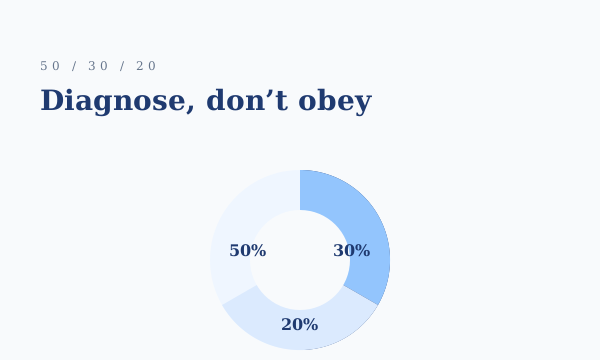
The 50/30/20 Budget Rule, Explained With a Real Example
A simple budgeting framework that splits take-home pay into needs, wants, and savings — with a worked example and adjustments for high cost of living.
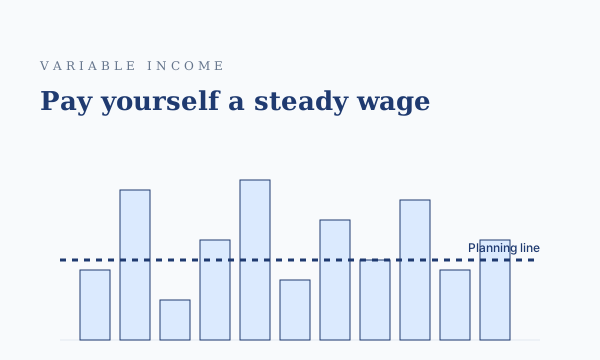
How to Budget on a Variable Income
Freelancers, contractors, and commission earners cannot budget from a steady paycheque. Here is a system that keeps a variable-income household stable month to month.
How to Choose a Budgeting App (What Actually Matters)
Every budgeting app promises to change your life. The one that actually will is the one you will still be opening in six months. Here is how to evaluate them honestly.