Saving
Social Security 101: How Benefits Are Calculated and When to Claim
Social Security is one of the largest lifetime assets most Americans have. When to claim is worth thinking about carefully because the difference can be tens of thousands of dollars.
Last updated September 3, 2026
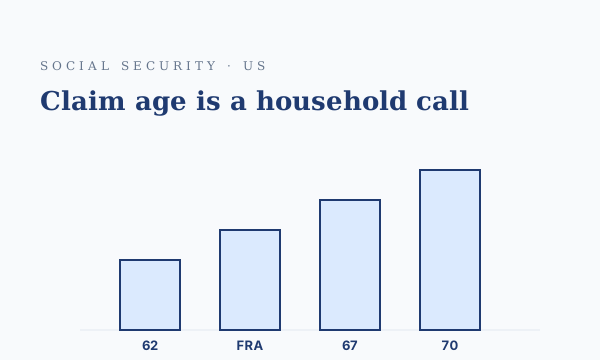
Social Security is a federal program that provides retirement, disability, and survivor benefits, funded by payroll taxes paid over your working life. For most retirees it is one of their largest lifetime assets, and the decision of when to start claiming benefits meaningfully changes the total amount you receive. Rules can and do change; verify current details at ssa.gov before making decisions.
How benefits are calculated
Your benefit is based on the Average Indexed Monthly Earnings (AIME) formula, which uses your 35 highest-earning years (indexed for wage growth). If you worked fewer than 35 years, the missing years count as zeros, which lowers the average. The AIME is then run through a benefit formula that replaces a higher percentage of income for lower earners than for higher earners.
The result is your Primary Insurance Amount (PIA), the benefit you receive if you claim at Full Retirement Age (FRA).
Full Retirement Age
FRA depends on your birth year. It is 66 for people born 1943 to 1954, gradually rises to 67 for people born 1960 or later. Claiming at FRA gives you 100 percent of your PIA.
Claiming early: age 62
You can claim as early as 62, but doing so permanently reduces your benefit. The reduction is roughly 30 percent if your FRA is 67 and you claim at 62. The reduction is not a temporary discount; it lasts the rest of your life.
Claiming late: age 70
Every year you delay claiming past FRA (up to age 70) increases your benefit by about 8 percent per year (delayed retirement credits). That is a guaranteed, inflation-adjusted return that is very hard to match anywhere else. Delaying from FRA to 70 raises your benefit by about 24 to 32 percent depending on birth year.
The breakeven analysis
People often ask: at what age do the delayed larger benefits catch up to the earlier smaller ones? For most people the breakeven age is somewhere in the late 70s or early 80s. If you live past the breakeven, delaying wins. If you die before it, claiming earlier wins. Because no one knows their lifespan, the decision has to balance life expectancy, health, other income sources, and how much you value guaranteed lifetime income.
Special situations
Spousal benefits, survivor benefits, and the rules around continuing to work while claiming are all significant enough to warrant separate reading before making the final decision. Married couples in particular often benefit from a coordinated strategy where the higher earner delays to maximise the survivor benefit for the lower earner.
Is Social Security going away?
The trust funds that supplement payroll tax revenue are projected to be depleted sometime in the 2030s under current law. If Congress takes no action, benefits would automatically be reduced by an estimated 20 to 25 percent at that point. Both parties have proposed fixes, and most personal-finance planners assume some legislative action before then. Plan conservatively but do not assume total loss of benefits.
Use your own record before estimating a claiming age
Create or access an official Social Security account and inspect the earnings history year by year. Missing or incorrect earnings can affect estimates, and the correction process may require old wage or tax records. Treat third-party calculators as scenario tools; the official record is the input that matters. Estimates can change with future earnings and law.
Compare lifetime cash flows under several survival ages rather than asking for one universal break-even age. Include the effect of continued work, taxes, health coverage, inflation adjustments, spouse or survivor benefits, and what happens if the higher earner dies first. A household decision is not simply two independent claiming decisions.
Separate programme rules from retirement readiness
A larger delayed monthly benefit does not solve a cash shortage before claiming. Map the bridge: employment income, cash reserves, pension income, retirement withdrawals, health costs, and debt payments. Conversely, claiming early solely to invest the cheque introduces market risk and can reduce survivor protection. Compare guaranteed benefit changes with realistic after-tax alternatives.
Rules for government pensions, disability history, divorced spouses, non-covered work, and international contribution records can be specialised. Verify them directly with the Social Security Administration and the relevant foreign authority where a totalisation agreement may apply. Avoid relying on an article’s annual thresholds or a calculator’s default assumptions.
How Social Security retirement benefits are calculated
Social Security retirement benefits are based on your 35 highest-earning years, adjusted for inflation using national average wage indexing. If you worked fewer than 35 years, zeros are averaged in for missing years — which significantly reduces benefits. The Social Security Administration converts your 35-year average into your Primary Insurance Amount (PIA) through a progressive formula that provides higher replacement rates for lower earners.
The 2024 PIA formula: 90% of the first $1,174 of average indexed monthly earnings, plus 32% of earnings between $1,174 and $7,078, plus 15% of earnings above $7,078. This structure means a low-income worker might receive 60-70% of pre-retirement earnings from Social Security, while a high-income worker might receive only 25-30%. This progressivity is intentional — the system is designed as insurance against poverty in old age, not as a proportional retirement account.
Your specific benefit estimate is available at ssa.gov/myaccount. Log in annually to verify your earnings record — errors are surprisingly common and can significantly reduce benefits. Corrections must typically be made within 3 years, 3 months, and 15 days of the mistake year to be guaranteed; older corrections require documentation and may be denied.
Full Retirement Age and claiming decisions
Full Retirement Age (FRA) is the age at which you can claim 100% of your PIA. For people born in 1960 or later, FRA is 67. Between 1955-1959, FRA scales from 66 to 66 years 10 months depending on birth year. FRA is not the "right" age to claim — it is simply the reference point for benefit calculations.
Claiming as early as age 62 permanently reduces monthly benefits. Someone with FRA of 67 who claims at 62 receives 70% of PIA — a 30% permanent reduction. Someone claiming at 65 receives about 86.7% of PIA. Someone claiming at 66 receives about 93.3% of PIA. These reductions are permanent for the rest of your life (and affect spousal and survivor benefits based on your record).
Delaying past FRA earns delayed retirement credits of 8% per year (for people born 1943 or later) up to age 70. Claiming at 70 with FRA of 67 provides 124% of PIA. Beyond age 70, no additional credits accrue. For high-income individuals who expect to live long lives, delaying to 70 significantly increases lifetime benefits.
Break-even analysis: when does delaying pay off?
Simple break-even analysis compares total lifetime benefits at different claiming ages. Claiming at 62 provides smaller monthly payments over more months; claiming at 70 provides larger monthly payments over fewer months. The break-even age (when total lifetime benefits equalize) depends on the specific comparison but typically falls in the late 70s to early 80s.
For claiming at 62 vs FRA (67), break-even is typically around age 78-80. For claiming at 67 vs 70, break-even is typically around age 82-84. If you live past the break-even age, delayed claiming produces more lifetime benefits; if you die before, early claiming produces more. Life expectancy data suggests average 65-year-olds today can expect to live to 84-87, making delayed claiming a mathematical win for most healthy retirees.
Break-even analysis is oversimplified because it ignores the value of Social Security as inflation-protected longevity insurance. The larger delayed benefit continues for life and adjusts for inflation, providing genuine protection against outliving other savings. This "insurance value" argues for delayed claiming even for people whose break-even math is uncertain due to health considerations.
Spousal and survivor benefits
Married individuals can claim benefits based on their own earnings record or up to 50% of their spouse’s PIA (spousal benefit), whichever is higher. Spousal benefits are reduced if claimed before FRA. To qualify, the working spouse must have already claimed their own benefit.
Divorced spouses can claim spousal benefits based on ex-spouse’s record if the marriage lasted 10+ years, both individuals are at least 62, the claiming spouse has not remarried, and either the ex-spouse has claimed benefits or the divorce occurred 2+ years ago. This benefit does not affect the ex-spouse’s benefit and does not require any contact or coordination.
Survivor benefits are significant for widows and widowers. A surviving spouse can receive up to 100% of the deceased spouse’s benefit (including any delayed retirement credits), starting as early as age 60 (or 50 if disabled). This can be dramatically more valuable than claiming their own reduced early benefit — but requires strategy to maximize, often involving one spouse (typically the higher earner) delaying to age 70 to maximize the eventual survivor benefit.
Taxation of Social Security benefits
Up to 85% of Social Security benefits may be taxable depending on your other income. The formula uses "combined income" — adjusted gross income + nontaxable interest + half of Social Security benefits. Combined income below $25,000 (single) or $32,000 (married) means benefits are not taxed. Above these thresholds, 50% of benefits become taxable; above higher thresholds ($34,000 single, $44,000 married), 85% become taxable.
These thresholds are not adjusted for inflation, meaning more retirees hit them over time even without real income increases. Strategic tax planning can reduce Social Security taxation: Roth conversions before claiming, using Roth IRAs and HSAs for tax-free withdrawals, and managing capital gains realizations all affect combined income. This is where working with a tax-aware financial planner in the years before claiming often pays for itself.
State taxation of Social Security varies widely. Most states do not tax benefits; a shrinking list of states (currently about 10) tax some or all benefits. If considering relocation for retirement, verify the tax treatment in your prospective state — this can meaningfully affect after-tax retirement income.
Working while receiving Social Security
Claiming Social Security before FRA while continuing to work triggers the earnings test. In 2024, benefits are reduced by $1 for every $2 earned above $22,320 (below FRA); in the year you reach FRA, benefits are reduced by $1 for every $3 above $59,520; after reaching FRA, no earnings limit applies.
Reduced benefits from the earnings test are not lost permanently — they are added back to your benefit calculation at FRA. But the reduced monthly benefit while working before FRA can be frustrating. The earnings test does not apply to investment income, pensions, or Social Security itself — only earned income.
For workers who plan to continue earning above the threshold before FRA, claiming Social Security at 62 typically makes little sense. Delaying at least until FRA (when the earnings test disappears) and often to 70 (to maximize benefits) usually produces better outcomes than claiming reduced benefits while giving much of them back through the earnings test.
Medicare coordination
Medicare eligibility begins at age 65 regardless of when you claim Social Security. If you claim Social Security before 65, you will be automatically enrolled in Medicare Parts A and B at 65 (Part A is premium-free for most; Part B has a monthly premium). If you delay Social Security past 65, you must actively sign up for Medicare during your Initial Enrollment Period (3 months before your 65th birthday through 3 months after).
Missing your Medicare Initial Enrollment window can result in permanent premium penalties (10% per year of delay for Part B, 1% per month for Part D). If you continue working with employer health coverage past 65, special enrollment rules apply — verify your specific situation with your employer HR and Social Security.
Social Security also administers the Medicare Income-Related Monthly Adjustment Amount (IRMAA) that increases Medicare premiums for higher-income beneficiaries. IRMAA is based on tax returns from 2 years prior, so decisions in the years before Medicare eligibility affect Medicare costs. This is another reason for strategic tax planning before claiming.
Common Social Security mistakes
The most common mistake is claiming as soon as eligible (age 62) without analysis. For most people who expect to live past 78-80, delaying at least until FRA and often to 70 produces significantly more lifetime benefits. The "get my money while I can" logic ignores that longevity risk (living longer than expected) is what Social Security specifically insures against.
The second common mistake is not coordinating spousal claiming strategies. Married couples have more claiming options than singles — the higher earner often should delay to 70 to maximize both their own and eventual survivor benefits. Coordinating claiming ages across a couple can add $50,000-$200,000 in lifetime household benefits versus uncoordinated claiming.
The third mistake is not verifying earnings records. The Social Security statement should show every year of earnings back to your first job. Missing years (particularly early career or self-employment) reduce your calculated PIA. Check your statement annually and dispute discrepancies promptly with pay stubs, W-2s, or tax returns as documentation.
Sources and methodology
We use primary and authoritative sources for rules, definitions, and data. Sources and factual claims were last checked September 3, 2026.
- Retirement benefits — U.S. Social Security Administration (United States)
- Financial education — OECD (Global)
Frequently asked questions
- Do I need 35 years of work to qualify?
- You need 40 quarters of work (10 years) to qualify for retirement benefits. But the benefit formula uses your 35 highest-earning years, so working fewer years leaves zeros in the calculation that lower your average.
- Are Social Security benefits taxable?
- Depending on your total income in retirement, up to 85 percent of benefits can be subject to federal income tax. State treatment varies.
- Can I collect Social Security while still working?
- Yes, but if you claim before FRA and earn above certain thresholds, some benefits are temporarily withheld. Withheld benefits are added back to your monthly amount after you reach FRA.
Related articles
The Right Order of Financial Priorities (Most People Get This Backwards)
A practical order of operations for money — from a starter emergency fund to long-term investing — that avoids the common mistake of skipping cheap wins for flashier ones.

How a 401(k) Actually Works (And How to Get the Most Out of It)
A 401(k) is the most common retirement account in the US, and its employer match is often the single best investment return available to any employee.
Inflation Explained: How Rising Prices Affect Your Money
Inflation is not just a headline number. It is the silent tax on cash. Here is how it works, why it matters for your savings, and how to protect against it.